Engbretson Underwater Photography

Search The Fish Photos


News From Behind the Scenes at Engbretson Underwater Photo and Stories about the Freshwater Environments We Visit.


Showing posts with label fish habitat. Show all posts

Wednesday, March 24, 2021

A Critical Look At Artificial Fish Habitat:


When considering fish habitat, I think we need to discuss the role artificial fish habitat can serve. They're being used more and more, especially in large southern reservoirs devoid of important structure fish need.  Fish managers have traditionally placed bundles of Christmas or cedar trees on the lake bottom to provide cover for fish.  Because the lifespan of tree bundles and brush piles is limited, replenishing them has always been an ongoing and expensive process.  One advantage of artificial habitat structures that help explain their growing popularity is that they don't decay or deteriorate.

But can “anything” man-made be placed in our waters and be called fish habitat? If we throw a rusty wheelbarrow into a lake today and catch a fish on it next week, can we genuinely say we’ve added fish habitat and therefore improved the lake? Are we unknowingly turning our lakes into landfills or the equivalent of the town dump under the guise of creating fish habitat? Is it really true that any structure of any kind is better than nothing?  If you’ve ever wondered if there’s any discernible line between “junk” and authentic fish habitat, you wouldn’t be alone.

If there’s any hope of understanding the potential benefits using artificial fish habitat might offer, I think we need to uncouple two terms: Fish habitat and fishing. Effective fish habitat needs to protect young fish too small to be of interest to anglers. The metric to evaluate how useful fish habitat is must be re-calibrated. The question shouldn’t be how many trophy bass did you catch this year on the habitat, but how many young-of-the year bass survived the brutal gauntlet of their first year of life because of the protection that habitat provided. 

It could be argued that the most successful fish habitat would be one that only attracted age 0 fish and was a lousy fishing spot. As anglers, we need to modify our point of view. Fish habitat should be regarded as an investment in the hope of a better day’s fishing in the future, not something with instant payoffs today. If fish habitat isn’t a vehicle for fish recruitment, what good is it?

Today, there isn’t a single designer of any artificial fish habitat that doesn’t promise their product or design will protect young fish. These are merely assertions that haven’t met their burden of proof. These claims must be demonstrated before we have warrant to accept them as true. Where is the evidence that any assemblage of man-made parts and scrap material does anything to help even a single fish survive its first year, let alone to adulthood? So far, Fishiding is the only design that has continuously and consistently documented in hundreds of underwater pictures and videos over the years the efficacy of their product.

If you work in the fish management sector, you should absolutely demand evidence that whatever artificial habitat you’re considering spending resources on legitimately works. As condescending as it may sound, intuition or gut feeling is not evidence. If we’re not more careful about scrutinizing and properly evaluating artificial fish habitat, we run the risk of unknowingly crossing what should be a distinct line between what authentic habitat is and what’s simply junk.

Thursday, November 14, 2019

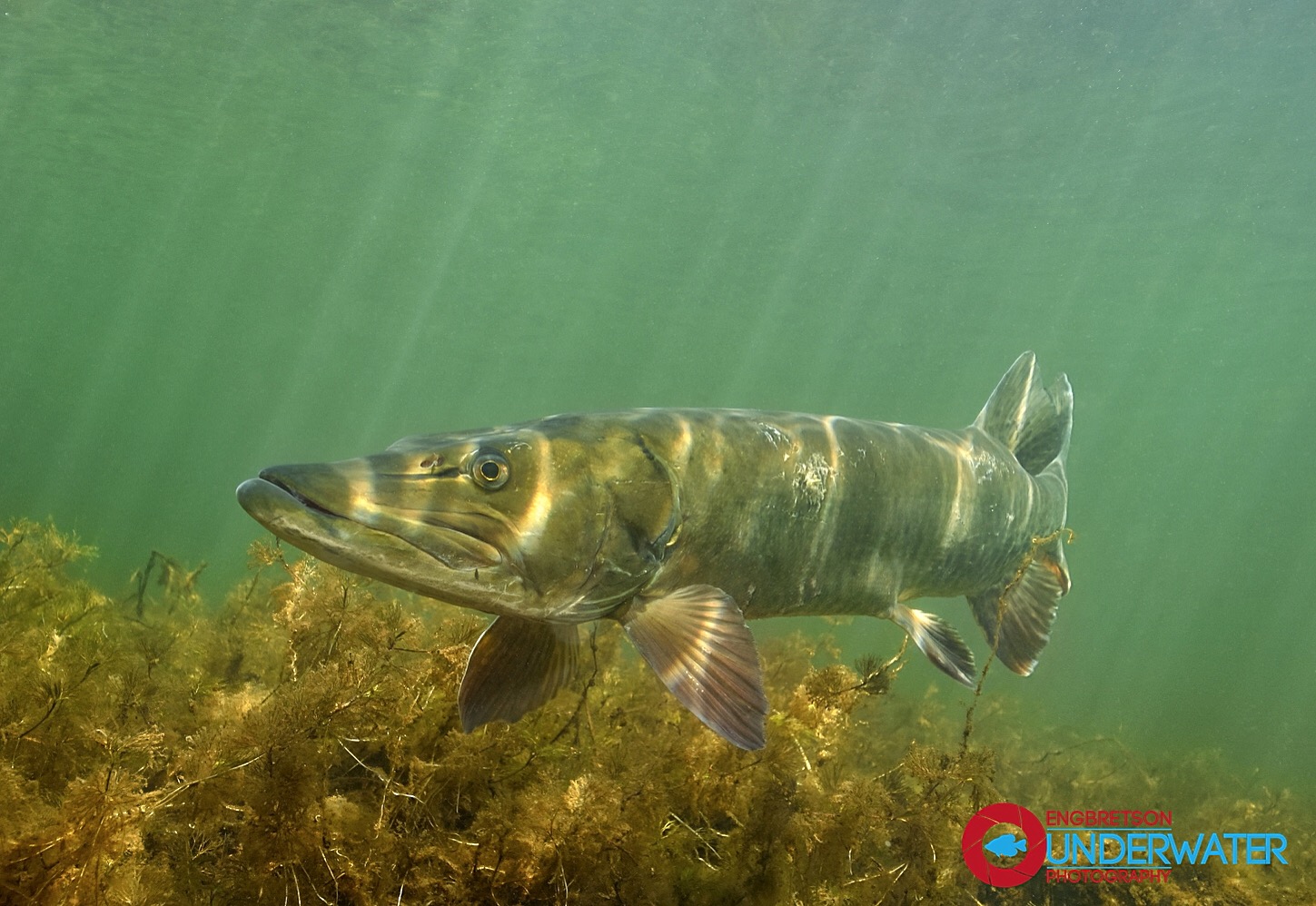
Swimming With Muskies

The first time I came face to face with a muskie underwater in its environment, I thought I was going to have a stroke. I was scuba diving in a small northern Wisconsin Lake known primarily for bass and bluegills, when I turned and found myself face to face with a monster that looked more like an alligator than anything else. To say I was startled would be an understatement. I remember screaming into my regulator as an eruption of air bubbles exploded from my lungs and raced towards the surface. My arms and legs flapped involuntarily in panic and I stirred up a cloud of silt that quickly enveloped both the beast and me. After a few seconds, when I had recovered from the start and regained my composure, I was amazed to see that the giant fish hadn’t moved an inch. It was still there, just three feet away hanging motionless in the slowly clearing water. In stark contrast to my initial panicked surprise its reaction was just the opposite. Its demeanor was calm, and its steely-eyed gaze remained fixed on me the entire time like a gunslinger in a Clint Eastwood western. This was a fish filled with confidence, instead of fear. He was the ruler of this underwater kingdom, and seemed to regard me with the same sense of apathy and disinterest that’s normally reserved only for telemarketers and late night TV pitchmen. Finally, he slowly finned away into the depths and I was left with a feeling of awe and admiration for these magnificent fish that has only grown over the years.

I’m very lucky that I just happen to live in an area that’s home to some of the most legendary muskie lakes in the country. Over the years, I’ve had a chance to swim in some of these famed waters and encounter muskies up close in their own environment. There’s nothing quite like seeing a large muskie underwater. They glide effortlessly through the water with the supreme confidence reserved for members at the top of their food chain. Because of this, they’re not afraid of divers and I’m able to approach them usually fairly easily. They are surely aware of all the other fish and animals that populate their world and because divers are an anomaly, they will routinely approach me with what I can only characterize as curiosity. They often make a complete circle around me as if to inspect this ‘strange creature” from every angle. They also display keen awareness. When I enter a lake, I don’t have to search for the muskies. I’ve discovered that if I’m patient, they will find me. Drawn, I’m sure by acute imperceptible sensory abilities and also probably just by the noise of my air bubbles too.

One of the attributes of water is that when viewed through a prism of air, objects appear to be larger than they really are.  So when I’m underwater looking through my diver’s mask, a 45-inch musky appears to me to be a 60-inch fish!  Fish and anything else viewed underwater are only ¾ of their actual size.  Fisherman often ask me how big the fish are that I see.  I do my best to adjust for the optics of underwater viewing, but the fact is, I just don’t know.  Fish look really big underwater, and big fish look positively huge when viewed underwater.  For the first few years, I got really excited whenever I saw muskies.  “Wow!  That’s got to be a world record!” I would say to myself.  But over the years, I’ve come to better understand this illusion and now I don’t pee my wetsuit quite as often when I see what looks like Moby Dick.  What this means sadly, is that all those reports you hear of 6 foot long monsters swimming next to the boat, or huge fish that got off before they could be netted are really just ordinary sized muskies.  Some may argue that the fish lined up exactly with something on the boat that’s of known size and therefore, that’s evidence that the fish was really a whopper.  This of course is nonsense. Since you would still be viewing the fish in water through a space of air, the magnification illusion is still in play.  Your boat is a poor yardstick since it’s in air, and the fish is underwater. 

I remember a particular encounter one spring a few years ago. I was taking pictures in Lake Tomahawk in Vilas County Wisconsin.  I came across 2 muskies engaged in spawning activity.  It was a very dark rainy morning. The light was terrible and I wasn’t able to get any pictures, but the fish I saw that day was truly impressive. The size of the spawning male was not remarkable.  In fact, he was simply dwarfed by the female he was swimming with.  She was a real beauty.  She was enormous, and had a girth like those big watermelons that win ribbons at the county fair.  She swam along side of me and I took a good long look.  I’m five foot, eight inches tall, and the fish lined up next to me was longer than I was!  Was this a 6-foot long muskie? I did the quick arithmetic: Since it appeared to be 70 inches or more, its real and actual size would have been a little over 50 inches.  Possibly 52 inches. While not a world record, she was still a spectacular fish in anyone’s book.

Saturday, August 24, 2019

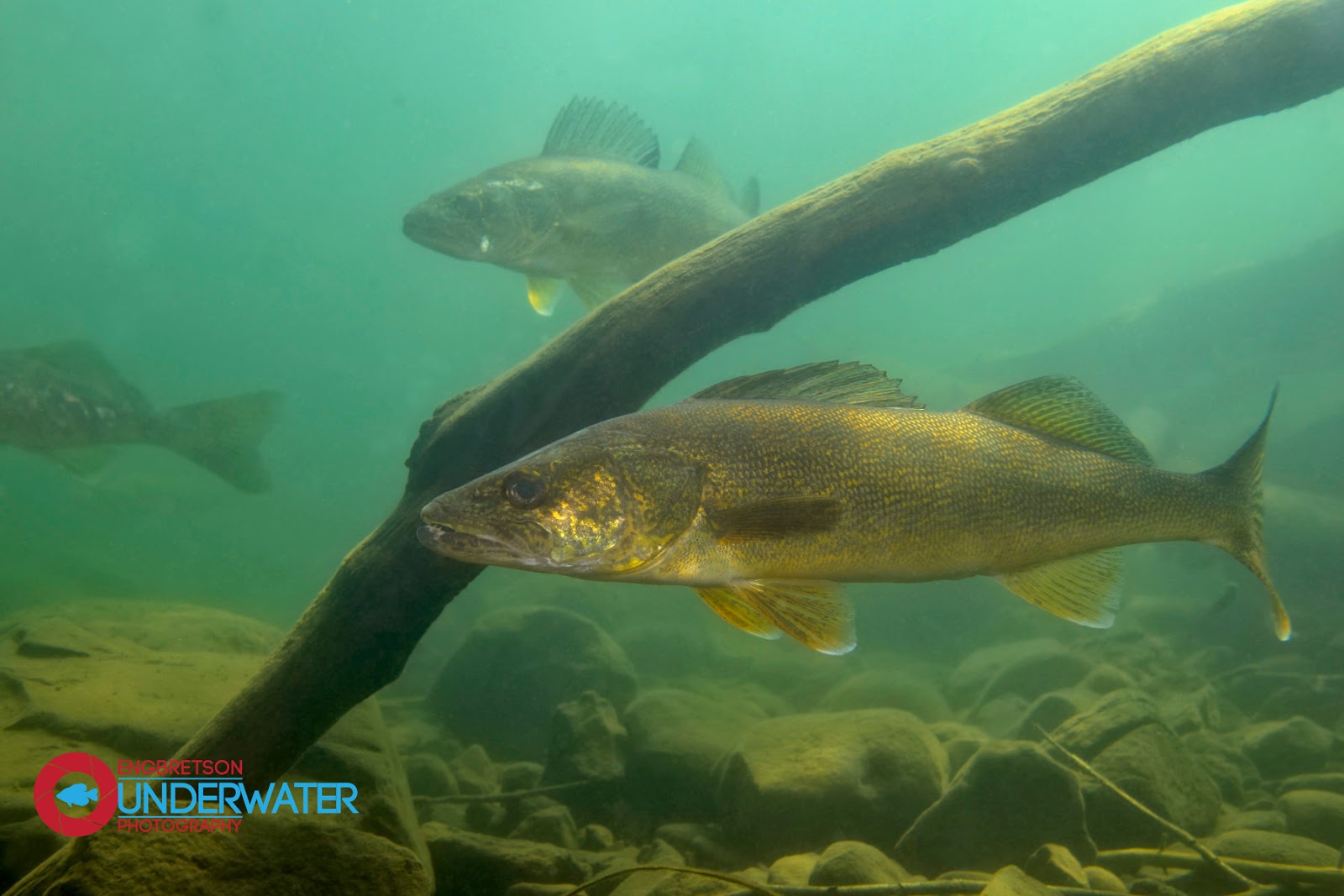
Where to Find Walleyes-Secret Locations That Are Often Overlooked

Often times when I'm coming off the lake and loading my scuba diving equipment and cameras into the car, fisherman will approach me at the boat landings to ask "Did you see any fish?"  Or, "Where are all the big ones?"  Since I'm actually under the water swimming with the fish, I do notice some things that escape most fisherman.  So in answer to the question, "Where are the fish?" I've compiled a list of the five most surprising areas where I regularly encounter walleyes that few fisherman pay any attention to. How many of these locations do you completely ignore when targeting walleyes?

1) Shallow Water. Since I'm trying to photograph fish, I tend to concentrate on areas where the light is the best.  This often means depths of 12 feet or less.  This shallow water is where I take 90% of my walleye pictures.  It's surprising how many fish can be found close to shore in water that's barely over your head.  If there are large submerged trees close to shore, I almost always find walleyes there.  Most walleye fisherman ignore shallow water, but I can tell you that the fish are there.

2) Under boat docks.  Not all boat docks have walleyes under them, but the ones that share certain characteristics will hold walleyes most of the year.  Nobody seems to fish for walleyes around shallow boat docks, but if you can find ones that have a hard or gravel substrate, extensive areas of shade, and deep water nearby, you'll find walleyes there.

3) Eurasian Watermilfoil.  This invasive plant is almost universally regarded as bad, but fish love milfoil.  If I'm on a lake where EWM is present, I head right for it. It's a fish magnet for all species including walleye.  Sometimes I'll find walleye cruising along the deep edge of milfoil colonies, but usually they're buried inside the thickest and most dense parts of milfoil beds.  It's hard to photograph walleyes in cover this thick and just as difficult to fish for them in these areas, but they're always there.

4) Fish Cribs.  Everyone knows that there are fish around fish cribs, but they aren't as famously known to be places to find walleyes.  The walleyes I see around cribs fall into two categories. Inactive fish are typically underneath the cribs, or buried deep inside them in thick brush.  Active fish cruise cribs in a radius that can extend up to 20 feet.  While it's easy for me to photograph them here, catching them here is harder because there's often an abundance of bass or panfish around that are higher in the water column that will strike the baits or lures before the walleyes get a chance to.  In the presence of other fish, walleyes are timid and won't fight a rock bass or smallmouth to get to a bait first.

5) Sunny days.  The last location where I always find walleyes isn't a location at all, but a condition.  Walleyes have a reputation for avoiding bright sunshine, or going deep on sunny days.  When I'm photographing fish, I relish bright sunny days with calm surface conditions and I'm usually in the water around high noon when the light penetration into the water is the best.  You might think these would be terrible conditions for walleye fishing, but I can tell you I encounter plenty of large walleyes actively feeding during these times... often in shallower water.  If you're a walleye fisherman and as a rule, avoid fishing during the midday hours or on bright sunny days, you're missing out on good opportunities to encounter fish.

For over twenty years I've been photographing walleyes underwater and those are some of my go-to places.  They're certainly overlooked locations and might even seem counter intuitive to most walleye fisherman, but I wouldn't be wasting my own time with them if they weren't highly productive.

(To view our walleye image gallery, click here.)
(For more on walleye behavior click here.)

Monday, May 27, 2019

How Does Artificial Fish Habitat Work?

The Science Behind Fishiding Artificial Fish Habitat


I recently collaborated with David Ewald from Fishiding.com on a ten-part video series that explains how artificial fish habitat works. In the videos, which you can watch on myYouTube channel, we examine many of the characteristics that are necessary to design the kinds of structures that serve fish most effectively.

While natural elements like trees, stumps, rocks and plants provide the best habitat, artificial surrogates have a place in this conversation. The bottom of many southern reservoirs resemble moonscapes and there is little if any existing natural habitat. In many of these man-made lakes, man-made habitat is often the only viable option to provide young fish with the kind of sanctuaries they require to survive the challenges of early life.

In our video series “The Science behind Fishiding Artificial Fish Habitat”, we show you never-before-seen underwater footage of how fish utilize this habitat and why it should be considered a legitimate tool for fisheries professionals faced with managing waters where habitat is marginal.

If you’re interested in watching the videos, make sure you also read the 800 word narratives that accompany each video. Each narrative provides a complete description of the footage you see and points out key aspects of design, function, installation, testing, configuration, size and complexity. There really is a lot to know, but we’ve worked to distill everything we’ve learned into an easy to understand presentation that we hope you’ll find both interesting and useful.

You can view the entire video series on YouTube here and on the Fishiding page here.

Tuesday, March 26, 2019

How To Photograph Timid Fish Underwater


In freshwater environments, photographing timid fish can be an exercise in frustration. After nearly 30 years of working with subjects underwater, I’ve learned a couple of things that might help you get closer to fish and get better images.
Since freshwater fish are relatively small, you have to get extremely close to them for striking, frame-filling pictures. On the other hand, this isn’t as difficult as it may seem. Once you see a fish, you need to make a quick assessment of its potential for your photographs. If it’s swimming away, let it go. Swimming after a fish is futile and results only in pictures of tails, not the stunning full-body portraits that you’re really trying to make. You’ll want instead to concentrate on fish that are not in motion. These are the easiest fish to photograph. Once you see a fish nearby, the first thing to do is to freeze and let the fish come to you. If you remain motionless and quiet, many fish are curious enough to swim right up to you for further investigation. Any sudden movements will cause them to swim away quickly.
Remain still and allow the fish to become accustomed to your presence. After a few minutes, if the fish doesn’t approach you, and it doesn’t swim off, move in closer. Do this slowly and only a few inches at a time, pausing with each new advance. Always try to approach fish mainly from the front. Let the fish see you. Because this approach is an unnatural tactic for a predator, the fish will more likely regard you as non-threatening if you behave like this in a slow and deliberate manner. As you move in closer and closer, stop to take a few pictures. Continue to move closer while carefully watching the fish. At some point, you will go beyond the fish’s zone of acceptable comfort. This is when the fish will retreat because you’ve gotten too close. But if you move slowly, studying the fish as you approach, you’ll see the early signs from the fish that you’re getting too near. It may begin to get nervous, to turn, or move slowly away. This is where you stop. This is as close as you’re going to get to this particular fish at this time. This is where you take your close-up pictures. If you’re doing it right, you should be only one to three feet away. Your pictures at this distance will be amazing, especially in very clear water on a bright sunny day!
It’s important to keep in mind that fish vary from lake to lake and species to species. If fish in a particular lake refuse to let you approach closely, go to another lake. There are just some places where fish don’t see many divers, snorkelers or swimmers.  In waters like these, they tend to be more apprehensive. On other lakes, where fish see people with more regularity, they’re less frightened by our presence.
 One technique I often employ is called the “swim by”. That’s where you make one pass near a group of fish at a distance. Your objective here is simply to be seen. You swim by not approaching them or barely even paying them any attention. This gives them an opportunity to see and evaluate you.  Later you can return to this group. They’ll be less alarmed because they’ve seen you before and their prior experience with you wasn’t regarded as hostile.  The “swim by” helps to build some confidence in timid fish.
Don’t be disappointed if you don’t get near enough for that breath- taking close-up every time you shoot. There will be other opportunities. With time and patience, you’ll enhance your skills at this method. With experience, you’ll get within arm’s length of most fish most of the time. 

Friday, February 22, 2019

Why Do Smallmouth Bass Catch and Release Crayfish?


The interaction between bass and crayfish is something I've been watching for a very long time and now think I understand. Typically, when people view these kinds of videos, they get the wrong impression of what's going on. Most people believe the crayfish is successfully repelling the attack of the hungry bass simply by its posture and extending the claws out in a menacing fashion. What in fact is happening is the bass is choosing not to eat the crayfish. This decision is arrived at by a single factor that has nothing to do with the defensive posturing of crayfish.

Bass are initially attracted visually to the crayfish, and rush in close. The decision to attack is then based solely on the hardness of the shell or exoskeleton. This most certainly can be determined once the crayfish is in the bass's mouth, causing the bass to immediately spit out the crayfish, if the crayfish is in its "hard shell" state. But it seems that bass can also detect this without first mouthing the crayfish. At first I thought they were doing this by visually inspecting the crayfish, but now I think they must be picking up a scent as well. Crayfish that have recently molted have soft shells and are much sought after by bass. Crayfish can't ward off attacks by sticking their claws out defensively when confronted by a bass. Bass laugh at this pathetic attempt. When they're in this soft shell phase, after a recent molt, no amount of claw wagging, or any other posturing is an effective defense.

When there are competing bass nearby, there's no time to evaluate whether the crayfish is soft or not. The main goal here is just to get to the food before your competitor. So in these cases, bass will more or less attack and "ask questions later". Once they have the prey in their mouths safely secured from other bass, they will release it if it turns out to have a hard shell.

Predation on individual crayfish seems to be solely determined by the current state of hardness of the crayfish exoskeleton.

Friday, December 21, 2018

Sixty Seconds Underwater

Today, I started a new video series on my YouTube Channel called "Sixty Seconds Underwater". In each episode, I'll feature a specific fish and present sixty seconds of stunning underwater footage of that species in it's natural habitat. In the premiere episode, I spotlight Black Crappie.  In future episodes, I'll cover bass, walleye, musky and many other freshwater fish.  Join me in going beneath the surface of crystal clear lakes and rivers and seeing fish close-up in their own environments.


Wednesday, November 28, 2018

Special Underwater Friendships


Steve, the Smallmouth Bass. His image has appeared dozens of times over the years in many magazines. He's likely the single most famous fish in Wisconsin.
Occasionally I’m interviewed about my underwater photography and experiences I’ve had photographing fish in freshwater environments. In today’s post, I’d like to share a portion of a recent interview I did that I think you’ll enjoy.
Question: When did you first start interacting with fresh water fishes and why? What drew you to them?
Answer: I’ve told this story many times.  I’ve loved fish for as long as I can remember.  Growing up, my father had many aquariums in the house.  As a child, I remember staring into them for hours watching the tropical fish and imagining what it would be like to be in the tanks with them. Later, I became an avid fisherman-and what fisherman doesn't wonder what it all "looks like down there".  In 1990 I moved to a home on a small lake in northern Wisconsin.  Then, a few years later came the day that changed my life.  One sunny August afternoon, I was just sitting on the deck looking at the lake.  For some reason, I noticed how clear the water was. Whether it was an epiphany sparked by the natural surroundings or a simple act of fate, I impulsively drove to a local chain store and bought a cheap swim mask, snorkel and fins. The mask leaked and the fins were too small. It was a disaster.  But once in the water I couldn’t believe the clarity and the beauty. The underwater world was radiant.  The play of light on rocks, emerald plants, sunken trees, and glowing green algae. It was an astounding realm of pure silence and unsurpassed visual delight.  And then there were the fish.  So many of them!  I was finally inside that aquarium I had fantasized about as a child.  I saw more fish that first day than I had seen all year as a fisherman.  But for the first time I saw them differently.  I saw them in their realm, relaxed and peaceful.  At home.
The mask and snorkel became my passport into a whole new world I never imagined.  It wasn’t long before my fishing rods were banished to a dusty corner in the garage and instead of looking at the new lures at the sporting goods store, I was looking at the snorkels, the wetsuits and the fins.  These were the accoutrements I was interested in now.  These were the tools that would best serve me in exploring this new world.  These were the instruments that would enable me to commune with fish in a way that I previously could scarcely imagine.  I began visiting other lakes and for me, every day became another “moon landing”-Another trip to the top of Mount Everest. Every trip under the surface was filled with awe, wonder and discovery.  I wanted to share with others the amazing things I was seeing.  In the following weeks a whole new purpose revealed itself to me and I started taking pictures.  I began to devote myself to documenting fish in their natural environment.  I wanted to show others the inherent natural beauty of these fish and the uniqueness of the freshwater environments they live in. 
Question: Can you recall or describe any very special encounters you've had?
Answer: Impossible question for me to answer.  There’s been so many.  They’ve become almost routine.  But here’s one that happened last summer that comes to mind, because it was a new one for me. There’s a lake I go to often where there’s a bass that I know and have been working with for about five years.  I call him Steve.  Every time I go to this lake it doesn’t take him long to find me.  I think he must hear my bubbles from the scuba gear.  I don’t know how far away he can hear me or how far he swims to reach me.  Sometimes it only takes him 10 minutes…. Other times it’s an hour.  Once Steve finds me, he stays with me for however long I’m in the lake, follows me everywhere, poses for pictures, and we’ve had lots of adventures together. 
So anyway, one day last summer, I went to Steve’s lake.  I looked for him as I always do, but he wasn’t around.  I was carrying two cameras that day.  My main camera for taking still photographs, and a GoPro mounted on a rack with strobes.  While it’s no problem to swim around with two camera outfits, once you start shooting, you need both your hands so you need to set one of the cameras down.  I left my main camera on the bottom in a clear spot.  You always try to leave it where it’s completely obvious.  It’s easy to lose your bearings underwater and find the exact spot you were at before, so you want to make it easily visible so you can find it again when you return.  So I leave my main camera out in plain sight on the lake floor and move down the shoreline about 200 yards to another place where I’m filming video with my GoPro.  I’m starting to get a little bummed out now because it’s been more than an hour and I haven’t yet seen Steve.  I always worry that a fisherman will catch him one of these days and… well… You get the idea. (Sigh)
So after more than an hour, I decide I’m done filming with the GoPro and now I want to take stills with my other camera.  I swim back to the place I’ve left it.  When I arrive at the spot, I see my camera just as I left it and hovering quietly next to it is Steve. 
It was a magical moment because while I know Steve recognizes me, it showed me that he also knows my camera.  After years of posing in front of it, he came to know it, with its dome port and all its knobs and buttons.  He was probably swimming by and saw it on the lake floor and recognized it.  While he didn’t know where I was, I think he knew that I set it down and that if he waited with it I would return for it.  After all, he’s witnessed me do that very thing many times.   This was an astonishing event.  I hope anyone who hears this story is amazed.  If they’re not, I need to do a better job at explaining how utterly amazing a feat this was.  It was absolutely one of the most incredible, and revealing demonstrations of fish intelligence I’ve ever seen.

Friday, September 21, 2018

Black Bullhead Tornado-Underwater Video


After the eggs hatch, thousands of black bullhead are guarded diligently by the male parent. Predation reduces their numbers, and by fall only a handful remain. No longer under the protection of their parents, survivors from multiple nests begin to reform in large schools in shallow water, as a new year class of fish is created.  At first the schools can be small, consisting only of the survivors from any given nest. But eventually, by early fall, each nest has merged with others creating giants schools that can number in the thousands.

In this unique, HD underwater video, you'll go below the surface to see black bullhead fry navigate the underwater landscape in their first year of life.

Friday, June 29, 2018

The Biodiversity of Florida's Springs


Our Isaac Szabo, continues to amaze us with more stunningly beautiful pictures he's taken from the clear spring-fed rivers of Florida.  The biodiversity of Florida's springs is astounding.  Not only has Isaac captured many freshwater species like gar and brown bullhead, but he's also masterfully photographed many coastal species that are generally regarded as marine fish, such as Tarpon and Snook.  We're pleased to add all of Isaac's new images to our online collection.  He is a superbly talented underwater photographer and we're excited to continue representing his work at this agency. You can view all of Isaac's latest underwater work, including new images from Florida Springs in our Isaac Szabo gallery here.

Saturday, May 26, 2018

From The Mailbox "How Do I Find Fish Cribs?"


I thought it would be fun to share with you some of the questions I get about the underwater environments I visit, the fish I see, the structure fish are attracted to, and other observations I make when I’m photographing fish underwater.  (If you have any questions, fire away, and I’ll do my best to answer them.)

Today’s email comes from George Mycroff of Antioch, IL. who writes: 

”Hi Eric.  I've been looking for a source for 'marked' crib location maps for various lakes I fish in Northern Wisconsin.   Very hard to come by!  While the 'primary' purpose of fish cribs is to promote the growth and proliferation of fish species in a lake,  the secondary purpose is that it's an excellent spot to find fish....The reasoning goes, 'find the cribs, you'll find the fish'!  So my question is how do I find 'fish cribs', marked on a DNR 'topo' map or 'GPS' coordinates?  If the DNR installs them don't they use permits and note the location for later study? So wouldn't they be 'public record' anyone should be able to obtain?  WHERE? I've checked with the DNR, they say since 'fish cribs' don't last over years, they may not have records, or the locations move from year to year. I’ve checked the internet, but have not had much luck finding 'marked' fish crib maps for, the lakes I'm interested in.  Any comments or suggestions or recommendations from you would be greatly appreciated!” 

George, Just to be accurate. Fish cribs DO NOT promote growth and proliferation of fish. This has been studied extensively, and fish cribs do not lead to more fish in the lake. If anything, they decrease over-all abundance because fish tend to be concentrated and can be over exploited. I don't spend a great deal of time around fish cribs myself.  When I'm taking pictures, I prefer more natural backgrounds like plants or sunken trees.  It just looks prettier in photos than a big cube of wood. Also, many cribs are poorly constructed or deployed in bad locations. Therefore, finding cribs doesn't at all mean that you'll also find fish.  I'd go as far to say that most of the cribs I've seen hold few if any fish. It depends on where they were placed and how they were constructed. 

Here's what I've noticed with marked fish crib maps.  Usually, those cribs were placed decades ago and have fallen apart.  Meaning, the wood is still on the lake floor, but the structure no longer has any vertical height and consequently no longer attract fish.  The cribs I occasionally visit aren't on any maps I've seen.  So I wouldn't put too much stock into the credibility or integrity of maps.  The best info comes from fisherman who know where the cribs are. They can usually direct you to the most active ones.  They share this info readily with me, but perhaps are more tight-lipped with fellow fisherman. 

The DNR topo maps that you refer to are a notoriously unreliable resource for finding any structure that was placed. So many of these maps were drawn in the 50s and 60s.  I think if I were you, I'd just spend some time slowly motoring around the lakes in the 10-20 foot depths and looking at your electronics.  I know this can be a tedious way to locate cribs, but if you're looking for a short cut, the DNR maps aren't going to help you.  Another trick is take a drive around the areas lakes before the ice goes out. You'll be able to spot any new cribs sitting on the ice and note the location.  But I don't expect you'll see many these days.  They aren't as popular as they once were.

Wisconsin DNR has never marked GPS coordinates of the cribs and made them public. Other states do this religiously.  WDNR is now of the opinion that fish cribs are detrimental to fish populations, and no longer deploy them. They now favor fish sticks, which actually do help to grow fish.  All the reasons the DNR gave you for why they can't help you are valid in my estimation. Cribs do disintegrate and move, and they didn't have GPS back when they were building and placing them.  Thanks very much for your question George. 


I love talking about the lakes, fish and of course underwater photography. If you have a question, feel free to email me.

Saturday, April 21, 2018

The Best Time of Year For Muskie Pictures

Muskellunge Underwater (c)Engbretson Underwater Photography


Spring is the best and easiest time of year to photograph muskies. I shoot most of my musky images before Memorial Day. After spawning, they will continue to hang around in shallow water (generally 6 feet or less) along the shorelines. This is where it's warmest for them. I can approach them quite easily up until Memorial Day. Then, boat traffic and other increased human activity on the water drives them from these locations toward their typical summer haunts where you're less likely to easily find them.

How do you get so close to fish like Muskies? Don't they spook?
That's a question I get asked frequently by many people. To photograph fish well underwater, it's necessary to get very close to them. So how do I do that? One thing I've done is to develope a series of techniques that communicate to the fish my lack of hostility, and my general inability to compete with them as creatures perfectly designed for life underwater. One way I do that is to present myself as obviously as... possible. I don't try to ambush or deceive them. I don't wear a camouflage wet suit. I don't sneak around or hide behind boulders or timber. I don't try to advance toward a fish when he can't see me. I don't even try to be particularly quiet.
In fact I do the opposite of all those things. I make sure the fish see me coming from a long way away. I try to show myself out in the open and to demonstrate what my limitations are. Ideally, you want to convey to the fish how slow and incompetent you are in it's environment; how clumsy you are; how incredibly un-stealthy you are; this is so opposite of what a predator would do that many fish are able to detect that you're not a threat to them, based on your complete lack of cunning or covertness. You want them to see you and think that you're completely ridiculous (which you are of course). The faster you can get them to understand this, the faster their fear will disappear.

Monday, February 5, 2018

How Do Spawning Benches Work?


Spawning Bench or half-log. (C) Eric Engbretson
In northern states, fish managers sometimes use spawning benches to promote the spawning of smallmouth bass.  While largemouth bass, rock bass, and sometimes bluegill also use spawning benches, it is the spawning of smallmouth bass that inspired the design. 
 
In a healthy lake, smallmouth bass build spawning nests against rocks, sunken trees, or large pieces of wood in about four to ten feet of water.  Next to these structures, the male excavates a shallow, circular crater in the lake bottom.  This system provides good natural protection to eggs and fry. 
 
But in lakes without coarse woody habitat, large rocks or similar objects, smallmouth bass may be forced to construct their nests out in the open.  When spawning and is over and the female has deposited her eggs in the nest, the male diligently guards the eggs and later the fry from predatory fish and crayfish.  When the nests are out in the open without natural protection, the male must guard up to 360 degrees of the crater he has dug.  This is exhausting and dangerous, since his back is always turned away from part of the nest.  Far fewer eggs incubate, and far fewer fry survive their first few weeks when fish have to use nests that lack the natural shield of a habitat's woody elements. 
 
Fish managers have studied the hard work put in by bass and have noted the decreased recruitment of young fish.  The managers came up with an idea for a simple structure they hoped would meet the needs of nesting fish and make it easier for eggs and fry to survive.  The idea for spawning benches was born. 
 
A spawning bench consists of a four to six foot piece of log sawed lengthwise in half and attached to concrete or cinder blocks on each end.  Spawning benches are therefore sometimes called half-logs.  Once placed on the suitable substrate, the spawning bench provides overhead cover from birds of prey.  The concrete blocks on each end protect the nest from raiders on two sides. 
Smallmouth bass guarding nest built adjacent to one of the concrete blocks of a spawning bench. (c) Eric Engbretson
It was a sound design and one that smallmouth bass readily used, but not exactly as intended.  It turned out that smallmouth bass weren't concerned about overhead cover. The benches usually sat in water deep enough to preclude threats from above by ospreys and other birds of prey.  While nests are occasionally built between the two concrete blocks as the designers intended, smallmouth bass usually construct nests next to one side or the other, thus allowing the male to guard the nest from only three sides.  The key element seems to be the concrete block itself and not so much the half log.  In fact, if the spawning bench falls on its side, it still provides excellent protection. 
 
Spawning benches are poor substitutes for the naturally occurring woody cover that fish prefer.  But in lakes devoid of suitable wood, rocks, or trees, spawning benches provide a superb means of helping smallmouth bass defend their nests and allowing more of their offspring to survive.

Thursday, August 3, 2017

The Wonderful World of Walleyes: Underwater Video


We’re getting some great walleye video in 2017.  Here’s a compilation of some of the remarkable underwater footage we’ve collected so far this summer.  Straight from the depths of Wisconsin’s northern lakes, see crystal-clear underwater video in HD of walleyes where they live.  Abundant crayfish, rock piles, sunken timber, and other habitat elements attract walleyes like magic as they pose for our cameras in their watery homes.  Thirty seconds of walleyes up close in incredible clarity and awesome fidelity.

Thursday, June 22, 2017

Why Underwater Fish Photos Are Important

In the December '09 issue of Fisheries MagazineJeremy B. Monroe wrote a brilliant article that poignantly discusses why images of freshwater fish underwater are so important in generating public awarenss and conservation of many species and their habitats.  It was the best summation I've ever read, and I'd like to share some of his comments here, (albeit in a heavily edited way) because I wish I had written this article myself.

    "As threats to freshwater ecosystems continue to grow, the vast majority of their inhabitants remain “out of sight, and largely out of mind”. This lack of public awareness of freshwater life may ultimately limit freshwater conservation as a popular cause, or movement. By its nature, aquatic life is inherently less visible to human eyes, and so images, such as photographs, play a critical role in visually connecting freshwater ecosystems to their would-be stewards. And while images by no means replicate human experiences in the natural world, they are a remarkably effective surrogate to enlighten audiences about natural ecosystems and their values. A passing glance at a magazine rack, television programming, and popular internet websites reveals a narrow view of freshwater life. In these popular sources of public information and entertainment, the vast majority of freshwater species are simply unseen, and therefore unknown to most people.  A closer examination of the common images of freshwater life reveals an issue that is perhaps more problematic than mere obscurity. Almost invariably, popular images portray sportfishes and most other freshwater species after they have been “landed” or otherwise extracted from their aquatic habitat. In these images, aquatic organisms are far removed from their natural environment and behavior, which precludes an aquatic, and perhaps empathetic, perspective of their lives and their world. Moreover, these struggling or dead organisms are commonly seen “at the hands” of both anglers, and biologists, portraying a conquering image. Though rarely seen in popular media, underwater images of fish and other freshwater life in their aquatic habitat can more naturally convey the intrinsic and ecological value of these organisms, as well as their evolutionary, and even spiritual aesthetics. These images celebrate the aquatic world by depicting the natural beauty and behavior of freshwater life, the splendor and uniqueness of freshwater environments, and the intricate relationships among species and their habitats. In their natural medium, free of human hands or devices, organisms appear independent of humankind, and their intrinsic value is therefore made more obvious. Indeed, the vision of an organism behaving naturally and relating to its natural environment is precisely what can allow us to sympathize or even empathize with other species and appreciate their significance in our own world or worldview. It is these ecological, evolutionary, and spiritual aesthetics that will presumably resonate more deeply with the broader public, and are most likely to drive conservation movements." 

Nice work Jeremy.  Thank you for putting into words what keeps me doing this.

Tuesday, May 9, 2017

Video: How Crayfish Escape from Hungry Bass


Smallmouth Bass love eating crayfish, but not every crayfish becomes prey.  Sometimes they’re able to fend off vicious attacks by remaining perfectly still, by adopting a defensive posture, and by simply never giving up.  While bass eat plenty of crayfish, in this video, you’ll see the ones that get away-dramatic underwater footage of crayfish escaping certain death from the jaws of hungry bass.  Make sure you check out our other popular videos on this channel of bass eating crayfish.
(Make sure to adjust your YouTube setting to HD 1080 for best viewing results.)
Special thanks to my longtime friend and professional Foley wizard Tommy Kleinschmidt, of Berlin, Germany for the custom soundtrack for this clip.

Tuesday, May 2, 2017

Striped Bass Underwater

School of Striped Bass (c)Sean Landsman/Engbretson Underwater Photo
Our Sean Landsman has recently captured some amazing new images of Striped Bass in a North Atlantic coastal river.  Swimming with giant schools of stripers, (some of them approaching 30 pounds) Sean has brilliantly photographed these dazzling fish as they move downstream from their over-wintering homes on their way to spawning grounds and later to summer habitats.  See all of Sean's Striped Bass photos in our Striped Bass Gallery, and view all of Sean's exciting underwater images in our Sean Landsman Gallery.

Sunday, April 30, 2017

What Do Fish Think of Humans Who Scuba Dive Into Their Homes?

(c)Engbretson Underwater Photography

I've been photographing fish underwater for twenty five years and this is a question I've thought about a lot. I know what's it's like on the lake bottom taking pictures of fish, but what's it like from the fish's point of view?  How do they process the experience?  I can’t imagine what it’s like for them, but let's try to experience the encounter from their point of view.  Let's imagine for a moment that the roles are reversed.

So imagine you’re sitting in your living room one day and then, out of nowhere, an alien creature enters your home. It doesn’t resemble anything you’ve ever seen before. It has eyes like you do, but there’s very little about its body that you can comprehend. It doesn’t resemble anything you’ve ever seen. It’s enormous in size and you’re not sure where it came from or why it’s in your home. You’re terrified. But…. you might also be a little curious. You’re torn between running for your life, and trying to understand what you’re seeing. Let’s say you choose not to run. You keep your distance and start observing this alien life form. It’s immediately obvious that this creature has severe limitations. It seems to be clumsy and awkward. It doesn’t move with any grace or fluidity. In fact, it seems to have difficulty moving around at all. It’s also slow. This is reassuring to you because you’re certain you can outrun it easily if it approaches too closely.    Then suddenly it moves up to the ceiling of your living room and seemingly disappears. Where did it go? The entire encounter is incomprehensible to you. This is how I imagine the first time encounter would be like if the roles were reversed.

I can’t imagine what fish think of us.  But I’m always impressed with the fish that don’t immediately flee. I don’t know if I would have the nerve to hang around and observe this strange monster in the scenario I described. It’s extremely humbling to realize that these fish are braver and have more courage than I would in their situation.

I think after many repeated encounters, a certain level of comfort develops. While fish may never understand what we are, they know we’re not the otters they see who move with great speed and agility and should be feared. We’re probably regarded more like the way they view snapping turtles. Large, plodding creatures with no real underwater skills who aren’t a threat unless they get very close.

Over time, the fish begin to notice that as we clumsily move through the water, we create a disturbance. Unseen insects and other invertebrates that are hiding on plants or on the lake floor may be exposed or displaced and to the fish, they magically appear for them to eat. Maybe a crayfish is suddenly seen fleeing and again a food item is summoned out of nowhere. They may begin to view us as sorcerers who can conjure up food items by our mere presence. If they arrive at this conclusion, the entire dynamic between fish and us changes. We become viewed as a waiter or sorts. Instead of fearing us, we instead become something that should be paid attention to and even followed around so they’re able to snap up any treats that we may cause to appear.  For this reason, eventually, over time, I would say some of the fish are absolutely gleeful when they see us.

Wednesday, March 22, 2017

The Secret Life of Walleyes

Jacques Cousteau once said, “The best way to observe a fish is to become a fish”. So, to better understand walleyes, we went beneath the surface to see them where they live, and filmed hours of high quality, HD underwater video of walleyes in their natural habitat. This compilation clip takes you beneath the surface to see big walleyes in their world, relaxed and at home.

I think every fisherman and anyone who spends time on the water wonders what it looks like beneath the surface of our lakes. Frankly, many waters are too murky to see well in, and that kind of defeats the purpose of underwater filming. In our underwater videos, we concentrate only on lakes with outstanding visibility. What good is underwater footage if you can’t see the fish clearly, right? In our films, you’ll see well-lit underwater scenes, in sharp focus and in stunning high definition clarity. The underwater world of our lakes and rivers are magnificent places and we wouldn’t be doing them or the fish justice if you we didn’t show them at their best. (Make sure to adjust your YouTube setting to HD 1080 for best results.)
 

Sunday, March 19, 2017

New Underwater Paddlefish Images


Paddlefish (c)Jennifer Idol/Engbretson Underwater Photo
Today, we're excited to add more than a dozen new Paddlefish pictures to our online galleries.  Our Jennifer Idol has beautifully photographed these prehistoric fish on a recent diving trip to Tennessee.  Paddlefish populations are in trouble and are rapidly declining due to pollution, overfishing, and habitat loss (often associated with the construction of dams). These fish are becoming rarer every year, so encountering them and photographing them in the wild is becoming more difficult than ever.  To see all of Jennifer's new Paddlefish images, visit our Paddlefish Gallery here.