
The first time I came face to face with a muskie underwater
in its environment, I thought I was going to have a stroke. I was scuba diving
in a small northern Wisconsin Lake known primarily for bass and bluegills, when
I turned and found myself face to face with a monster that looked more like an
alligator than anything else. To say I was startled would be an understatement.
I remember screaming into my regulator as an eruption of air bubbles exploded
from my lungs and raced towards the surface. My arms and legs flapped involuntarily
in panic and I stirred up a cloud of silt that quickly enveloped both the beast
and me. After a few seconds, when I had recovered from the start and regained
my composure, I was amazed to see that the giant fish hadn’t moved an inch. It
was still there, just three feet away hanging motionless in the slowly clearing
water. In stark contrast to my initial panicked surprise its reaction was just
the opposite. Its demeanor was calm, and its steely-eyed gaze remained fixed on
me the entire time like a gunslinger in a Clint Eastwood western. This was a
fish filled with confidence, instead of fear. He was the ruler of this
underwater kingdom, and seemed to regard me with the same sense of apathy and
disinterest that’s normally reserved only for telemarketers and late night TV
pitchmen. Finally, he slowly finned away into the depths and I was left with a
feeling of awe and admiration for these magnificent fish that has only grown
over the years.
I’m very lucky that I just happen to live in an area that’s
home to some of the most legendary muskie lakes in the country. Over the years,
I’ve had a chance to swim in some of these famed waters and encounter muskies
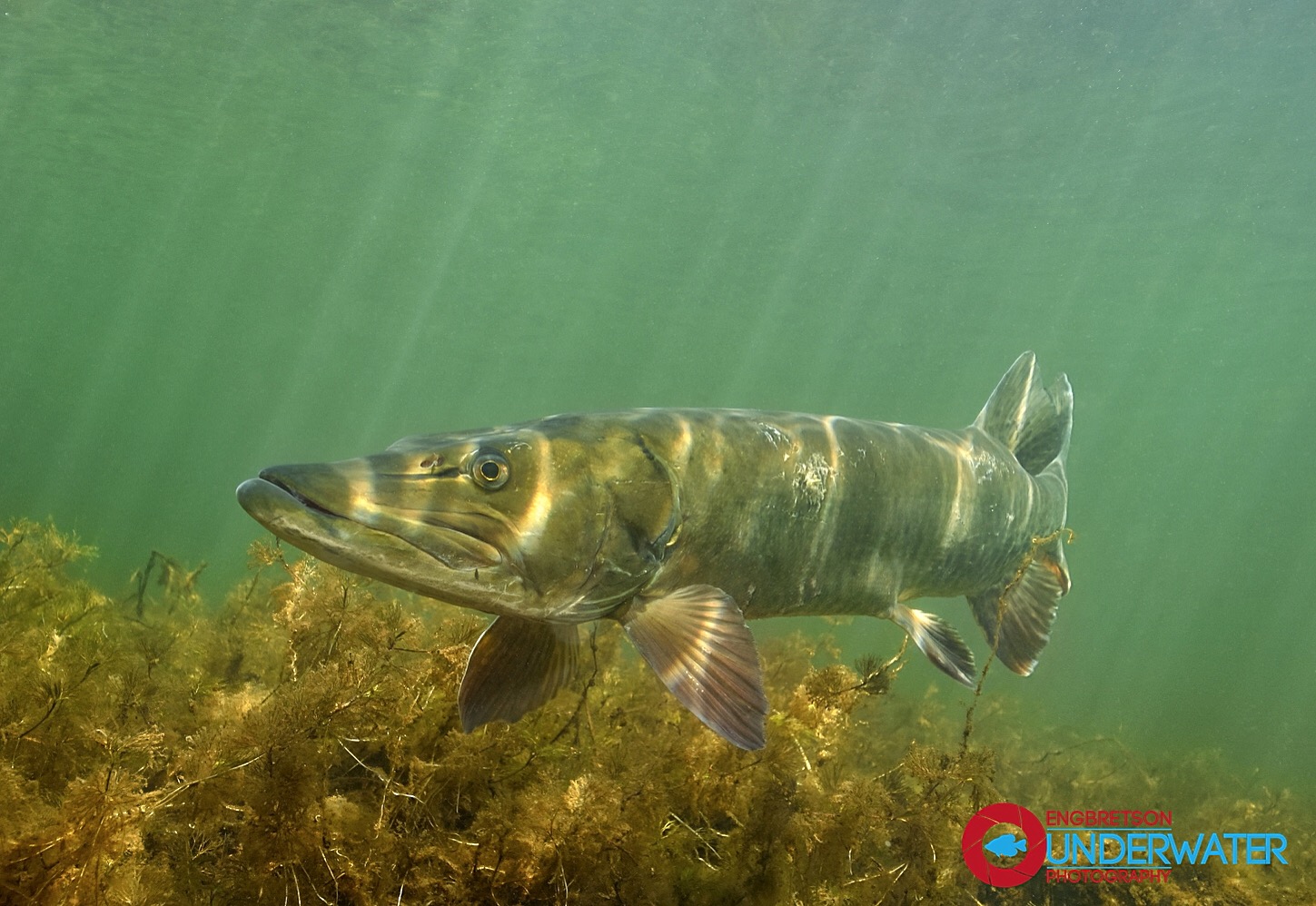
up close in their own environment. There’s nothing quite like seeing a large
muskie underwater. They glide effortlessly through the water with the supreme
confidence reserved for members at the top of their food chain. Because of
this, they’re not afraid of divers and I’m able to approach them usually fairly
easily. They are surely aware of all the other fish and animals that populate
their world and because divers are an anomaly, they will routinely approach me
with what I can only characterize as curiosity. They often make a complete
circle around me as if to inspect this ‘strange creature” from every angle.
They also display keen awareness. When I enter a lake, I don’t have to search
for the muskies. I’ve discovered that if I’m patient, they will find me. Drawn,
I’m sure by acute imperceptible sensory abilities and also probably just by the
noise of my air bubbles too.
One of the attributes of water is that when viewed through a
prism of air, objects appear to be larger than they really are. So when I’m underwater looking through my
diver’s mask, a 45-inch musky appears to me to be a 60-inch fish! Fish and anything else viewed underwater are
only ¾ of their actual size. Fisherman
often ask me how big the fish are that I see.
I do my best to adjust for the optics of underwater viewing, but the
fact is, I just don’t know. Fish look
really big underwater, and big fish look positively huge when viewed
underwater. For the first few years, I
got really excited whenever I saw muskies.
“Wow! That’s got to be a world
record!” I would say to myself. But over
the years, I’ve come to better understand this illusion and now I don’t pee my
wetsuit quite as often when I see what looks like Moby Dick. What this means sadly, is that all those
reports you hear of 6 foot long monsters swimming next to the boat, or huge
fish that got off before they could be netted are really just ordinary sized
muskies. Some may argue that the fish
lined up exactly with something on the boat that’s of known size and therefore,
that’s evidence that the fish was really a whopper. This of course is nonsense. Since you would
still be viewing the fish in water through a space of air, the magnification
illusion is still in play. Your boat is
a poor yardstick since it’s in air, and the fish is underwater.
I remember a particular encounter one spring a few years
ago. I was taking pictures in Lake Tomahawk in Vilas County Wisconsin. I came across 2 muskies engaged in spawning
activity. It was a very dark rainy morning.
The light was terrible and I wasn’t able to get any pictures, but the fish I
saw that day was truly impressive. The size of the spawning male was not
remarkable. In fact, he was simply
dwarfed by the female he was swimming with.
She was a real beauty. She was
enormous, and had a girth like those big watermelons that win ribbons at the county
fair. She swam along side of me and I
took a good long look. I’m five foot,
eight inches tall, and the fish lined up next to me was longer than I was! Was this a 6-foot long muskie? I did the
quick arithmetic: Since it appeared to be 70 inches or more, its real and
actual size would have been a little over 50 inches. Possibly 52 inches. While not a world record,
she was still a spectacular fish in anyone’s book.



Engbretson+Underwater+Photography.jpg)


 Posts
Posts


