Engbretson Underwater Photography

Search The Fish Photos


News From Behind the Scenes at Engbretson Underwater Photo and Stories about the Freshwater Environments We Visit.


Showing posts with label Muskie. Show all posts

Thursday, January 27, 2022

King of the Deep: Swimming with Muskies in Their Natural Habitat

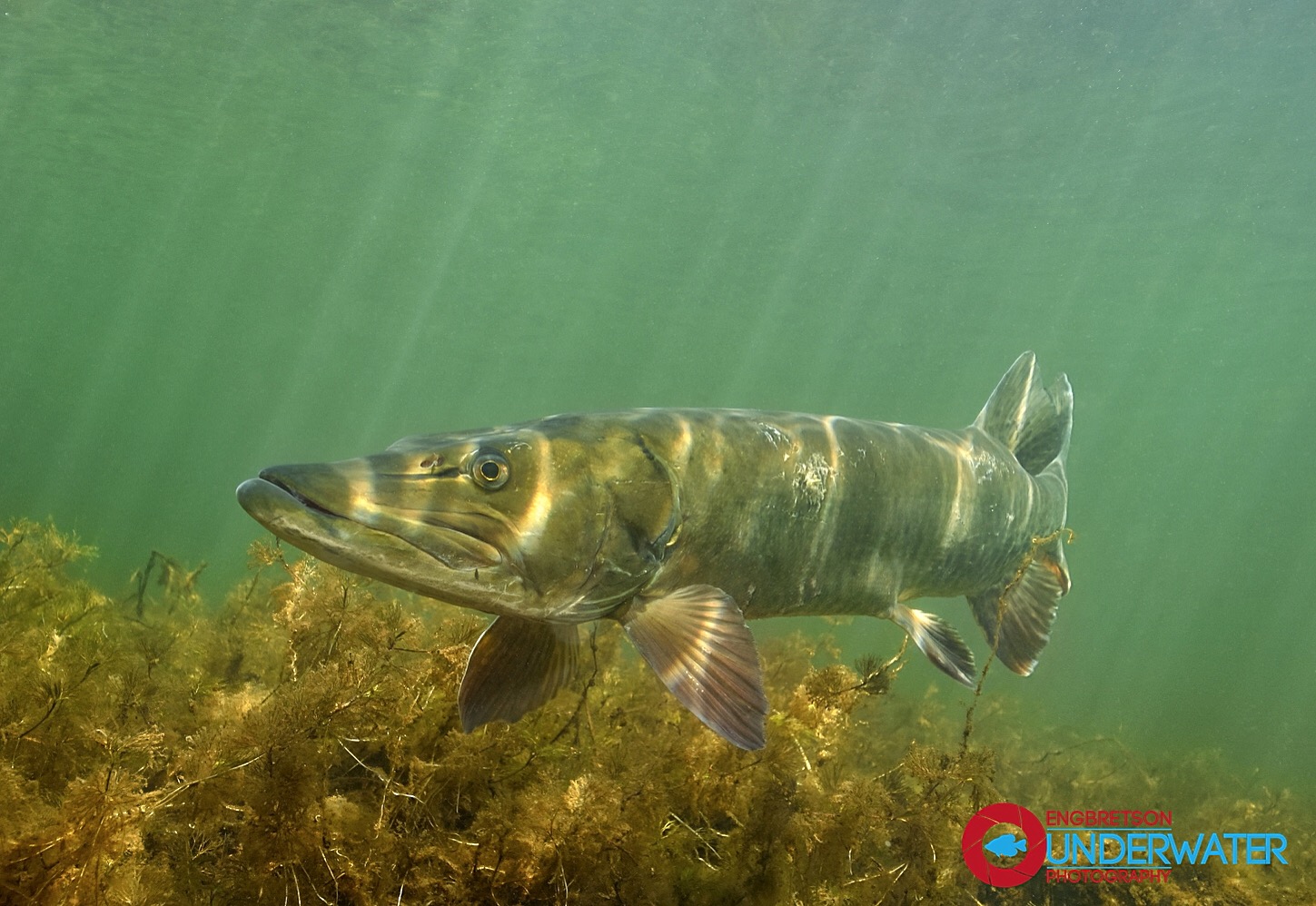
I’m very lucky that I just happen to live in an area that’s home to some of the most legendary muskie lakes in the country.  Over the years, I’ve had a chance to swim in some of these famed waters and encounter muskies up close in their own environment.  There’s nothing quite like seeing a large muskie underwater.  They glide effortlessly through the water with the supreme confidence reserved for members at the top of their food chain.  Because of this, they’re not afraid of divers and I’m able to approach them usually fairly easily.  They are surely aware of all the other fish and animals that populate their world and because divers are an anomaly, they will routinely approach me with what I can only characterize as curiosity. They often make a complete circle around me as if to inspect this ‘strange creature” from every angle.  They also display keen awareness.  When I enter a lake, I don’t have to search for the muskies.  I’ve discovered that if I’m patient, they will find me.  Drawn, I’m sure by acute imperceptible sensory abilities and also probably just by the noise of my air bubbles too.

Thursday, November 14, 2019

Swimming With Muskies

The first time I came face to face with a muskie underwater in its environment, I thought I was going to have a stroke. I was scuba diving in a small northern Wisconsin Lake known primarily for bass and bluegills, when I turned and found myself face to face with a monster that looked more like an alligator than anything else. To say I was startled would be an understatement. I remember screaming into my regulator as an eruption of air bubbles exploded from my lungs and raced towards the surface. My arms and legs flapped involuntarily in panic and I stirred up a cloud of silt that quickly enveloped both the beast and me. After a few seconds, when I had recovered from the start and regained my composure, I was amazed to see that the giant fish hadn’t moved an inch. It was still there, just three feet away hanging motionless in the slowly clearing water. In stark contrast to my initial panicked surprise its reaction was just the opposite. Its demeanor was calm, and its steely-eyed gaze remained fixed on me the entire time like a gunslinger in a Clint Eastwood western. This was a fish filled with confidence, instead of fear. He was the ruler of this underwater kingdom, and seemed to regard me with the same sense of apathy and disinterest that’s normally reserved only for telemarketers and late night TV pitchmen. Finally, he slowly finned away into the depths and I was left with a feeling of awe and admiration for these magnificent fish that has only grown over the years.

I’m very lucky that I just happen to live in an area that’s home to some of the most legendary muskie lakes in the country. Over the years, I’ve had a chance to swim in some of these famed waters and encounter muskies up close in their own environment. There’s nothing quite like seeing a large muskie underwater. They glide effortlessly through the water with the supreme confidence reserved for members at the top of their food chain. Because of this, they’re not afraid of divers and I’m able to approach them usually fairly easily. They are surely aware of all the other fish and animals that populate their world and because divers are an anomaly, they will routinely approach me with what I can only characterize as curiosity. They often make a complete circle around me as if to inspect this ‘strange creature” from every angle. They also display keen awareness. When I enter a lake, I don’t have to search for the muskies. I’ve discovered that if I’m patient, they will find me. Drawn, I’m sure by acute imperceptible sensory abilities and also probably just by the noise of my air bubbles too.

One of the attributes of water is that when viewed through a prism of air, objects appear to be larger than they really are.  So when I’m underwater looking through my diver’s mask, a 45-inch musky appears to me to be a 60-inch fish!  Fish and anything else viewed underwater are only ¾ of their actual size.  Fisherman often ask me how big the fish are that I see.  I do my best to adjust for the optics of underwater viewing, but the fact is, I just don’t know.  Fish look really big underwater, and big fish look positively huge when viewed underwater.  For the first few years, I got really excited whenever I saw muskies.  “Wow!  That’s got to be a world record!” I would say to myself.  But over the years, I’ve come to better understand this illusion and now I don’t pee my wetsuit quite as often when I see what looks like Moby Dick.  What this means sadly, is that all those reports you hear of 6 foot long monsters swimming next to the boat, or huge fish that got off before they could be netted are really just ordinary sized muskies.  Some may argue that the fish lined up exactly with something on the boat that’s of known size and therefore, that’s evidence that the fish was really a whopper.  This of course is nonsense. Since you would still be viewing the fish in water through a space of air, the magnification illusion is still in play.  Your boat is a poor yardstick since it’s in air, and the fish is underwater. 

I remember a particular encounter one spring a few years ago. I was taking pictures in Lake Tomahawk in Vilas County Wisconsin.  I came across 2 muskies engaged in spawning activity.  It was a very dark rainy morning. The light was terrible and I wasn’t able to get any pictures, but the fish I saw that day was truly impressive. The size of the spawning male was not remarkable.  In fact, he was simply dwarfed by the female he was swimming with.  She was a real beauty.  She was enormous, and had a girth like those big watermelons that win ribbons at the county fair.  She swam along side of me and I took a good long look.  I’m five foot, eight inches tall, and the fish lined up next to me was longer than I was!  Was this a 6-foot long muskie? I did the quick arithmetic: Since it appeared to be 70 inches or more, its real and actual size would have been a little over 50 inches.  Possibly 52 inches. While not a world record, she was still a spectacular fish in anyone’s book.

Tuesday, October 9, 2018

Do Muskies Eat Walleyes?


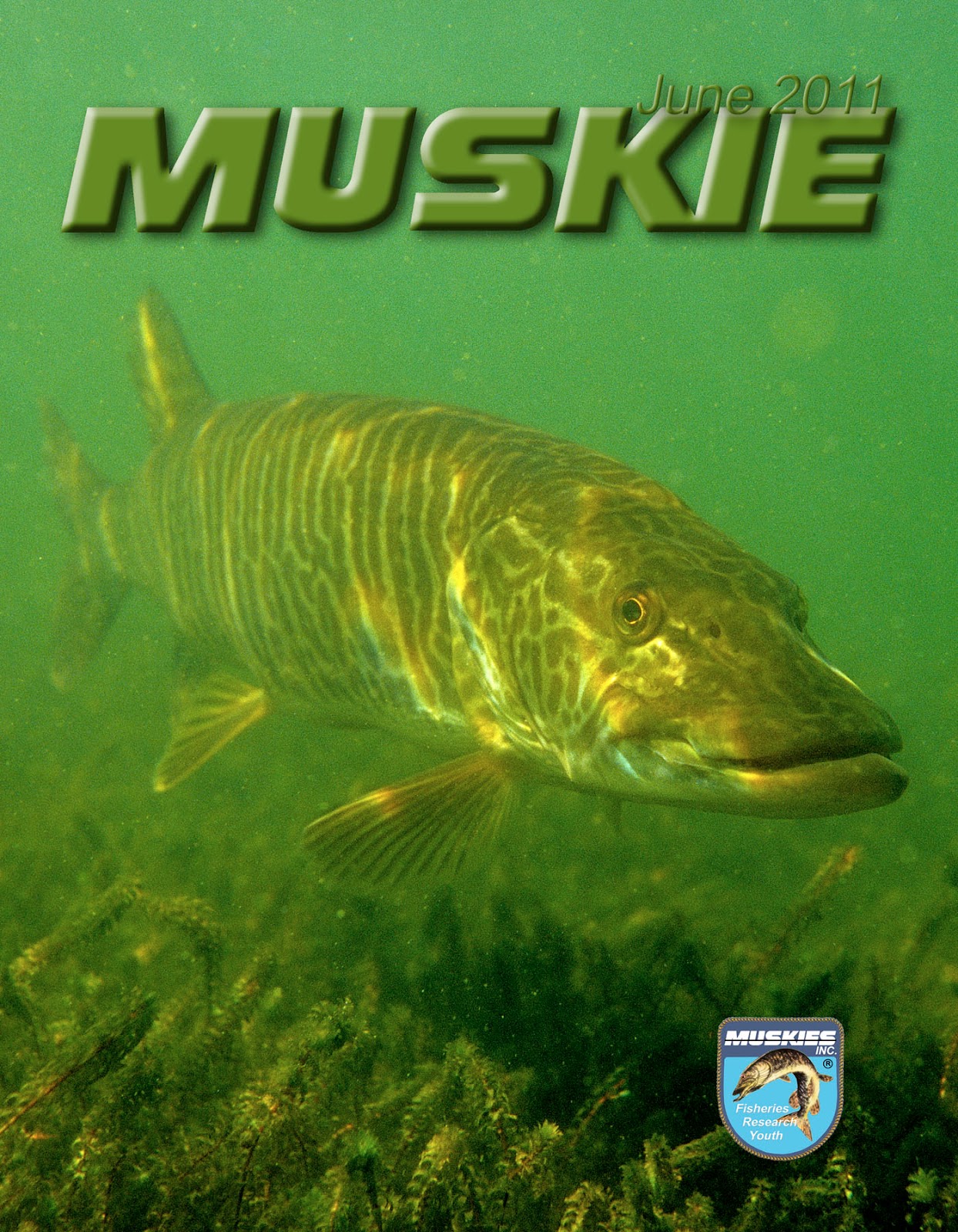
In June 2007, Muskie Magazine published an article I wrote about my underwater observations photographing muskie.  In the last paragraph of that article I shared some conclusions I had made regarding muskie preying on walleye.  I said at the time that I believe muskie routinely prey on walleye and cited many of my own observations that led me to believe that.
 
In the last ten years, I’ve witnessed additional muskie behavior underwater and while humbling, I think it’s only fair that I set the record straight and tell you why I now believe I was wrong about my original conclusions.  
 
Here are the facts:
 
I have never once seen a muskie actually capture a walleye.  Certainly, when walleyes are around, a muskie will show interest as they do in all fish they encounter that might be regarded as potential prey.  I often saw muskies following walleyes-a term I called ‘stalking” or “targeting”.  On occasion, I had seen muskies “rush” a walleye in what could only be considered an attack.  The muskies were always unsuccessful.  The conclusion I made from these observations is that while I saw only misses, they must be successful most of the time when targeting walleye.  I now think that I completely misinterpreted those observations.  
 
Today, ten years after I wrote the article, I have a different idea of what I really saw.  I’ve had almost a decade more to observe many more muskies interact with other fish and I feel I’ve learned a great deal.  I’ve now seen a great many “misses” and still not a single successful capture. Today, I’m convinced that muskies actually eat very few walleyes.  The reason for this will seem counter intuitive to everything you know about muskie, but it’s a conclusion that seems well supported.  I don’t believe muskie are very efficient predators… at least not of walleyes.  In reviewing my underwater video of muskie attempting to prey on walleye, they fail time and time again because of many huge disadvantages they have.  Walleyes on the other hand, seem to be uniquely designed for the purpose of evading muskie.  Walleyes have excellent vision and are always keenly aware of the location of any nearby muskie.  It’s nearly impossible for a muskie to actually “sneak up” on a walleye.  My videos show that walleyes are speedy and agile and they escape with very little effort at all.  Muskie, it has to be said, are rather clumsy.  They have some speed but only for very short bursts.  Their long bodies are difficult to turn and they lack the mobility to out maneuver walleyes.  They have good vision that they use to their advantage in low light when preying on perch or suckers, but it’s no match against a walleye’s vision.  The videos that I’ve taken underwater show how positively feeble and overmatched muskie are when attempting to chase down a walleye.  In short, walleyes seem specifically designed by nature to possess the exact traits needed to evade muskie.  
 
It’s not surprising that walleye fisherman sometimes have muskie attack their catch as they’re reeling it in.  Only a walleye already hooked and struggling on a line would be incapable of escaping a muskie attack.  When this occurs, it’s easy to assume that muskie must eat walleye all the time.  I came to the same false conclusion myself.  But now I think only walleyes that are compromised ever become prey for muskie.
 
For people who appreciate or even revere the muskie, it almost seems blasphemous to suggest that muskies have any shortcomings whatsoever, but I think they do.  I now believe that muskies don’t eat many walleyes, not because they wouldn’t want to, but because they’re unable to.  At last, the mighty muskie has met his match and it’s the wily walleye.

Saturday, April 21, 2018

The Best Time of Year For Muskie Pictures

Muskellunge Underwater (c)Engbretson Underwater Photography


Spring is the best and easiest time of year to photograph muskies. I shoot most of my musky images before Memorial Day. After spawning, they will continue to hang around in shallow water (generally 6 feet or less) along the shorelines. This is where it's warmest for them. I can approach them quite easily up until Memorial Day. Then, boat traffic and other increased human activity on the water drives them from these locations toward their typical summer haunts where you're less likely to easily find them.

How do you get so close to fish like Muskies? Don't they spook?
That's a question I get asked frequently by many people. To photograph fish well underwater, it's necessary to get very close to them. So how do I do that? One thing I've done is to develope a series of techniques that communicate to the fish my lack of hostility, and my general inability to compete with them as creatures perfectly designed for life underwater. One way I do that is to present myself as obviously as... possible. I don't try to ambush or deceive them. I don't wear a camouflage wet suit. I don't sneak around or hide behind boulders or timber. I don't try to advance toward a fish when he can't see me. I don't even try to be particularly quiet.
In fact I do the opposite of all those things. I make sure the fish see me coming from a long way away. I try to show myself out in the open and to demonstrate what my limitations are. Ideally, you want to convey to the fish how slow and incompetent you are in it's environment; how clumsy you are; how incredibly un-stealthy you are; this is so opposite of what a predator would do that many fish are able to detect that you're not a threat to them, based on your complete lack of cunning or covertness. You want them to see you and think that you're completely ridiculous (which you are of course). The faster you can get them to understand this, the faster their fear will disappear.

Monday, September 18, 2017

Are the Muskies You See Really That Big?

Muskies underwater are only 3/4 of the size they appear.  (c)Eric Engbretson

One of my favorite websites for fishing information is Lake Link. The fishing reports posted on this site by the thousands of fisherman who fish the many lakes in the Midwest region can be useful, informative and entertaining. While some of the most experienced and knowledgeable fisherman post fishing reports and their observations while on the water, I am constantly amazed at one glaring mistake so many fisherman make. That error is not understanding the magnifying effects of water. Simply put-fish look bigger under water than they really are. The message boards on Lake Link are filled with hundreds of eye-witness accounts of fisherman reporting large muskies that "swam right next to the boat that were 50 inches!" Could there really be that many 50 inch muskies swimming around? The answer is a disappointing "No".  What these fisherman all fail to realize is that fish in water, viewed through air are only 3/4 of the size they appear to be. So, all those mammoth 50 inch fish are really just ordinary 37.5 inch long muskies.

Scuba divers all understand that one attribute of water is that when viewed through a prism of air, also known as a diver's mask, objects appear much larger than they really are. Underwater, a 45 inch musky will look a 60 inch whopper! Fisherman often ask me how large the fish are that I see underwater. Honestly, most fish look big underwater, and big fish look like Godzilla. In my early days of diving I was convinced that each musky I encountered was a world record.  Many scuba dives later, I've come to better understand the illusion, and realize that reports of monster muskie that "got off just as they were about to be netted" were likely ordinary sized fish.

Some may argue that the fish lined up exactly with something on the boat that's of known size and reference, but the viewer doesn't understand the illusion facing scuba divers all the time. Boats and the objects on them are poor comparison tools as they're in the atmosphere, visually accurate in size, while the musky is underwater, distorted in size. To test this concept yourself, measure your hand. Then lean over the side of a fishing boat or dock and stick it about a foot underwater. Hold the ruler above the surface while viewing your submersed hand, and measure it best you can. How'd the numbers come out? If you did this correctly, your dry hand will be roughly ¾ the underwater hand size.

While the fishing reports on websites like Lake Link can be valuable research tools, don't be fooled by eye-witness accounts of large fish that were seen underwater. They just weren't that big. 

Friday, January 1, 2016

New Muskie Underwater Video

I just added a new video to my YouTube Channel.  This time, it's a short compilation clip of muskies I've encountered and photographed underwater.