Engbretson Underwater Photography

Search The Fish Photos


News From Behind the Scenes at Engbretson Underwater Photo and Stories about the Freshwater Environments We Visit.


Showing posts with label Fishiding. Show all posts

Thursday, February 10, 2022

Why Do-It-Yourself Artificial Fish Habitat Fails:

Fishiding Artificial Fish Habitat is unique because of its size, complexity, and the protection it provides juvenile fish.

Constructing a conglomeration of rubber tubing, plastic barrels, and old hose, throwing it into the lake and calling it fish habitat because we saw a bass next to it, is like putting a cardboard box on the street corner and calling it “housing” when a homeless person takes refuge in it. Most DIY fish habitat is as much fish habitat as a plastic tarp strung between two shopping carts is “a house” to a homeless person.

Look around at your own home. Why is it comfortable? Why do you like it? Look past the man cave you’ve built in the basement, the expensive wall-to-wall carpeting, and the refrigerator with the built-in ice-cube dispenser. What makes your house useful and practical is its utilitarian functionality.

The insulation keeps you warm in the winter. The roof keeps the rain out. There’s a dark bedroom to sleep in at night. The doors and windows all have locks that provide you with safety and security. Your pantry is stocked with food and you have a kitchen to prepare it. Your home functions in a way that addresses all your family’s needs in a utilitarian way.

By and large, DIY artificial fish habitat doesn’t do anything close to that. To be comparable, artificial fish habitat needs to be large to accommodate many fish. (You wouldn’t want to live in a one-bedroom bungalow with a family of six would you?) It needs to provide a refuge for young fish the same way your children have their bedrooms where they can be away from grown-ups while hanging out with their friends. There needs to be on-site food so you’re not driving to McDonald’s every single time you want a snack. Size, security, protection, privacy, and food are just some of the important aspects of any home that we would never compromise on in our dwellings yet seemingly never consider when constructing habitat for fish. Instead, we create the equivalent of tent cities in the most impoverished part of town and congratulate ourselves when homeless people congregate there to get out of the rain. That’s not a solution to the homeless problem any more than lashing rubber hoses to cinder blocks is to solving the lack of fish habitat.

What’s needed in both scenarios is genuine housing/habitat for both impoverished people and fish.

When looking at the wide variety of homemade so-called fish habitat, one thing seems to be evident. Most well-intentioned builders don’t seem to know exactly what fish need and the poverty of their designs betray this fact. Bad designs continue to be copied, while far superior ones are ignored. This is because so few of us can tell the difference between good designs and poor ones. This failure is epidemic but also understandable. Fish live in a separate world largely invisible to us. We rarely glimpse them in their natural habitat and have little idea of how they live or how they spend their time. Our only interaction is when we hoist them into the boat on the end of our fishing lines. Occasionally we notice that fishing under the neighbor’s dock or next to that old Cyprus tree stump seem to be good spots, but we’re completely in the dark about why. We often leap to the false conclusion that any structure in the water is a fish’s home and any solid piece of material we find in the back of our garage could work just as well. Do it yourselfers are thwarted not only by their lack of understanding of fish but also by what materials might currently be available in their sheds and garages. I think this explains why we see so many awful constructions.

To design and construct authentic fish habitats and not merely dilapidated, makeshift shelters of the kind we might see on urban streets, we need to think backward. We need to think first about function over form. Utility over availability. We need our designs to meet the specific needs of fish. We can look to natural habitats for guidance. Natural habitat has a myriad of desirable characteristics but for this discussion, we can single out the three most often violated elements that any proposed artificially constructed fish habitat must have. The first is size. Is our construction large enough to accommodate a community of fishes? The second is protection. Are there tight spaces, crevices, alleys, pockets, holes, depressions, and retreats that smaller fish can occupy that larger fish absolutely cannot access? The third is complexity. Is the structure large and complex enough to offer shade, to block sight-lines, and to hide or conceal what’s in and around it? If it were in your backyard, could your kids use it when they play hide and seek?  Keeping in mind this trio of primary functions will help you begin to understand what fish need and enable you to reject bad design ideas and eliminate potential construction materials that don’t amplify these important characteristics.

Across our country, there are many bodies of water from large sprawling reservoirs to small backyard ponds. Many of them are lacking fish habitat for a variety of reasons. In many cases, artificial habitat can be a surrogate but only if it addresses in utilitarian ways the features of genuine habitat. 

If you work in the fish management sector, you and your colleagues have an obligation to be very critical of the designs being paraded in front of you. If we’re not more careful about scrutinizing and properly evaluating artificial fish habitats, we run the risk of unknowingly filling our waterways with useless materials instead of creating legitimate habitat. 

Certainly, there’s much to discuss about creating artificial fish habitat, and because true innovation has slowed to a trickle, we find ourselves mired in a kind of estuary between realizing we have a habitat deficiency and creating the kinds of authentic habitat that will make any difference. Artificial fish habitat needs to provide functional value to our fish. The scale of the problem is enormous in many locations, and won’t be solved by adding more sub-standard and inadequate structures any more than human homelessness can be solved by putting out more cardboard boxes and tents. 

Wednesday, March 24, 2021

A Critical Look At Artificial Fish Habitat:


When considering fish habitat, I think we need to discuss the role artificial fish habitat can serve. They're being used more and more, especially in large southern reservoirs devoid of important structure fish need.  Fish managers have traditionally placed bundles of Christmas or cedar trees on the lake bottom to provide cover for fish.  Because the lifespan of tree bundles and brush piles is limited, replenishing them has always been an ongoing and expensive process.  One advantage of artificial habitat structures that help explain their growing popularity is that they don't decay or deteriorate.

But can “anything” man-made be placed in our waters and be called fish habitat? If we throw a rusty wheelbarrow into a lake today and catch a fish on it next week, can we genuinely say we’ve added fish habitat and therefore improved the lake? Are we unknowingly turning our lakes into landfills or the equivalent of the town dump under the guise of creating fish habitat? Is it really true that any structure of any kind is better than nothing?  If you’ve ever wondered if there’s any discernible line between “junk” and authentic fish habitat, you wouldn’t be alone.

If there’s any hope of understanding the potential benefits using artificial fish habitat might offer, I think we need to uncouple two terms: Fish habitat and fishing. Effective fish habitat needs to protect young fish too small to be of interest to anglers. The metric to evaluate how useful fish habitat is must be re-calibrated. The question shouldn’t be how many trophy bass did you catch this year on the habitat, but how many young-of-the year bass survived the brutal gauntlet of their first year of life because of the protection that habitat provided. 

It could be argued that the most successful fish habitat would be one that only attracted age 0 fish and was a lousy fishing spot. As anglers, we need to modify our point of view. Fish habitat should be regarded as an investment in the hope of a better day’s fishing in the future, not something with instant payoffs today. If fish habitat isn’t a vehicle for fish recruitment, what good is it?

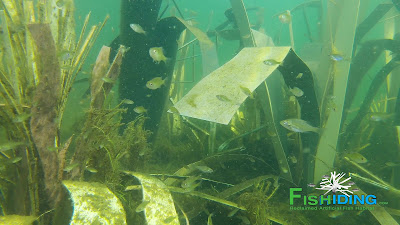
Today, there isn’t a single designer of any artificial fish habitat that doesn’t promise their product or design will protect young fish. These are merely assertions that haven’t met their burden of proof. These claims must be demonstrated before we have warrant to accept them as true. Where is the evidence that any assemblage of man-made parts and scrap material does anything to help even a single fish survive its first year, let alone to adulthood? So far, Fishiding is the only design that has continuously and consistently documented in hundreds of underwater pictures and videos over the years the efficacy of their product.

If you work in the fish management sector, you should absolutely demand evidence that whatever artificial habitat you’re considering spending resources on legitimately works. As condescending as it may sound, intuition or gut feeling is not evidence. If we’re not more careful about scrutinizing and properly evaluating artificial fish habitat, we run the risk of unknowingly crossing what should be a distinct line between what authentic habitat is and what’s simply junk.

Monday, May 27, 2019

How Does Artificial Fish Habitat Work?

The Science Behind Fishiding Artificial Fish Habitat


I recently collaborated with David Ewald from Fishiding.com on a ten-part video series that explains how artificial fish habitat works. In the videos, which you can watch on myYouTube channel, we examine many of the characteristics that are necessary to design the kinds of structures that serve fish most effectively.

While natural elements like trees, stumps, rocks and plants provide the best habitat, artificial surrogates have a place in this conversation. The bottom of many southern reservoirs resemble moonscapes and there is little if any existing natural habitat. In many of these man-made lakes, man-made habitat is often the only viable option to provide young fish with the kind of sanctuaries they require to survive the challenges of early life.

In our video series “The Science behind Fishiding Artificial Fish Habitat”, we show you never-before-seen underwater footage of how fish utilize this habitat and why it should be considered a legitimate tool for fisheries professionals faced with managing waters where habitat is marginal.

If you’re interested in watching the videos, make sure you also read the 800 word narratives that accompany each video. Each narrative provides a complete description of the footage you see and points out key aspects of design, function, installation, testing, configuration, size and complexity. There really is a lot to know, but we’ve worked to distill everything we’ve learned into an easy to understand presentation that we hope you’ll find both interesting and useful.

You can view the entire video series on YouTube here and on the Fishiding page here.

Monday, January 11, 2016

Artificial Fish Habitat or Fish Attractors: Which Do Fish Need and Why?

​Artificial Fish Habitat or Fish Attractors: Which Do The Fish Need and Why?  First of its kind comparison of artificial fish attractors and artificial fish habitat, explaining what works best for fish reproduction, protection and sustainability of fisheries.

Newly placed, this Fishiding High Rise model towers 12 feet off the lake floor and will soon become a haven for fish in lakes where natural cover is at a premium.  (C)Eric Engbretson Photo

Saturday, June 21, 2014

Fishiding Leads the Way in Artificial Fish Habitat-Designed By Fish, For Fish

Newly placed, this Fishiding High Rise model towers 12 feet off the lake floor and will soon become a haven for fish in lakes where natural cover is at a premium.  (C)Eric Engbretson Photo

Artificial fish habitat structures are becoming more popular today.  They're being used more and more, especially in large southern reservoirs devoid of important structure fish need.  Fish managers have traditionally placed bundles of Christmas trees or cedar trees on the lake bottom to try to provide cover for fish.  While effective, the lifespan of tree bundles or brush piles is limited, so replenishing them has always been an ongoing and expensive process.  Today, artificial habitat structures are gaining popularity because they don't decay or deteriorate. 

Of all the outfits manufacturing artificial habitat, David Ewald's Wonder Lake, IL company Fishiding, is ahead of all others, at least if you ask the fish, which is what David does.  Ewald has recently introduced his latest models:  The High Rise.  Ranging in height from 8 to 14 feet, these new designs are the only artificial fish habitat on the market today that incorporate the vertical element.  They tower off the lake floor and provide legitimate structure for fish, unlike his competitors who largely manufacture small and short structures that are inconspicuous to fish and do little to provide them with the kind of cover they're looking for.  The vertical dimension used in Ewald's High Rise models gives fish a range or depth at which to stage, and mimics the effectiveness of sunken vertical timber.      

Ewald's company, Fishiding sells a variety of different fish habitat structures that continue to evolve.  The reason for this is repeated testing.  Ewald monitors test structures over time and modifies them based on how fish respond to them.  The prototypes that don't attract as many fish are retooled and modified until they do or even scrapped altogether.  In effect, the fish vote, and new habitat is designed based on the observed preferences of fish.  No other artificial habitat structures are custom made for fish preferences the way Fishiding is.  When Ewald learned about the often overlooked but highly important vertical dimension, he got to work designing new models that would address this important fish preference and give fish what they want.  The result is his High Rise line of structures.  "Fishiding's artificial fish structures are designed not by what we think will be effective, but what they fish tell us they prefer", says Ewald.

For more information on Fishiding structures or the innovative High Rise models, click on this link, or go to http://www.fishiding.com/