Engbretson Underwater Photography

Search The Fish Photos


News From Behind the Scenes at Engbretson Underwater Photo and Stories about the Freshwater Environments We Visit.


Showing posts with label Fish Cribs. Show all posts

Thursday, February 10, 2022

Why Do-It-Yourself Artificial Fish Habitat Fails:

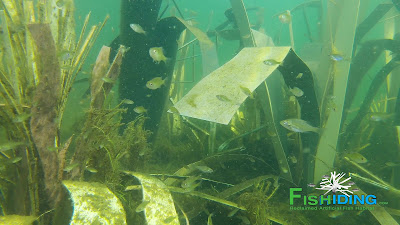
Fishiding Artificial Fish Habitat is unique because of its size, complexity, and the protection it provides juvenile fish.

Constructing a conglomeration of rubber tubing, plastic barrels, and old hose, throwing it into the lake and calling it fish habitat because we saw a bass next to it, is like putting a cardboard box on the street corner and calling it “housing” when a homeless person takes refuge in it. Most DIY fish habitat is as much fish habitat as a plastic tarp strung between two shopping carts is “a house” to a homeless person.

Look around at your own home. Why is it comfortable? Why do you like it? Look past the man cave you’ve built in the basement, the expensive wall-to-wall carpeting, and the refrigerator with the built-in ice-cube dispenser. What makes your house useful and practical is its utilitarian functionality.

The insulation keeps you warm in the winter. The roof keeps the rain out. There’s a dark bedroom to sleep in at night. The doors and windows all have locks that provide you with safety and security. Your pantry is stocked with food and you have a kitchen to prepare it. Your home functions in a way that addresses all your family’s needs in a utilitarian way.

By and large, DIY artificial fish habitat doesn’t do anything close to that. To be comparable, artificial fish habitat needs to be large to accommodate many fish. (You wouldn’t want to live in a one-bedroom bungalow with a family of six would you?) It needs to provide a refuge for young fish the same way your children have their bedrooms where they can be away from grown-ups while hanging out with their friends. There needs to be on-site food so you’re not driving to McDonald’s every single time you want a snack. Size, security, protection, privacy, and food are just some of the important aspects of any home that we would never compromise on in our dwellings yet seemingly never consider when constructing habitat for fish. Instead, we create the equivalent of tent cities in the most impoverished part of town and congratulate ourselves when homeless people congregate there to get out of the rain. That’s not a solution to the homeless problem any more than lashing rubber hoses to cinder blocks is to solving the lack of fish habitat.

What’s needed in both scenarios is genuine housing/habitat for both impoverished people and fish.

When looking at the wide variety of homemade so-called fish habitat, one thing seems to be evident. Most well-intentioned builders don’t seem to know exactly what fish need and the poverty of their designs betray this fact. Bad designs continue to be copied, while far superior ones are ignored. This is because so few of us can tell the difference between good designs and poor ones. This failure is epidemic but also understandable. Fish live in a separate world largely invisible to us. We rarely glimpse them in their natural habitat and have little idea of how they live or how they spend their time. Our only interaction is when we hoist them into the boat on the end of our fishing lines. Occasionally we notice that fishing under the neighbor’s dock or next to that old Cyprus tree stump seem to be good spots, but we’re completely in the dark about why. We often leap to the false conclusion that any structure in the water is a fish’s home and any solid piece of material we find in the back of our garage could work just as well. Do it yourselfers are thwarted not only by their lack of understanding of fish but also by what materials might currently be available in their sheds and garages. I think this explains why we see so many awful constructions.

To design and construct authentic fish habitats and not merely dilapidated, makeshift shelters of the kind we might see on urban streets, we need to think backward. We need to think first about function over form. Utility over availability. We need our designs to meet the specific needs of fish. We can look to natural habitats for guidance. Natural habitat has a myriad of desirable characteristics but for this discussion, we can single out the three most often violated elements that any proposed artificially constructed fish habitat must have. The first is size. Is our construction large enough to accommodate a community of fishes? The second is protection. Are there tight spaces, crevices, alleys, pockets, holes, depressions, and retreats that smaller fish can occupy that larger fish absolutely cannot access? The third is complexity. Is the structure large and complex enough to offer shade, to block sight-lines, and to hide or conceal what’s in and around it? If it were in your backyard, could your kids use it when they play hide and seek?  Keeping in mind this trio of primary functions will help you begin to understand what fish need and enable you to reject bad design ideas and eliminate potential construction materials that don’t amplify these important characteristics.

Across our country, there are many bodies of water from large sprawling reservoirs to small backyard ponds. Many of them are lacking fish habitat for a variety of reasons. In many cases, artificial habitat can be a surrogate but only if it addresses in utilitarian ways the features of genuine habitat. 

If you work in the fish management sector, you and your colleagues have an obligation to be very critical of the designs being paraded in front of you. If we’re not more careful about scrutinizing and properly evaluating artificial fish habitats, we run the risk of unknowingly filling our waterways with useless materials instead of creating legitimate habitat. 

Certainly, there’s much to discuss about creating artificial fish habitat, and because true innovation has slowed to a trickle, we find ourselves mired in a kind of estuary between realizing we have a habitat deficiency and creating the kinds of authentic habitat that will make any difference. Artificial fish habitat needs to provide functional value to our fish. The scale of the problem is enormous in many locations, and won’t be solved by adding more sub-standard and inadequate structures any more than human homelessness can be solved by putting out more cardboard boxes and tents. 

Wednesday, March 24, 2021

A Critical Look At Artificial Fish Habitat:


When considering fish habitat, I think we need to discuss the role artificial fish habitat can serve. They're being used more and more, especially in large southern reservoirs devoid of important structure fish need.  Fish managers have traditionally placed bundles of Christmas or cedar trees on the lake bottom to provide cover for fish.  Because the lifespan of tree bundles and brush piles is limited, replenishing them has always been an ongoing and expensive process.  One advantage of artificial habitat structures that help explain their growing popularity is that they don't decay or deteriorate.

But can “anything” man-made be placed in our waters and be called fish habitat? If we throw a rusty wheelbarrow into a lake today and catch a fish on it next week, can we genuinely say we’ve added fish habitat and therefore improved the lake? Are we unknowingly turning our lakes into landfills or the equivalent of the town dump under the guise of creating fish habitat? Is it really true that any structure of any kind is better than nothing?  If you’ve ever wondered if there’s any discernible line between “junk” and authentic fish habitat, you wouldn’t be alone.

If there’s any hope of understanding the potential benefits using artificial fish habitat might offer, I think we need to uncouple two terms: Fish habitat and fishing. Effective fish habitat needs to protect young fish too small to be of interest to anglers. The metric to evaluate how useful fish habitat is must be re-calibrated. The question shouldn’t be how many trophy bass did you catch this year on the habitat, but how many young-of-the year bass survived the brutal gauntlet of their first year of life because of the protection that habitat provided. 

It could be argued that the most successful fish habitat would be one that only attracted age 0 fish and was a lousy fishing spot. As anglers, we need to modify our point of view. Fish habitat should be regarded as an investment in the hope of a better day’s fishing in the future, not something with instant payoffs today. If fish habitat isn’t a vehicle for fish recruitment, what good is it?

Today, there isn’t a single designer of any artificial fish habitat that doesn’t promise their product or design will protect young fish. These are merely assertions that haven’t met their burden of proof. These claims must be demonstrated before we have warrant to accept them as true. Where is the evidence that any assemblage of man-made parts and scrap material does anything to help even a single fish survive its first year, let alone to adulthood? So far, Fishiding is the only design that has continuously and consistently documented in hundreds of underwater pictures and videos over the years the efficacy of their product.

If you work in the fish management sector, you should absolutely demand evidence that whatever artificial habitat you’re considering spending resources on legitimately works. As condescending as it may sound, intuition or gut feeling is not evidence. If we’re not more careful about scrutinizing and properly evaluating artificial fish habitat, we run the risk of unknowingly crossing what should be a distinct line between what authentic habitat is and what’s simply junk.

Monday, May 27, 2019

How Does Artificial Fish Habitat Work?

The Science Behind Fishiding Artificial Fish Habitat


I recently collaborated with David Ewald from Fishiding.com on a ten-part video series that explains how artificial fish habitat works. In the videos, which you can watch on myYouTube channel, we examine many of the characteristics that are necessary to design the kinds of structures that serve fish most effectively.

While natural elements like trees, stumps, rocks and plants provide the best habitat, artificial surrogates have a place in this conversation. The bottom of many southern reservoirs resemble moonscapes and there is little if any existing natural habitat. In many of these man-made lakes, man-made habitat is often the only viable option to provide young fish with the kind of sanctuaries they require to survive the challenges of early life.

In our video series “The Science behind Fishiding Artificial Fish Habitat”, we show you never-before-seen underwater footage of how fish utilize this habitat and why it should be considered a legitimate tool for fisheries professionals faced with managing waters where habitat is marginal.

If you’re interested in watching the videos, make sure you also read the 800 word narratives that accompany each video. Each narrative provides a complete description of the footage you see and points out key aspects of design, function, installation, testing, configuration, size and complexity. There really is a lot to know, but we’ve worked to distill everything we’ve learned into an easy to understand presentation that we hope you’ll find both interesting and useful.

You can view the entire video series on YouTube here and on the Fishiding page here.

Saturday, May 26, 2018

From The Mailbox "How Do I Find Fish Cribs?"


I thought it would be fun to share with you some of the questions I get about the underwater environments I visit, the fish I see, the structure fish are attracted to, and other observations I make when I’m photographing fish underwater.  (If you have any questions, fire away, and I’ll do my best to answer them.)

Today’s email comes from George Mycroff of Antioch, IL. who writes: 

”Hi Eric.  I've been looking for a source for 'marked' crib location maps for various lakes I fish in Northern Wisconsin.   Very hard to come by!  While the 'primary' purpose of fish cribs is to promote the growth and proliferation of fish species in a lake,  the secondary purpose is that it's an excellent spot to find fish....The reasoning goes, 'find the cribs, you'll find the fish'!  So my question is how do I find 'fish cribs', marked on a DNR 'topo' map or 'GPS' coordinates?  If the DNR installs them don't they use permits and note the location for later study? So wouldn't they be 'public record' anyone should be able to obtain?  WHERE? I've checked with the DNR, they say since 'fish cribs' don't last over years, they may not have records, or the locations move from year to year. I’ve checked the internet, but have not had much luck finding 'marked' fish crib maps for, the lakes I'm interested in.  Any comments or suggestions or recommendations from you would be greatly appreciated!” 

George, Just to be accurate. Fish cribs DO NOT promote growth and proliferation of fish. This has been studied extensively, and fish cribs do not lead to more fish in the lake. If anything, they decrease over-all abundance because fish tend to be concentrated and can be over exploited. I don't spend a great deal of time around fish cribs myself.  When I'm taking pictures, I prefer more natural backgrounds like plants or sunken trees.  It just looks prettier in photos than a big cube of wood. Also, many cribs are poorly constructed or deployed in bad locations. Therefore, finding cribs doesn't at all mean that you'll also find fish.  I'd go as far to say that most of the cribs I've seen hold few if any fish. It depends on where they were placed and how they were constructed. 

Here's what I've noticed with marked fish crib maps.  Usually, those cribs were placed decades ago and have fallen apart.  Meaning, the wood is still on the lake floor, but the structure no longer has any vertical height and consequently no longer attract fish.  The cribs I occasionally visit aren't on any maps I've seen.  So I wouldn't put too much stock into the credibility or integrity of maps.  The best info comes from fisherman who know where the cribs are. They can usually direct you to the most active ones.  They share this info readily with me, but perhaps are more tight-lipped with fellow fisherman. 

The DNR topo maps that you refer to are a notoriously unreliable resource for finding any structure that was placed. So many of these maps were drawn in the 50s and 60s.  I think if I were you, I'd just spend some time slowly motoring around the lakes in the 10-20 foot depths and looking at your electronics.  I know this can be a tedious way to locate cribs, but if you're looking for a short cut, the DNR maps aren't going to help you.  Another trick is take a drive around the areas lakes before the ice goes out. You'll be able to spot any new cribs sitting on the ice and note the location.  But I don't expect you'll see many these days.  They aren't as popular as they once were.

Wisconsin DNR has never marked GPS coordinates of the cribs and made them public. Other states do this religiously.  WDNR is now of the opinion that fish cribs are detrimental to fish populations, and no longer deploy them. They now favor fish sticks, which actually do help to grow fish.  All the reasons the DNR gave you for why they can't help you are valid in my estimation. Cribs do disintegrate and move, and they didn't have GPS back when they were building and placing them.  Thanks very much for your question George. 


I love talking about the lakes, fish and of course underwater photography. If you have a question, feel free to email me.

Monday, January 11, 2016

Artificial Fish Habitat or Fish Attractors: Which Do Fish Need and Why?

Artificial Fish Habitat or Fish Attractors: Which Do The Fish Need and Why?  First of its kind comparison of artificial fish attractors and artificial fish habitat, explaining what works best for fish reproduction, protection and sustainability of fisheries.

Newly placed, this Fishiding High Rise model towers 12 feet off the lake floor and will soon become a haven for fish in lakes where natural cover is at a premium.  (C)Eric Engbretson Photo

Tuesday, November 11, 2014

5 Walleye Hotspots That Nobody Fishes (Inside Tips from an Underwater Photographer)

Often times when I'm coming off the lake and loading my scuba diving equipment and cameras into the car, fisherman will approach me at the boat landings to ask "Did you see any fish?"  Or, "Where are all the big ones?"  Since I'm actually under the water swimming with the fish, I do notice some things that escape most fisherman.  So in answer to the question, "Where are the fish?" I've compiled a list of the five most surprising areas where I regularly encounter walleyes that few fisherman pay any attention to. How many of these locations do you completely ignore when targeting walleyes?

1) Shallow Water. Since I'm trying to photograph fish, I tend to concentrate on areas where the light is the best.  This often means depths of 8 feet or less.  This shallow water is where I take 90% of my walleye pictures.  It's surprising how many fish can be found close to shore in water that's barely over your head.  If there are large submerged trees close to shore, I almost always find walleyes there.  Most walleye fisherman ignore shallow water, but I can tell you that the fish are there.

2) Under boat docks.  Not all boat docks have walleyes under them, but the ones that share certain characteristics will hold walleyes most of the year.  Nobody seems to fish for walleyes around shallow boat docks, but if you can find ones that have a hard or gravel substrate, extensive areas of shade, and deep water nearby, you'll find walleyes there.

3) Eurasian Watermilfoil.  This invasive plant is almost universally regarded as bad, but fish love milfoil.  If I'm on a lake where EWM is present, I head right for it. It's a fish magnet for all species including walleye.  Sometimes I'll find walleye cruising along the deep edge of milfoil colonies, but usually they're buried inside the thickest and most dense parts of milfoil beds.  It's hard to photograph walleyes in cover this thick and just as difficult to fish for them in these areas, but they're always there.

4) Fish Cribs.  Everyone knows that there are fish around fish cribs, but they aren't as famously known to be places to find walleyes.  The walleyes I see around cribs fall into two categories. Inactive fish are typically underneath the cribs, or buried deep inside them in thick brush.  Active fish cruise cribs in a radius that can extend up to 20 feet.  While it's easy for me to photograph them here, catching them here is harder because there's often an abundance of bass or panfish around that are higher in the water column that will strike the baits or lures before the walleyes get a chance to.  In the presence of other fish, walleyes are timid and won't fight a rock bass or smallmouth to get to a bait first.

5) Sunny days.  The last location where I always find walleyes isn't a location at all, but a conditionWalleyes have a reputation for avoiding bright sunshine, or going deep on sunny days.  When I'm photographing fish, I relish bright sunny days with calm surface conditions and I'm usually in the water around high noon when the light penetration into the water is the best.  You might think these would be terrible conditions for walleye fishing, but I can tell you I encounter plenty of large walleyes actively feeding during these times... often in shallower water.  If you're a walleye fisherman and as a rule, avoid fishing during the midday hours or on bright sunny days, you're missing out on good opportunities to encounter fish.

For over twenty years I've been photographing walleyes underwater and those are some of my go-to places.  They're certainly overlooked locations and might even seem counterintuitive to most walleye fisherman, but I wouldn't be wasting my own time with them if they weren't highly productive. 

(To view our walleye image gallery, click here.)
(For more on walleye behavior click here.)

Monday, May 5, 2014

Fish Sticks-The Habitat Management Tool That's Giving Wisconsin Lakes A Make-Over

 
Fish Sticks are assembled on lake ice over the winter. (DNR Photo)

In pre-settlement times, the near shore areas of all of Wisconsin’s lakes were filled with vast amounts of fallen trees.  Due to natural decay and storms that toppled large trees into lakes, our waters contained impressive amounts of timber that provided important habitat for fish and other species.  Today, those natural shorelines and their abundance of downed trees can only be found in a few places.  Lakes like those in Michigan’s undisturbed Sylvania Wilderness Area for example, give us a glimpse of the way all our lakes looked at one time.

As Wisconsin was settled and lakes were developed, shoreline trees were removed to make swimming beaches or to create an “uncluttered” look.  Large trees still growing along the shores were cut down to provide vistas of the lake for home owners to gaze at from their cottage windows.  In a short period of time, most of the wood on Wisconsin’s lakes was gone, eliminating a critical habitat element important to a wide variety of animals who made their homes in or near the lakes.
Today, we recognize the damage we’ve done by removing trees and interrupting the eons old process that replenished our lakes with a constant source of wood.  While it may take hundreds of years to restore our lakes to begin to resemble their original state, one innovative idea is jump-starting the process.  Referred to as “Fish Sticks”, it’s a way to move wood back to our lakes that’s been lost.  Fish sticks were made popular in Wisconsin by Bayfield County Fisheries Biologist Scott Toshner.  He’s worked on more than twenty fish sticks projects in the past four years.  "People tend to clean up their shorelines and remove fallen trees," said Toshner. "Sometimes the trees never get the chance to naturally fall into the water because lawns have taken over eliminating trees, shrubs, and ground cover. Fortunately, some northern Wisconsin communities are taking action to turn back the clock and restore the habitat on which fish, frogs, turtles, bugs, songbirds, ducks, and other critters thrive. Not only that, but they're good for water quality and shoreline protection, too."
Last year, a similar project, called “tree-drops” began on Florence County’s Lake Emily.  Tree drops are helpful but differ in that they usually involve single trees.  While their impact is important, a single tree can’t do the same job as multiple fish sticks.  Dr. Mike Bozek, formally of UW-Stevens Point, has studied this distinction.  “Submerged trees located closer to other submerged trees result in greater numbers and diversity of fish compared to individual trees. Larger numbers of submerged trees create a mosaic of habitats over greater shoreline areas than single trees do. This underscores the importance of riparian areas. We need to manage entire riparian areas and develop complex littoral zone habitats, not just individual trees.” 

As science has begun to better understand the importance of woody habitat in lakes, one type of habitat enhancement that’s been used on Wisconsin’s lakes for generations is on the way out.  In recent years, Fish cribs, have fallen out of favor with fish managers.  New studies show it’s a poor substitute for more natural and legitimate types of fish habitat like fish sticks.   "With the fish cribs, the one thing you kind of miss with them is the link between the near shore area where a lot of these fish spawn and spend their lives as juveniles ... [With fish sticks] the wood in this near shore area may be a missing link in terms of habitat in some of these lakes," Toshner said. 

To further illustrate the difference between single tree drops and fish sticks complexes, we can look to Bony Lake in Bayfield County.  This 191 acre lake was one of the first to employ fish sticks.  To date, more than 400 trees have been added to the lake, and they’re not done yet.  This may seem like a whole lot of wood, but in truth, it’s only a fraction of what the lake would have contained had shoreline property not been radically altered by development. Toshner hopes that as users of lakes, we’ll redefine our idea of what beauty is and discard our desire to create white sandy beaches and instead embrace the wild, unorganized, and natural look of shorelines comprised of fallen trees.  “Fish sticks projects are paying off in northern Wisconsin lakes by providing critical habitat for fish and insects, birds, turtles and frogs," says Toshner. “Beaches are really ecological deserts which don’t support any habitat or sustain any life”. 
A new streamlined permit available from the state and an easy step-by-step guide for fish sticks is now available from the Wisconsin Department of Natural Resources.  This will help lake associations or individuals get started with their own lake improvement projects that incorporate fish sticks.  Scott Toshner is excited about the changing landscapes of our lakes and is optimistic about how as stewards we’ll make better decisions in the future.  "If people can see that trees in the near shore area are a valuable resource, they're less likely to remove a tree that might fall in along their own shoreline."

Sunday, June 16, 2013

Why Fish Cribs Work and Why They Fail


When I encounter fish cribs in lakes where I scuba dive, I typically see one of two opposite things: cribs holding fish, and cribs attracting no fish at all. In years of first-hand underwater observation, I have noticed that the cribs with fish share certain characteristics. So do the cribs devoid of fish. I’ve concluded that there are two key aspects of cribs that succeed in drawing and holding impressive numbers of fish. Those two critical components are design and location. Let’s look at each one separately and see why some cribs succeed while other cribs fail.  

Design:

Years ago, fish cribs usually shared a single design. They consisted of big logs lashed together to make a cube like a miniature log cabin without a roof. The interior was stuffed with brush or tree branches and they were weighed down with concrete, cinder blocks, or heavy rocks. Since these structures can be very large, heavy, and almost impossible to move, they’re built in the wintertime in northern states and left on the ice, where they sink into place in the spring when the ice starts to melt. The cribs are usually square but sometimes rectangular. They are typically four or five feet high and four to eight feet long.

Since the classic wooden log-cabin style is the most popular kind of fish crib, my observations and comments focus on these specific types of cribs and in particular on the best ways to make them as effective as possible.

By their very nature, most fish cribs have a distinctly limited lifespan. When they’re fresh and their interiors are tightly packed with brush and tree limbs, minnows and juvenile fish will flock their way. The thick cover provides shelter and a place to hide from predators. The smaller fish penetrate deep into the cribs. Panfish will congregate outside or squeeze their way in where they can. Larger predator fish, such as bass and northern pike, will hang around the perimeter, attracted by the throngs of fish concentrated in this area.

The interior material of thick brush or tree branches gives rise to a problem that is endemic to fish cribs. The material provides dense cover that small fish need, but over time it disintegrates, leaving only the cribs’ outside skeleton intact. The center portion remains basically empty. Without brush and branches, the cribs can no longer protect small fish from larger fish. And once the small fish--a source of food--disappear, the crib also loses its appeal to the game fish, which no longer gather around the crib to enjoy the all-you-can-eat buffet it once was. While these cribs might occasionally still draw a few larger fish for shade or cover, they lose their major attraction as a feeding center. Most people don’t understand that the secret ingredient that makes a crib design successful is not the frame or the exoskeleton, but the thick interior brush. If that’s not a central component from the start, or if it’s lost, cribs will stop attracting fish. The frame may stay intact and last for decades, but the brush deteriorates much more quickly. If there were some way to re-stock these cribs with interior brush, we could vastly extend their viability and lifetime.

The Vertical Dimension

Height is infinitely more important than length. The higher the walls of the crib extend from the bottom, the more attractive the crib will prove to fish. You want a piece of genuine structure, not something that is just an inconspicuous component of the floor of the lake. In fact, cribs should measure no less than four feet high. Fish want something well above the lake floor, and they like to choose the depth they want to hold while remaining close to the structure.

One of the best fish cribs I’ve ever seen was created entirely by accident. It was rectangular and four feet high, four feet wide, and 12 feet long. It was placed on the ice in 17 feet of water. When the ice melted in the spring, the rocks weighing it down shifted position, and the crib plunged to the bottom on its side. As a result, the crib towered 12 feet from the bottom. Underwater it looked like a skyscraper. Fish flocked to the crib and occupied various stories from top to bottom. A long, dark shadow fell on one side and served as a magnet for fish. In short, the structure turned into an amazingly effective accidental home. Another crib of the same dimensions fell nearby as originally intended but, since it ranged only four feet from the bottom, it attracted only a fraction of the fish the skyscraper did.

Complexity of Design

Since this is not an article about building cribs, I won’t go into the blueprints on how to construct them. The key element in one word is complexity. This refers to the guts of the crib, not the frame. The interior brush should be packed tightly enough to block out most light. Don’t worry about making it so dense that fish won’t be able to get inside. Pockets will form here and there, and fish are astoundingly adept at squeezing into the tiniest spaces. Long branches should extend from the crib on all sides and through all the slats. If possible, include some long branches stuck into the top of the crib to give it some extra dimension. The idea is to create as thick and complex a jungle as possible. The final result will resemble a thick mass of long branches extending from the dense pack inside the crib. The branches should reach from every depth of the crib in every direction and at every possible angle. If your finished crib looks even vaguely tidy, it needs more work.
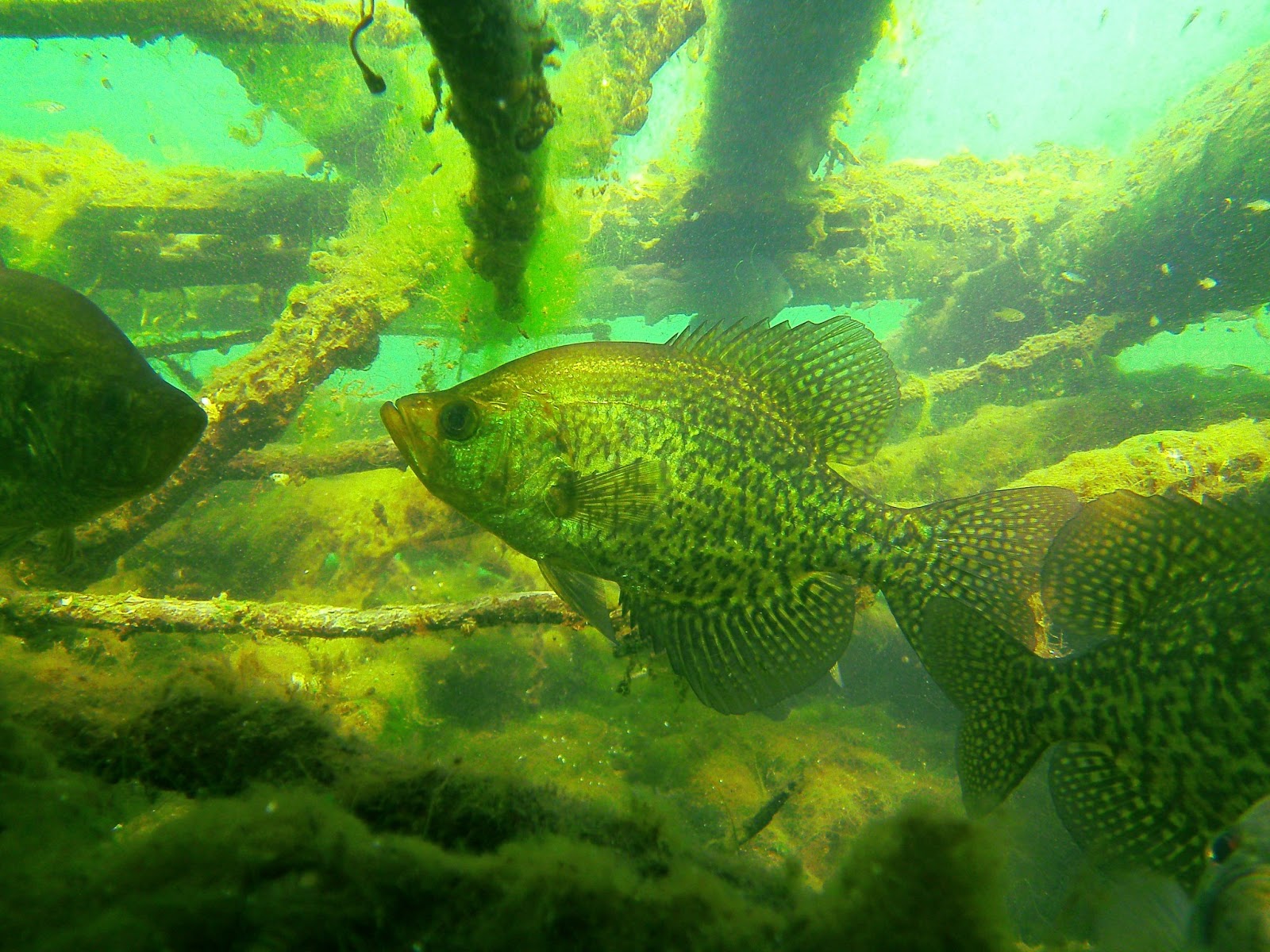
View from Inside a Fish Crib (c)Eric Engbretson

Designs that Don’t Work from Day One

Cribs that incorporate Christmas trees work adequately but for a very short time. Christmas trees deteriorate so quickly that in just a year or two, they no longer provide the complex cover that fish desire. In addition, fish will ignore cribs that are too small, too short, or too simple in design.

Examples of poor designs are cribs made of wooden pallets that rest only a couple of feet off the bottom, or cribs with huge spaces between pallets and no interior brush. Star-shaped cribs that resemble the obstacles used on the beaches of Normandy in World War II may look fascinating, but they lack the complexity, shade, and cover to attract fish well. This list is scarcely exhaustive: There are many other design flaws in cribs that don’t attract fish.

Location:

Depth

When it comes to location, success depends largely on depth. When cribs are placed shallow enough to let sunlight reach them, they grow algae and other organic material. This serves as a food source for juvenile fish and also makes the cribs fuller and denser. When cribs are placed closer to the littoral zone, they’re much more accessible to the newly hatched fry that will quickly colonize them and provide the food that attracts larger fish.
 
When I’m scuba diving, I see fish cribs in deep water go largely unused most of the year. The water is colder here and may lack adequate oxygen. In general, these cribs receive visits by fish in fall and winter. On the other hand, fish in shallower water will use a crib virtually year-round. Some of the best fish cribs I’ve seen were ones that weren’t properly weighted. When the ice melted, they floated toward shore and ran aground. When allowed to remain in place, these cribs were quickly covered by algae and were populated immediately by juvenile fish and newly hatched fry. Despite their extremely shallow location, they attracted game fish year after year and even served some fish as a structure for spawning.

The Substrate

Cribs should always be placed on a hard bottom or substrate. If placed on a lake bottom with 12 inches of muck, let’s say, the crib will sink into the muck and you’ll effectively lose a foot of height. Since height is vital to fish, you don’t want to lose it. A muck bottom also eliminates the basement floor.

The Basement Level

Another reason a hard bottom matters is that you want about a foot of clearance between the lake bottom and the base of the crib. If fish can swim underneath your crib in this basement level, you’ve really got something to brag about. Walleyes and bass, by the way, are two species especially drawn to cribs that let them swim underneath.

Plants

If the crib rests in shallow water where plants can grow, it’s often possible to extend the life of the crib almost indefinitely. As multitudes of fish congregate around the crib season after season, their feces can accelerate a lush growth of plants. This patch of vegetation is denser than the surrounding area and creates desirable habitat all by itself. In time, after the interior brush decomposes, it’s possible that tall aquatic plants will replace it, a process that prolongs the lifespan and effectiveness of the crib. If the crib sits in water that’s too deep for plants to grow, none of this growth will take place.

Multiple Cribs in One Location

Cribs located close to each other always outperform single units. Fish will often travel back and forth in a cluster of cribs. Even if they are built alike and placed at the very same depth, they form individual identities, and multiple cribs will be used by different species in various ways. For example, one crib may attract many more rock bass than another that is just a few feet away and populated mainly by sunfish. The differences in the cribs are largely indiscernible to our eyes, but the fish notice subtle distinctions that drive their preferences. The rule, then, is simple: Multiple cribs offer multiple choices and greater numbers of fish.

Regulations

The regulations on the placement of fish cribs are mandated by Natural Resources Departments in many states and other jurisdictions. In my state, Wisconsin, permits for fish crib construction and placement explicitly instruct builders to place them with at least five feet of water over the top of the structure. Since the cribs themselves are typically four or five feet high, the minimum depth for placement is nine or ten feet. The concern here is understandable. Cribs can create hazards for boaters, who may be unaware of their locations. However, if I were placing cribs on my own private lake, free from regulations, I would place them shallow enough so that only two or three feet of water covered the top. This way, I might be able to replenish them with new brush from time to time as the older material disintegrated. This would greatly extend their natural lifespan.

The Future of Artificial Fish Shelters

In recent years, fish-crib makers have gotten very creative and used a variety of materials. Most popular of the new wave of materials are things normally destined for the junk pile or landfill. Today it’s not unusual to see fish cribs made of stacked wooden pallets, plastic, or PVC. They feature clever designs, and I’ve seen some of them underwater in lakes that I frequent. But the truth is that they don’t seem to fare well. While they may be lighter, easier, and cheaper to make, their main drawback is that they lack the size and complexity to prove attractive to fish. The best ones take up the most space and most effectively mimic trees, sunken timber, and other natural elements.

When artificial cribs made of PVC pipe first appeared, it was widely believed that they would be less effective because fish would refuse to be silhouetted against a white background.  Although I also originally believed this, I've reversed my position.  What we've discovered in further studying this is that color doesn't seem to be the significant factor we once thought it was.  In fact, there's evidence that suggests that PVC pipe color plays no role in fish preference whatsoever.  Instead, the combination of vertical height and complexity determine whether any structure, natural or artificial, will be attractive to fish.
 

An example of a poorly constructed fish attractant.  Notice the lack of complexity and the large open spaces that provide shade, but nothing in the way of cover. @Eric Engbretson Photo


Fish Cribs as Fish Habitat

Let’s get one thing straight. Fish cribs are definitely not fish habitat. They’re artificial constructions designed to concentrate unusually large numbers of fish in a very small area so fishermen can catch them. Fish cribs do not normally provide the elements fish need for spawning or nesting. At their best, fish cribs merely impersonate fish habitat. In fact, in lakes with an abundance of excellent fish habitat, even the best- made and best-placed cribs will go ignored by fish in favor of superior natural structure. In sum, fish cribs work best in lakes where there is little or no natural structure for fish to use.

Traits of Effective Cribs

·They reside in relatively shallow water (10 to 15 feet)

·They receive ample sunlight and they support algae and other organic growth

·They are in water that is shallow enough to let submergent plants grow nearby

·They sit on a hard bottom

·They are at least four feet high

·They have a space at the base that lets fish swim under the crib

·They are thickly packed in the center with various sizes of brush and branches

·They have long and complex branches on all faces extending away from the crib

·They have a complex design

·They are placed together with other cribs

·They are in lakes that contain little or no natural structure

Traits of Ineffective Cribs

·They sit in water that’s too deep (or too shallow if the water’s too warm for fish)

·They sit too deep to receive ample sunlight and support organic growth

·They are in water too deep for plants to grow nearby

·They sit on a mucky bottom

·They are less than four feet high

·They have no space at the base where fish can swim under the crib

·They contain Christmas trees or have little or no brush packed into their center

·They have a design of limited complexity

·They are placed alone

·They are in lakes with abundant natural habitat and structure

Conclusion

As with any set of guidelines and suggestions, there are always exceptions. My observations and conclusions come from years of scuba diving in the northern lakes of the upper Midwest. While complexity of design is universally important, in other parts of the country, many of my suggestions on placement may ignore local conditions and require adaptation. For example, in large southern reservoirs, water temperatures can soar into the 80s and force fish to spawn and live in far deeper water, where lower and more comfortable temperatures prevail. In very clear lakes, sunlight may penetrate 30 feet or more, and plants can grow at greater depths than in other locales. In lakes like these, specific local conditions must be taken into account. Because of such variables, it’s important to have a good understanding of your lake’s ecology and other characteristics. Understanding the specific dynamics of any given lake will help immeasurably when you decide on the best locations for a crib.