Engbretson Underwater Photography

Search The Fish Photos


News From Behind the Scenes at Engbretson Underwater Photo and Stories about the Freshwater Environments We Visit.


Showing posts with label Engbretson Underwater Photography. Show all posts

Tuesday, November 23, 2021

2022 Underwater Fish Calendar from Engbretson Underwater Photography

Looking for a cool wall calendar for 2022?  Check out the 2022 Fishing Calendar from the Koozie Group featuring 13 underwater images from the Engbretson Underwater Photography team. Bass, salmon, walleye, trout, panfish, and others are all represented in vibrant color expertly photographed underwater in their natural habitats. 

Click here to order from Amazon.com  Only $7.98!

Engbretson Underwater Fishing Calendar Cover

Interior of Engbretson Underwater Fishing Calendar
2022 Engbretson Underwater Fishing Calendar Images

Saturday, November 20, 2021

Underwater Photography of Reptiles and Amphibians

At Engbretson Underwater Photography we're best known for our exceptional underwater images of freshwater fishes of North America. But because our photographers spend so much time under the surface of lakes and rivers, they also often observe and photograph a variety of aquatic non-fish species. Over the years, we've accumulated many underwater images of turtles, snakes, and salamanders. We've added them to our online galleries because they represent a segment of the underwater ecosystem that helps make these freshwater environments both interesting and diverse.  

Today we've added some new Eastern Hellbender Salamander images from our ace photographer Isaac Szabo.  Because Eastern Hellbenders are largely reclusive creatures whose range is shrinking, they're not easy to locate and photograph. Isaac's done a great job of traveling to remote areas in North Carolina and other places where they can still be found in significant numbers. His hellbender images are striking.  

To view all of Isaac's underwater material, see our Isaac Szabo Gallery here, or visit our gallery solely devoted to underwater images of reptiles and amphibians

Thursday, September 30, 2021

Noted Conservation Photographer Joins Our Team


One of the best parts of operating a stock photo agency is acquiring exciting, new photographers to represent. Our newest contributor is Fernando Lessa, one of the country's most talented Salmon photographers.  Fernando's amazing images of salmon, taken underwater in the iconic streams of the American Pacific Northwest and Canada are among the most stunning ever made. 

Based in Vancouver, British Columbia, Lessa has both a biology degree and a master’s degree in photography and specializes in documenting the relationship between humans and mother nature.  He's spent a great deal of time in the field, having worked on projects in a wide variety of areas, including the untouched Amazon Rainforest of Brazil, the unique Brazilian Savannah, and the Pacific Northwest.  He's a book author, filmmaker, and superb underwater photographer. 

Fernando joins Patrick Clayton, Jennifer Idol, Sean Landsman, Victor Vrbovsky, Garold Sneegas, Bryce Gibson, Todd Pearsons, Christopher Morey, Isaac Szabo, Paul Vecsei, and Roger Peterson on our "dream team" of the USA's best freshwater fish photographers.  His work can be licensed for commercial and editorial purposes by contacting us here at Engbretson Underwater Photography. To view more of Fernando's work, check out our Fernando Lessa Gallery here.

Wednesday, May 19, 2021

The Pros and Cons of Early Season Scuba Diving


The 2021 season is underway. Water temperatures finally broke the 60-degree mark here in northern Wisconsin, which moved fish out of deep water and into the shallows for spawning.  At this time of year, I don't see many panfish, but the muskies are in the littoral zone completing their spawning rituals. I'm focusing on them now and getting some excellent pictures of post-spawn fish. In the next few weeks, I'll be switching my attention to the bass and crappie that will be spawning next and providing some excellent photo opportunities. Bluegills and pumpkinseed will be the last to spawn, with many bluegills still on nests well into July.

At this time of year, water clarity varies widely. Some lakes have excellent clarity very early in the year that degrades very quickly and never clears up. Other lakes are murky in spring and gradually clear up by mid-summer. Quickly rising temperatures also cause the water to stratify. A barrier can be formed that's difficult to see through. As long as you're looking straight ahead in a horizontal column of water that's the same temperature, you can see well. However, if you look up or down, even a few feet, you won't be able to see far because of this thermal barrier. This can make finding fish difficult. Once the water temperature warms enough, this layer will fall dramatically and form the thermocline, which is typically 20-30 feet deep.

One of the best things about diving Wisconsin's lakes in May is that boat traffic is still very limited. Kids are still in school, summer visitors haven't arrived and many cottages have yet to open for the year. This usually means that during the week, I have the lakes all to myself. After Memorial Day, things get busier. The increased boating traffic always drives the fish away from the shallows to deeper stretches where they're not as easy to find and photograph. Right now, even walleyes are in untypically shallow water and I've seen a few of them near shoreline cover in less than 10 feet of water.  

If you've always wanted to see our native fish in their natural habitat, pick up a snorkel and some swim fins and jump into the closest lake near you. You'll be surprised what you can see this time of year. 

Wednesday, April 21, 2021

Making Fish Look Their Very Best


I once read an article about how fashion photographers for Vogue and Cosmo never shoot a super-model from below unless she has a terrific jaw-line.  It occurred to me that fish, with their gills, all have great jaw-lines, so I began getting below eye-level and photographing them from below.  The results were so breathtakingly stunning that I began to try to compose every fish picture this way.  Over time, it's become a distinct hallmark of my work.  I'm convinced that it's the best angle to photograph fish underwater.

I think it's incumbent on all wildlife photographers to portray their subjects with as much style and beauty as possible.  This is easy to do with cuddly puppies and furry baby seals, but with reptiles, amphibians and even fish, we often have to work hard to convey their inherent beauty to our audience. People will always care more about pretty things than ugly ones. That's just human nature. 

As a fish photographer, I feel a responsibility to my subjects to try to portray their magnificence in every picture I make. Because of this, I usually won't shoot fish with split fins, scars, injuries or other physical deficiencies. Instead, I look for fish that are healthy and vibrant. I want the best ambassadors of each species to represent the entire population. If I want viewers to care about fish the way I do, I have to make it as easy as possible for them to appreciate and embrace these finned marvels.

2021 will be the start of my 28th year of photographing native North American freshwater fish underwater in their natural habitat. I can't wait to get back in the water with my super-models!

Monday, January 25, 2021

Why Underwater Photography in Freshwater?


I'm often asked why I'm interested in freshwater fish like bass and walleye.  Well, the freshwater world has never had an ambassador in the same way the oceans had Jacques Cousteau.  Perhaps, all of us who spend time in lakes can collectively be some sort of equivalent to that.

I think there’s always room for more good photographers, and I think interest in freshwater fish will continue.  I’d encourage beginners to learn about their subjects.  Become an expert on the life and behavior of these fish.  Become a steward of their habitat.  Whether it's a musky, a largemouth bass or a bluegill, think of yourself as a PR person for that particular fish.  If you do this, you’ll show them in the best light, you’ll be mindful of disturbing them, and your work will automatically show these creatures at their most magnificent.  Don’t sell pictures or videos.  Instead, fall in love with your subjects and sell that love!  And instead of exploiting them for personal profit, you’ll become partners with them in calling attention to their inherent beauty and value in the ecosystem, and the special problems each one of them face in an increasingly crowded world.

Sunday, December 27, 2020

2021 Fishing Calendar

Looking for a cool wall calendar for 2021?  Check out the 2021 Fishing Calendar from Bic Graphics featuring 13 images all from the Engbretson Underwater Photography team. Bass, salmon, musky, trout, and panfish are all represented in vibrant color expertly photographed underwater in their natural habitats. Click here to order from Amazon.com


Monday, November 30, 2020

How to Use GoPros to get Great Underwater Fish Videos

Whether you're scuba diving or just snorkeling, shooting nice underwater footage of fish from a nearby lake has never been easier. Here's a few answers to questions I'm often asked by beginners:

Where can I go?
No matter where you live, there's probably a pond, lake or river nearby teeming with fish and other interesting underwater subjects. It's important to find the clearest body of water you can, since clarity is critical to underwater videography. Contact your state's fish and wildlife office. They're very familiar with the characteristics of local lakes and can point you in the right direction.

Which GoPro should I use?
Gopro seems to come out with a new camera every year.  Their latest, the Hero 9 is their best by far. Waterproof to 33 feet without a supplemental housing, it's video and stabilization capabilities are superb. If you can't afford the newest GoPro, the Hero 8 and Hero 7 are also good choices. I wouldn't suggest using anything older than the Hero 6. The earlier models (1 thru 5) just don't work as well.

Do I need to use a filter?
If you use strobes as I do, you won't need filters to correct for losses in the light spectrum which filters are designed to compensate for. The term "strobe" is a bit of a misnomer. Basically any powerful waterproof flashlight will work as well. If you use strobe lights, you'll also need a handle and tray that you can attach your camera and lights to. This keeps everything together and is easy to hold and swim with.  Strobe lighting is wonderful because it brings out colors and fills in dark shadows. 

How do I get close to the fish?
The best way is to let them come to you. If you remain relatively still and non threatening, fish will usually come right to you which makes your video of them much more interesting that than the "tail shots" you'll always get if you chase them.  Fish are naturally curious and if you're patient, you'll find that they'll swim directly into your lens on their own.

I don't want to get wet. Can't I just mount my GoPro on a pole and shoot video that way?
You can try, but you'll be frustrated. Using a pole cam seems like a good idea, because you won't have to get your head underwater. But because you're not able to see through the viewfinder, you'll never be sure your videos are being framed correctly. I've shot many videos using pole cams trying carefully to aim the camera at the fish. Many times I've been disappointed because I've guessed wrong and the fish was barely in frame. When you're underwater, the aiming is precise every time. Also, being underwater with the fish is half the fun!  

If you have any questions about using GoPros to film fish, please let me know. I'm happy to share what I've learned over the years. Filming fish underwater has never been easier, and most anyone can get great underwater video with a little patience. If you try it, let me know how it goes for you.
 
To see more of my underwater fish videos, visit my YouTube Channel.

Thursday, October 29, 2020

Photographing Native Fish in Freshwater Lakes: Overcoming the Obstacles

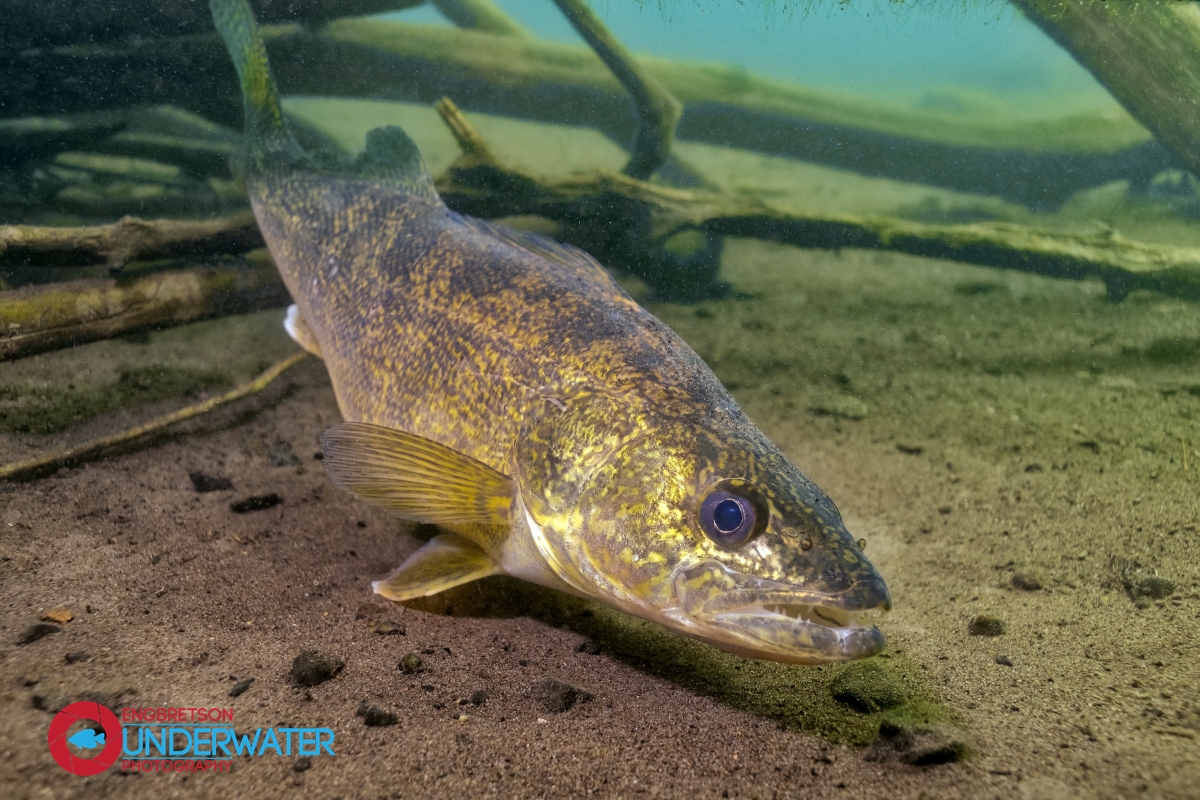
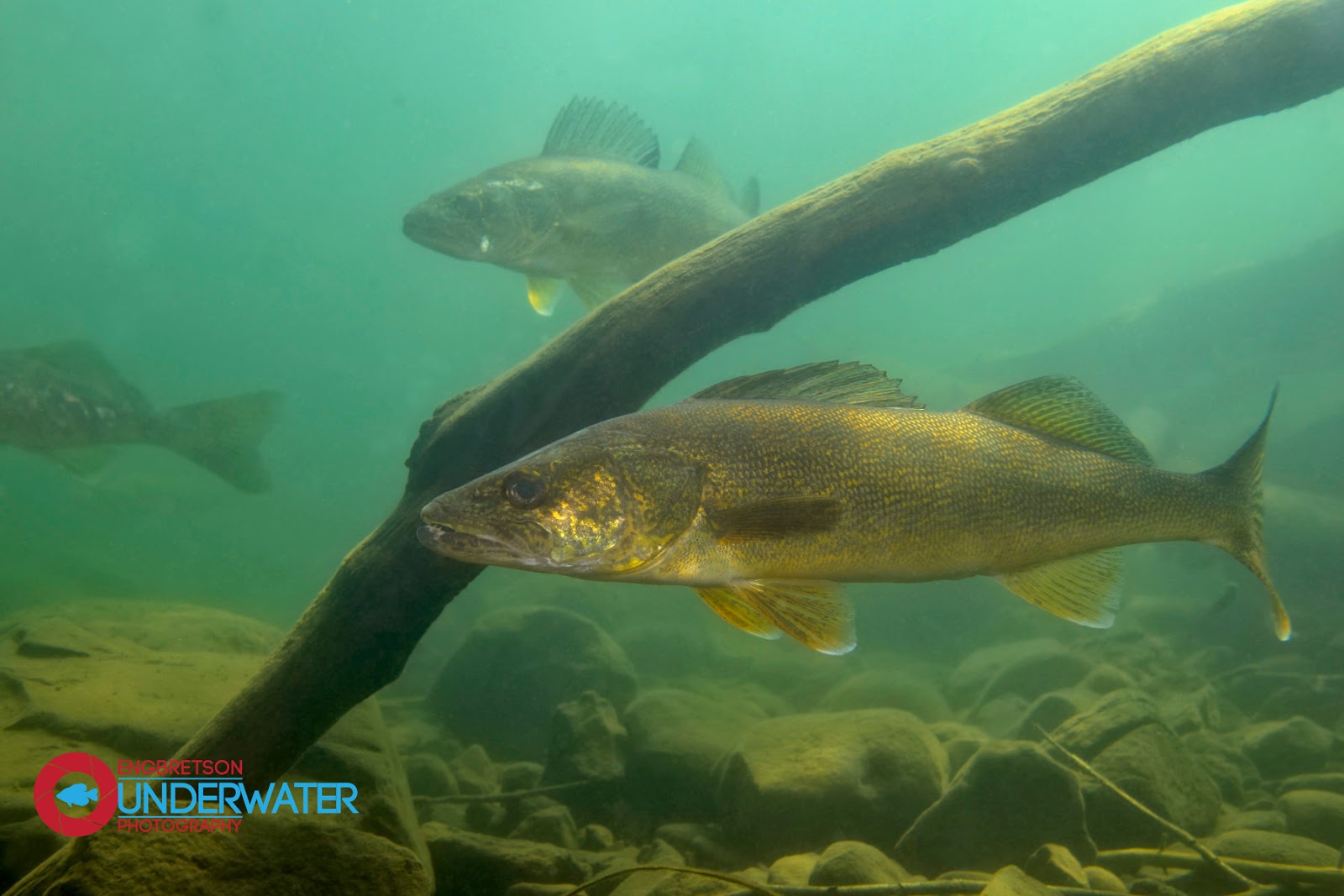
Walleye Underwater

I'm often asked what the biggest challenge is to taking underwater fish pictures.  Well, there are quite a few obstacles and many things that have to be right to be able to get a good picture.  First, the water has to be clear, which is actually a greater challenge than you might think.  Freshwater lakes are typically pretty crummy so finding lakes that have the necessary clarity is an ongoing process.  I usually won't even look at a lake if the clarity isn't at least 18 feet.  Water clarity can change from week to week and season to season too, so even though I have my favorite lakes, they’re not always clear enough to work in.  Everything starts with water clarity and if you don’t have that, nothing else matters.  It’s always a challenge to find clear water.

Once I find a clear lake, I have to find fish.  Next I have to find fish of desirable size.  This is easier said than done too.  It's always a problem especially these days when it seems like there’s fewer and fewer really nice fish available.  If I do find a lake that’s clear and it does have a few good fish, another challenge is getting close enough to photograph them.  I like to be 2 or 3 feet away.  Any further and I won’t take a picture at all.  Fish often times have a problem with a diver being that close, so it takes a lot of patience to even get close enough to think about composing a picture.  But once I have clear water, good fish, and get close enough to shoot them, I still have to make the shot.  So even if everything else is right, sometimes I blow it all on the final step because I was moving, or the composition is bad or I forgot to turn on the strobe, etc.….

A lot goes wrong.  Sometimes I feel like it’s truly a miracle to get any good pictures at all because so many things that I can’t control have to be right all at the same time.

Conditions underwater are typically very hostile to a photographer.  The lakes and rivers where I shoot can be very cold.  In rivers, currents can be strong, and visibility is always an issue.  Underwater photography is inherently tricky.  Water is 800 times thicker than air, and there's always particles floating around or algae and things like that, so you've never going to get the really "clean" look you can get shooting through air. The water is often cold, the fish can be elusive, and you've got to always be concerned about your air supply, so there's a lot to think about. The light underwater is very poor too, so often I have to carry underwater strobes to illuminate subjects in deeper water. If you can imagine taking photos on a dark, cold, foggy, windy day… that sort of comes close to the everyday conditions of the environment I work in.  Saltwater environments are infinitely easier.  The water’s 100 times clearer, there’s 100 times more light, and ocean fish are used to seeing very large things swimming around them.  In freshwater, you look like Godzilla to those poor fish.

So, yes-the challenges are many, but as I always say, "If it was easy, everyone would be doing this".

Sunday, August 23, 2020

Summer Largemouth Bass-Where to Find Them

Largemouth Bass in Milfoil

It's late summer and we're getting some really attractive Largemouth Bass images showing these fish using thick weed cover and a variety of other natural habitat elements.  

At this time of year, we face several obstacles when photographing bass. They tend to be harder to find because they're occupying all areas of the water column and tend to be widely dispersed. Water clarity diminishes this time of year as well, making normally suitable lakes too murky or "green" for good photography.  Finally, there's a seasonal shift in attitude of these fish by August.  Bass that were very approachable in the spring have become more wary and timid by late summer, so getting closeups of them becomes more difficult.  

Despite all those challenges, we're still able to get some fine images of them in their natural habitat.  Check out all our latest Largemouth Bass in our Largemouth Bass Gallery.

Thursday, July 30, 2020

There's a Poisonous Spider in Your Wetsuit!

It was a normal day much like any other. I drove from my home in northern Wisconsin to a nearby lake in Michigan’s Upper Peninsula to take underwater pictures of largemouth bass.  The water was clear, the fish eagerly posed for my cameras and another successful dive trip was in the books. While changing out of my wetsuit I noticed what I thought at the time was a mosquito bite on the calf of my leg. I work in lakes and rivers every day, so dealing with insect bites are routine. I didn’t think anything of it. The next morning, the bite seemed to look a little odd and I took this picture of it.


By the end of the day, it was clear that the bite was infected and looking worse. The doctor I saw that evening told me it was likely a non-venomous spider bite. She prescribed a dose of antibiotics, bandaged it and sent me on my way. Three days later, I was in the emergency room. My entire leg was severely swollen and had turned bright red. The area around the bite was badly infected and turning black. ER doctors peppered me with questions and determined that the bite had come from a Brown Recluse Spider, one of three venomous spiders we have in the USA.

The bite of brown recluse spiders contain a potentially deadly hemotoxic venom.  These toxins destroy red blood cells, disrupt blood clotting and cause tissue damage.  We’ve all heard terrifying stories of what can happen to people who are bitten by brown recluse spiders. The worst cases, the ones that get all the press, are indeed horrifying.
 

In the ER, I was immediately placed on a powerful antibiotic IV drip. The prescription antibiotics I had been taking are ineffective against venomous spider bites. They were replaced by a much stronger type. I was also prescribed another drug that is typically used to treat leprosy, to help prevent possible tissue loss.  

The doctor who examined me speculated that my wetsuit had caused compression on my leg that may have exasperated the effects of the bite and the amount of venom the spider had injected.  Did the spider somehow get into my wetsuit while I was at the lake, or did it crawl inside the suit while it hung in its regular place in my basement laundry room?  Who knows? 

It’s been four weeks and my wound is barely noticeable now. I consider myself lucky that I won’t have a permanent scoop mark or divot in my leg. Scuba diving has inherent risks and dangers, but until now, I never thought those risks also included poisonous spider bites. 

From now on, I’ll be diligent where I store my wetsuit between dives. More importantly, I think it’s critical to carefully check your wetsuit, dive boots, gloves, and all your dive equipment before every use. They all provide the kind of dark and secluded hiding places spiders like to inhabit, especially if they’re routinely stored in your basement or garage.        

Friday, December 27, 2019

Best Fish Photographers to Follow on Instagram

If you're like me and enjoy seeing the work of some of the world's best underwater fish photographers, here are five Instagram accounts you need to follow in 2020.  All five of these photographers work in freshwater environments and their talent is truly exceptional. They continually awe and inspire me and just seeing their pictures make me want to grab my mask and wet-suit and head to the nearest lake. I think you'll agree that their work is simply breathtaking.  While freshwater underwater photographers never get the recognition that marine photographers get, I hope you'll support these brilliant individuals by following them on Instagram.

  • Dr. Paul Vecsei has a M.Sc. in ichthyology and a Ph.D. in fisheries and his underwater photos of cold water fish are exceptional. His pictures of Lake Whitefish, lake trout and cisco are without a doubt the finest images ever made of these species in their natural habitat.
  • Isaac Szabo is a very talented and patient shooter who beautifully photographs native fish and other aquatic life of the Ozarks region and the springs of Florida.
  • Jennifer Idol is the first woman to dive all 50 states and is the author of An American Immersion. As an underwater conservation photographer, her pictures and articles are widely published.
  • Dr. Sean Landsman, PhD is a professional fisheries scientist who has beautifully captured many difficult-to-photograph coastal species like American Eel, Alewife, Eastern Brook Trout and Rainbow Smelt.
  • Patrick Clayton is the USA's premier photographer of wild trout from the streams of the American West.
  • Finally, here’s my own Instagram account.  Evidence that I can occasionally take a picture that's actually in focus.

Saturday, September 28, 2019

Working with Fish Models: The Best Angle To Photograph Fish


Recently, a friend of mine commented on my photography: "I can always spot your fish images when I see them in magazines...", he said. "It's because you always show the fish from below".  I haven't thought about that for a long time, but he's right.  

When I first began taking portraits of fish underwater, I was almost always hovering above the fish looking down on them.  It was just more convenient for me to shoot pictures that way.  The images were Ok, but this angle tended to give them a flat and uninteresting look. It also made them somehow insignificant or easily dismissible. Every beginners book on photography points out that pets and children will always look awful when photographed from above and that you should try to shoot them at eye-level.  I began trying this underwater with fish and noticed the immediate improvement in my images.  

Later, I was reading about Vogue and Cosmo photographers and how the pros never shoot a super-model from below unless she has a terrific jaw-line.  It occurred to me that fish, with their gills, all had great jaw-lines, so I began getting below eye-level and photographing them from below.  The results were so breathtakingly stunning that I began to try to compose every fish picture this way.  Over time, it's become a distinct hallmark of my work.  I'm convinced that it's the best angle to photograph fish underwater.

I think it's incumbent on all wildlife photographers to portray their subjects with as much style and beauty as possible.  This is easy to do with cuddly puppies and furry baby seals, but with reptiles, amphibians and even fish, we often have to work hard to convey their inherent beauty to our audience. People will always care more about pretty things than ugly ones. That's just human nature. 

As a fish photographer, I feel a responsibility to my subjects to try to portray their magnificence in every picture I make. Because of this, I usually won't shoot fish with split fins, scars, injuries or other physical deficiencies. Instead I look for fish that are healthy and vibrant. I want the best ambassadors of each species to represent the entire population. If I want viewers to care about fish the way I do, I have to make it as easy as possible for them to appreciate and embrace these finned marvels.

Saturday, August 24, 2019

Where to Find Walleyes-Secret Locations That Are Often Overlooked

Often times when I'm coming off the lake and loading my scuba diving equipment and cameras into the car, fisherman will approach me at the boat landings to ask "Did you see any fish?"  Or, "Where are all the big ones?"  Since I'm actually under the water swimming with the fish, I do notice some things that escape most fisherman.  So in answer to the question, "Where are the fish?" I've compiled a list of the five most surprising areas where I regularly encounter walleyes that few fisherman pay any attention to. How many of these locations do you completely ignore when targeting walleyes?

1) Shallow Water. Since I'm trying to photograph fish, I tend to concentrate on areas where the light is the best.  This often means depths of 12 feet or less.  This shallow water is where I take 90% of my walleye pictures.  It's surprising how many fish can be found close to shore in water that's barely over your head.  If there are large submerged trees close to shore, I almost always find walleyes there.  Most walleye fisherman ignore shallow water, but I can tell you that the fish are there.

2) Under boat docks.  Not all boat docks have walleyes under them, but the ones that share certain characteristics will hold walleyes most of the year.  Nobody seems to fish for walleyes around shallow boat docks, but if you can find ones that have a hard or gravel substrate, extensive areas of shade, and deep water nearby, you'll find walleyes there.

3) Eurasian Watermilfoil.  This invasive plant is almost universally regarded as bad, but fish love milfoil.  If I'm on a lake where EWM is present, I head right for it. It's a fish magnet for all species including walleye.  Sometimes I'll find walleye cruising along the deep edge of milfoil colonies, but usually they're buried inside the thickest and most dense parts of milfoil beds.  It's hard to photograph walleyes in cover this thick and just as difficult to fish for them in these areas, but they're always there.

4) Fish Cribs.  Everyone knows that there are fish around fish cribs, but they aren't as famously known to be places to find walleyes.  The walleyes I see around cribs fall into two categories. Inactive fish are typically underneath the cribs, or buried deep inside them in thick brush.  Active fish cruise cribs in a radius that can extend up to 20 feet.  While it's easy for me to photograph them here, catching them here is harder because there's often an abundance of bass or panfish around that are higher in the water column that will strike the baits or lures before the walleyes get a chance to.  In the presence of other fish, walleyes are timid and won't fight a rock bass or smallmouth to get to a bait first.

5) Sunny days.  The last location where I always find walleyes isn't a location at all, but a condition.  Walleyes have a reputation for avoiding bright sunshine, or going deep on sunny days.  When I'm photographing fish, I relish bright sunny days with calm surface conditions and I'm usually in the water around high noon when the light penetration into the water is the best.  You might think these would be terrible conditions for walleye fishing, but I can tell you I encounter plenty of large walleyes actively feeding during these times... often in shallower water.  If you're a walleye fisherman and as a rule, avoid fishing during the midday hours or on bright sunny days, you're missing out on good opportunities to encounter fish.

For over twenty years I've been photographing walleyes underwater and those are some of my go-to places.  They're certainly overlooked locations and might even seem counter intuitive to most walleye fisherman, but I wouldn't be wasting my own time with them if they weren't highly productive.

(To view our walleye image gallery, click here.)
(For more on walleye behavior click here.)

Friday, July 26, 2019

Largemouth Bass Underwater in HD

We're getting some really nice Largemouth Bass images this summer showing these fish using thick weed cover, sunken timber and other natural habitat elements.  Check out all our latest Largemouth Bass in our Largemouth Bass Gallery. We're also getting some very nice HD video of these fish and we have some superb b-roll footage available.  As always we're interested in partnering with producers of outdoors related content who are looking for excellent high-quality underwater footage of freshwater game fish to include in their programs and films. For more information on licensing our video clips for your project contact us.  

Friday, June 28, 2019

The Best Thing About Being An Underwater Photographer


What's it like to be a professional underwater photographer? It’s like every day is Saturday!  

Sometimes in the mornings when I’m driving to a lake I plan to shoot in, I’ll see people on their way to work.  Inside the other cars are guys wearing suits and ties holding cellphones in one hand and spilling coffee from the other.  Often they have scowls on their faces.  The stress and despair is evident in their zombie-like gazes and they haven’t even arrived at the office yet.  Meanwhile, I’m in shorts and sandals and heading to my office: the lake bottom.  I never forget that I was just like them not too long ago, and I feel so grateful and appreciative of the life I have now. I’m really lucky to love what I do, and do what I love.  I wouldn’t trade places with anybody.  

The early days were tough. I began taking pictures professionally in 1993.  I was disillusioned with my previous occupation (radio broadcasting) and was looking for some kind of business where I could set my own hours and be my own boss.  I had no training or education in photography whatsoever and knew nothing about the business aspects of shooting, selling and marketing stock images.  But I had a passion for my subject matter that made up for my lack of experience and knowledge. I loved fish, and I just wanted to show people images of common freshwater fish that perhaps they’d never seen before.  Seeing underwater Images of freshwater fish in their natural habitat were almost as rare then as they continue to be today.  I was motivated by three things:  1) I wanted to create a self-sustaining income that would replace my regular 9-5 hamster wheel job, 2) I knew it had to something that I enjoyed, had fun with, and would never regard as work, and 3) I wanted to generate in others the same kind of awe and appreciation I had for fish, and I thought that through photos I might be able to do that.     
During those humble early years, it was difficult to even find a mentor. There were many underwater photographers, but none who worked in freshwater with the subjects I was interested in.  One guy who did a little of the kind of photography I wanted to do was Doug Stamm.  He became a role model to me because of the way he was able to sell and market so many of his images to the same venues that I would later work for.  I remember going to the magazine stand and counting the number of covers and inside pictures he was selling in any given month and being astounded.  One of my goals then was to generate an income I could live from, so seeing what Doug was doing gave me hope that it was indeed possible. 

I’ve gotten so much help over the years.  I can’t begin to tell you about all the different individuals who have made it all possible.  From fisheries biologists who share information with me about lakes and fish behavior to lake-front property owners who grant me access to their lakes and suggest specific places to check out. There’s been family members who gave me financial support in the early years that made it possible for me to spend time shooting instead of “working”.  There’s literally been hundreds of people who certainly share a part in my success.  

But not every association was useful. Because of the uniqueness of what I was doing, it was difficult to find a group of people to relate to.  I dive underwater to photograph fish, but I’ve found I have little in common with either photographers or divers.  The photography people just wanted to talk about cameras.  The scuba diving people just wanted to talk about dive computers or dive vacations.  Nobody wanted to talk about fish.  I felt very alone until I began meeting professional fisheries biologists. Those were the friendships that were naturally harmonious. I'd finally found a group of people, who like me, could talk about fish all day long.

I'm often asked what advice I have for aspiring underwater photographers. I think today it's very difficult to make a living in this field. The saltwater environments are really saturated with photographers, many of whom have the world’s best locations in their back yards.  It would be extremely difficult to compete with them.  They actually live in the same places that others spend thousands of dollars and travel thousands of miles to get to.  How can you possibly compete with someone who has access to places like that 51 weeks of the year more than you do?  Freshwater however, is a different situation altogether.  Freshwater material is an area nobody is covering, so there is no competition.  On the down side, the demand for freshwater images isn’t as great either.  I’m hoping to draw more awareness to freshwater environments so that more people will become aware of the importance of these ecosystems.
I think there’s always room for more good photographers, and I think interest in underwater subjects will continue.  I encourage beginners to learn about their subjects.  Become an expert on the life and behavior of your animal subjects.  Become a steward of their habitat.  Think of yourself as a PR person for that particular animal.  If you do this, you’ll show them in the best light, you’ll be mindful of disturbing them, and your work will automatically show these creatures at their most magnificent.  Don’t sell pictures.  Instead, fall in love with your subjects and sell that love!  And instead of exploiting them for personal profit, you’ll become partners with them in calling attention to their inherent beauty and value in the ecosystem, and the special problems each one of them face in an increasingly crowded world.   You know, the freshwater world has never had an ambassador in the same way the oceans had Jacques Cousteau.  Perhaps, all of us who spend time in lakes can collectively be some sort of equivalent to that.  At least that's my dream.
Speaking of dreams-  I often refer to the small group of freshwater photographers that my stock photo agency represents as the “dream team”. I look for people who have a genuine interest in freshwater subjects.  They’re not as glamorous and sexy as whales, dolphins and sharks, so very few people are attracted to them.  I look for people who can competently take a picture and get it technically right.  And I look for people who are going to be shooting freshwater with some regularity and frequency.  Anybody can get a picture here or there, but I want someone who’s going to be generating new material often.  That essentially means someone who's spending a whole lot of time in freshwater.  
I see how miserable many people are at their daily jobs, and I still remember what it was like to live that way.  I’m thankful and appreciative for what I have and the niche I’ve carved out.  I guess my only goals are to be able to get up tomorrow morning and do the same thing all over again.  For people lucky enough to have a career that brings them genuine joy, it’s indescribable.  You’d do it for free because you’re so passionate about it.  It’s like being on vacation every day.  When there’s no distinction between work and play, you know you’re there.  What more could anyone want?

Friday, February 22, 2019

Why Do Smallmouth Bass Catch and Release Crayfish?


The interaction between bass and crayfish is something I've been watching for a very long time and now think I understand. Typically, when people view these kinds of videos, they get the wrong impression of what's going on. Most people believe the crayfish is successfully repelling the attack of the hungry bass simply by its posture and extending the claws out in a menacing fashion. What in fact is happening is the bass is choosing not to eat the crayfish. This decision is arrived at by a single factor that has nothing to do with the defensive posturing of crayfish.

Bass are initially attracted visually to the crayfish, and rush in close. The decision to attack is then based solely on the hardness of the shell or exoskeleton. This most certainly can be determined once the crayfish is in the bass's mouth, causing the bass to immediately spit out the crayfish, if the crayfish is in its "hard shell" state. But it seems that bass can also detect this without first mouthing the crayfish. At first I thought they were doing this by visually inspecting the crayfish, but now I think they must be picking up a scent as well. Crayfish that have recently molted have soft shells and are much sought after by bass. Crayfish can't ward off attacks by sticking their claws out defensively when confronted by a bass. Bass laugh at this pathetic attempt. When they're in this soft shell phase, after a recent molt, no amount of claw wagging, or any other posturing is an effective defense.

When there are competing bass nearby, there's no time to evaluate whether the crayfish is soft or not. The main goal here is just to get to the food before your competitor. So in these cases, bass will more or less attack and "ask questions later". Once they have the prey in their mouths safely secured from other bass, they will release it if it turns out to have a hard shell.

Predation on individual crayfish seems to be solely determined by the current state of hardness of the crayfish exoskeleton.

Friday, December 21, 2018

Sixty Seconds Underwater

Today, I started a new video series on my YouTube Channel called "Sixty Seconds Underwater". In each episode, I'll feature a specific fish and present sixty seconds of stunning underwater footage of that species in it's natural habitat. In the premiere episode, I spotlight Black Crappie.  In future episodes, I'll cover bass, walleye, musky and many other freshwater fish.  Join me in going beneath the surface of crystal clear lakes and rivers and seeing fish close-up in their own environments.


Wednesday, November 28, 2018

Special Underwater Friendships


Steve, the Smallmouth Bass. His image has appeared dozens of times over the years in many magazines. He's likely the single most famous fish in Wisconsin.
Occasionally I’m interviewed about my underwater photography and experiences I’ve had photographing fish in freshwater environments. In today’s post, I’d like to share a portion of a recent interview I did that I think you’ll enjoy.
Question: When did you first start interacting with fresh water fishes and why? What drew you to them?
Answer: I’ve told this story many times.  I’ve loved fish for as long as I can remember.  Growing up, my father had many aquariums in the house.  As a child, I remember staring into them for hours watching the tropical fish and imagining what it would be like to be in the tanks with them. Later, I became an avid fisherman-and what fisherman doesn't wonder what it all "looks like down there".  In 1990 I moved to a home on a small lake in northern Wisconsin.  Then, a few years later came the day that changed my life.  One sunny August afternoon, I was just sitting on the deck looking at the lake.  For some reason, I noticed how clear the water was. Whether it was an epiphany sparked by the natural surroundings or a simple act of fate, I impulsively drove to a local chain store and bought a cheap swim mask, snorkel and fins. The mask leaked and the fins were too small. It was a disaster.  But once in the water I couldn’t believe the clarity and the beauty. The underwater world was radiant.  The play of light on rocks, emerald plants, sunken trees, and glowing green algae. It was an astounding realm of pure silence and unsurpassed visual delight.  And then there were the fish.  So many of them!  I was finally inside that aquarium I had fantasized about as a child.  I saw more fish that first day than I had seen all year as a fisherman.  But for the first time I saw them differently.  I saw them in their realm, relaxed and peaceful.  At home.
The mask and snorkel became my passport into a whole new world I never imagined.  It wasn’t long before my fishing rods were banished to a dusty corner in the garage and instead of looking at the new lures at the sporting goods store, I was looking at the snorkels, the wetsuits and the fins.  These were the accoutrements I was interested in now.  These were the tools that would best serve me in exploring this new world.  These were the instruments that would enable me to commune with fish in a way that I previously could scarcely imagine.  I began visiting other lakes and for me, every day became another “moon landing”-Another trip to the top of Mount Everest. Every trip under the surface was filled with awe, wonder and discovery.  I wanted to share with others the amazing things I was seeing.  In the following weeks a whole new purpose revealed itself to me and I started taking pictures.  I began to devote myself to documenting fish in their natural environment.  I wanted to show others the inherent natural beauty of these fish and the uniqueness of the freshwater environments they live in. 
Question: Can you recall or describe any very special encounters you've had?
Answer: Impossible question for me to answer.  There’s been so many.  They’ve become almost routine.  But here’s one that happened last summer that comes to mind, because it was a new one for me. There’s a lake I go to often where there’s a bass that I know and have been working with for about five years.  I call him Steve.  Every time I go to this lake it doesn’t take him long to find me.  I think he must hear my bubbles from the scuba gear.  I don’t know how far away he can hear me or how far he swims to reach me.  Sometimes it only takes him 10 minutes…. Other times it’s an hour.  Once Steve finds me, he stays with me for however long I’m in the lake, follows me everywhere, poses for pictures, and we’ve had lots of adventures together. 
So anyway, one day last summer, I went to Steve’s lake.  I looked for him as I always do, but he wasn’t around.  I was carrying two cameras that day.  My main camera for taking still photographs, and a GoPro mounted on a rack with strobes.  While it’s no problem to swim around with two camera outfits, once you start shooting, you need both your hands so you need to set one of the cameras down.  I left my main camera on the bottom in a clear spot.  You always try to leave it where it’s completely obvious.  It’s easy to lose your bearings underwater and find the exact spot you were at before, so you want to make it easily visible so you can find it again when you return.  So I leave my main camera out in plain sight on the lake floor and move down the shoreline about 200 yards to another place where I’m filming video with my GoPro.  I’m starting to get a little bummed out now because it’s been more than an hour and I haven’t yet seen Steve.  I always worry that a fisherman will catch him one of these days and… well… You get the idea. (Sigh)
So after more than an hour, I decide I’m done filming with the GoPro and now I want to take stills with my other camera.  I swim back to the place I’ve left it.  When I arrive at the spot, I see my camera just as I left it and hovering quietly next to it is Steve. 
It was a magical moment because while I know Steve recognizes me, it showed me that he also knows my camera.  After years of posing in front of it, he came to know it, with its dome port and all its knobs and buttons.  He was probably swimming by and saw it on the lake floor and recognized it.  While he didn’t know where I was, I think he knew that I set it down and that if he waited with it I would return for it.  After all, he’s witnessed me do that very thing many times.   This was an astonishing event.  I hope anyone who hears this story is amazed.  If they’re not, I need to do a better job at explaining how utterly amazing a feat this was.  It was absolutely one of the most incredible, and revealing demonstrations of fish intelligence I’ve ever seen.

Friday, September 21, 2018

Black Bullhead Tornado-Underwater Video


After the eggs hatch, thousands of black bullhead are guarded diligently by the male parent. Predation reduces their numbers, and by fall only a handful remain. No longer under the protection of their parents, survivors from multiple nests begin to reform in large schools in shallow water, as a new year class of fish is created.  At first the schools can be small, consisting only of the survivors from any given nest. But eventually, by early fall, each nest has merged with others creating giants schools that can number in the thousands.

In this unique, HD underwater video, you'll go below the surface to see black bullhead fry navigate the underwater landscape in their first year of life.