Engbretson Underwater Photography

Search The Fish Photos


News From Behind the Scenes at Engbretson Underwater Photo and Stories about the Freshwater Environments We Visit.


Showing posts with label bass. Show all posts

Saturday, June 20, 2020

What's the Easiest Fish to Photograph Underwater?

Smallmouth Bass Underwater (c)Eric Engbretson

I received an email the other day from someone who asked me what I thought was the easiest fish to photograph. Well, none of them are that easy to photograph well, but if I had to pick one that gave me the least trouble, it would be smallmouth bass. The reason for that is they have a unique inherent curiosity and sociable nature. They’re not by nature a timid fish so they'll eagerly come around you. I think they've learned that divers stir up food items. They’ve kind of put that together. So when you get in the water, you’ll get them following you around after a while. It’s not unusual at the end of a dive to have 15 or 20 smallmouth bass in a parade, following you. 

If a smaller one comes too close to you the larger ones will chase them away so they can have exclusive access. Because they are so friendly and easy to approach, you can blow all the bubbles you want to or spend crazy amounts of time fooling around with different camera adjustments or lighting angles without worrying about them being scared off.  

They're an excellent fish to spend time with if you're a novice photographer, because they have loads of patience. But after decades of underwater photography, I wouldn't say photographing them is especially challenging. At the end of a dive, if I can’t find anything else, that’s when I do the smallmouth pictures.

So, what's the most difficult fish to photograph? I think it's the carp. They are so aware. They have excellent vision and hearing. They can see you so far away in clear water and if you make any slight noise, they're gone. Even if you don’t blow a bubble but you take a breath, it makes a tiny whooshing noise. It’s such a tiny sound, but they hear that and they react. You have to be so still and so quiet. 

What I do with carp is I pick a spot where I know they’re milling about and I get behind a rock and hide and hopefully one will cruise by. If they see you it’s over. They’re really smart and are really sensitive to the bubbles of divers. That's why they give me so much trouble. But they're not the only species that are bothered by bubbles. Crappie, yellow perch, trout, catfish, sturgeon are some others. They’re all hard to get close enough to to get great pictures. To be successful, you need patience, and frankly a lot of times luck.


Friday, July 26, 2019

Largemouth Bass Underwater in HD

We're getting some really nice Largemouth Bass images this summer showing these fish using thick weed cover, sunken timber and other natural habitat elements.  Check out all our latest Largemouth Bass in our Largemouth Bass Gallery. We're also getting some very nice HD video of these fish and we have some superb b-roll footage available.  As always we're interested in partnering with producers of outdoors related content who are looking for excellent high-quality underwater footage of freshwater game fish to include in their programs and films. For more information on licensing our video clips for your project contact us.  

Wednesday, November 28, 2018

Special Underwater Friendships


Steve, the Smallmouth Bass. His image has appeared dozens of times over the years in many magazines. He's likely the single most famous fish in Wisconsin.
Occasionally I’m interviewed about my underwater photography and experiences I’ve had photographing fish in freshwater environments. In today’s post, I’d like to share a portion of a recent interview I did that I think you’ll enjoy.
Question: When did you first start interacting with fresh water fishes and why? What drew you to them?
Answer: I’ve told this story many times.  I’ve loved fish for as long as I can remember.  Growing up, my father had many aquariums in the house.  As a child, I remember staring into them for hours watching the tropical fish and imagining what it would be like to be in the tanks with them. Later, I became an avid fisherman-and what fisherman doesn't wonder what it all "looks like down there".  In 1990 I moved to a home on a small lake in northern Wisconsin.  Then, a few years later came the day that changed my life.  One sunny August afternoon, I was just sitting on the deck looking at the lake.  For some reason, I noticed how clear the water was. Whether it was an epiphany sparked by the natural surroundings or a simple act of fate, I impulsively drove to a local chain store and bought a cheap swim mask, snorkel and fins. The mask leaked and the fins were too small. It was a disaster.  But once in the water I couldn’t believe the clarity and the beauty. The underwater world was radiant.  The play of light on rocks, emerald plants, sunken trees, and glowing green algae. It was an astounding realm of pure silence and unsurpassed visual delight.  And then there were the fish.  So many of them!  I was finally inside that aquarium I had fantasized about as a child.  I saw more fish that first day than I had seen all year as a fisherman.  But for the first time I saw them differently.  I saw them in their realm, relaxed and peaceful.  At home.
The mask and snorkel became my passport into a whole new world I never imagined.  It wasn’t long before my fishing rods were banished to a dusty corner in the garage and instead of looking at the new lures at the sporting goods store, I was looking at the snorkels, the wetsuits and the fins.  These were the accoutrements I was interested in now.  These were the tools that would best serve me in exploring this new world.  These were the instruments that would enable me to commune with fish in a way that I previously could scarcely imagine.  I began visiting other lakes and for me, every day became another “moon landing”-Another trip to the top of Mount Everest. Every trip under the surface was filled with awe, wonder and discovery.  I wanted to share with others the amazing things I was seeing.  In the following weeks a whole new purpose revealed itself to me and I started taking pictures.  I began to devote myself to documenting fish in their natural environment.  I wanted to show others the inherent natural beauty of these fish and the uniqueness of the freshwater environments they live in. 
Question: Can you recall or describe any very special encounters you've had?
Answer: Impossible question for me to answer.  There’s been so many.  They’ve become almost routine.  But here’s one that happened last summer that comes to mind, because it was a new one for me. There’s a lake I go to often where there’s a bass that I know and have been working with for about five years.  I call him Steve.  Every time I go to this lake it doesn’t take him long to find me.  I think he must hear my bubbles from the scuba gear.  I don’t know how far away he can hear me or how far he swims to reach me.  Sometimes it only takes him 10 minutes…. Other times it’s an hour.  Once Steve finds me, he stays with me for however long I’m in the lake, follows me everywhere, poses for pictures, and we’ve had lots of adventures together. 
So anyway, one day last summer, I went to Steve’s lake.  I looked for him as I always do, but he wasn’t around.  I was carrying two cameras that day.  My main camera for taking still photographs, and a GoPro mounted on a rack with strobes.  While it’s no problem to swim around with two camera outfits, once you start shooting, you need both your hands so you need to set one of the cameras down.  I left my main camera on the bottom in a clear spot.  You always try to leave it where it’s completely obvious.  It’s easy to lose your bearings underwater and find the exact spot you were at before, so you want to make it easily visible so you can find it again when you return.  So I leave my main camera out in plain sight on the lake floor and move down the shoreline about 200 yards to another place where I’m filming video with my GoPro.  I’m starting to get a little bummed out now because it’s been more than an hour and I haven’t yet seen Steve.  I always worry that a fisherman will catch him one of these days and… well… You get the idea. (Sigh)
So after more than an hour, I decide I’m done filming with the GoPro and now I want to take stills with my other camera.  I swim back to the place I’ve left it.  When I arrive at the spot, I see my camera just as I left it and hovering quietly next to it is Steve. 
It was a magical moment because while I know Steve recognizes me, it showed me that he also knows my camera.  After years of posing in front of it, he came to know it, with its dome port and all its knobs and buttons.  He was probably swimming by and saw it on the lake floor and recognized it.  While he didn’t know where I was, I think he knew that I set it down and that if he waited with it I would return for it.  After all, he’s witnessed me do that very thing many times.   This was an astonishing event.  I hope anyone who hears this story is amazed.  If they’re not, I need to do a better job at explaining how utterly amazing a feat this was.  It was absolutely one of the most incredible, and revealing demonstrations of fish intelligence I’ve ever seen.

Monday, February 5, 2018

How Do Spawning Benches Work?


Spawning Bench or half-log. (C) Eric Engbretson
In northern states, fish managers sometimes use spawning benches to promote the spawning of smallmouth bass.  While largemouth bass, rock bass, and sometimes bluegill also use spawning benches, it is the spawning of smallmouth bass that inspired the design. 
 
In a healthy lake, smallmouth bass build spawning nests against rocks, sunken trees, or large pieces of wood in about four to ten feet of water.  Next to these structures, the male excavates a shallow, circular crater in the lake bottom.  This system provides good natural protection to eggs and fry. 
 
But in lakes without coarse woody habitat, large rocks or similar objects, smallmouth bass may be forced to construct their nests out in the open.  When spawning and is over and the female has deposited her eggs in the nest, the male diligently guards the eggs and later the fry from predatory fish and crayfish.  When the nests are out in the open without natural protection, the male must guard up to 360 degrees of the crater he has dug.  This is exhausting and dangerous, since his back is always turned away from part of the nest.  Far fewer eggs incubate, and far fewer fry survive their first few weeks when fish have to use nests that lack the natural shield of a habitat's woody elements. 
 
Fish managers have studied the hard work put in by bass and have noted the decreased recruitment of young fish.  The managers came up with an idea for a simple structure they hoped would meet the needs of nesting fish and make it easier for eggs and fry to survive.  The idea for spawning benches was born. 
 
A spawning bench consists of a four to six foot piece of log sawed lengthwise in half and attached to concrete or cinder blocks on each end.  Spawning benches are therefore sometimes called half-logs.  Once placed on the suitable substrate, the spawning bench provides overhead cover from birds of prey.  The concrete blocks on each end protect the nest from raiders on two sides. 
Smallmouth bass guarding nest built adjacent to one of the concrete blocks of a spawning bench. (c) Eric Engbretson
It was a sound design and one that smallmouth bass readily used, but not exactly as intended.  It turned out that smallmouth bass weren't concerned about overhead cover. The benches usually sat in water deep enough to preclude threats from above by ospreys and other birds of prey.  While nests are occasionally built between the two concrete blocks as the designers intended, smallmouth bass usually construct nests next to one side or the other, thus allowing the male to guard the nest from only three sides.  The key element seems to be the concrete block itself and not so much the half log.  In fact, if the spawning bench falls on its side, it still provides excellent protection. 
 
Spawning benches are poor substitutes for the naturally occurring woody cover that fish prefer.  But in lakes devoid of suitable wood, rocks, or trees, spawning benches provide a superb means of helping smallmouth bass defend their nests and allowing more of their offspring to survive.

Tuesday, May 9, 2017

Video: How Crayfish Escape from Hungry Bass


Smallmouth Bass love eating crayfish, but not every crayfish becomes prey.  Sometimes they’re able to fend off vicious attacks by remaining perfectly still, by adopting a defensive posture, and by simply never giving up.  While bass eat plenty of crayfish, in this video, you’ll see the ones that get away-dramatic underwater footage of crayfish escaping certain death from the jaws of hungry bass.  Make sure you check out our other popular videos on this channel of bass eating crayfish.
(Make sure to adjust your YouTube setting to HD 1080 for best viewing results.)
Special thanks to my longtime friend and professional Foley wizard Tommy Kleinschmidt, of Berlin, Germany for the custom soundtrack for this clip.

Saturday, December 17, 2016

Big Bass Underwater-New HD Video in Stunning Clarity

Compilation of the biggest smallmouth bass we saw in 2016, while filming underwater in the pristine lakes of northern Wisconsin.  You'll see 21 giant bass in under sixty seconds, all filmed underwater in their natural habitat in stunning HD clarity.

Thursday, October 6, 2016

Prettiest Underwater Video of Smallmouth Bass!


Smallmouth Bass are amazing fish and I wanted to show them in all their magnificence, in a very high quality underwater HD video.  I’ve looked at many videos of Smallmouth Bass and none of them truly convey the grace and beauty of this fish and the stunning splendor of their underwater habitat.  This is my video tribute to Smallmouth Bass.  I hope you enjoy it.

Sunday, July 24, 2016

Underwater Video: Largemouth Bass Under Large Pine Tree


When large trees fall into our lakes, they create dynamic homes for a variety of fish.  In this clip you'll see how largemouth bass and panfish relate to this kind of important cover.  Filmed in Northern Wisconsin.

Thursday, February 4, 2016

Amazing Underwater Escapes


I've just put together another video clip.  In this one you'll see how large bass and walleye try to prey on crayfish and how they escape to live another day.  See the strategies they employ to evade capture.

Wednesday, December 16, 2015

Watch Bass Swim Where They Live | Bassmaster


Sunday, April 1, 2012

Creating Great Fish Habitat

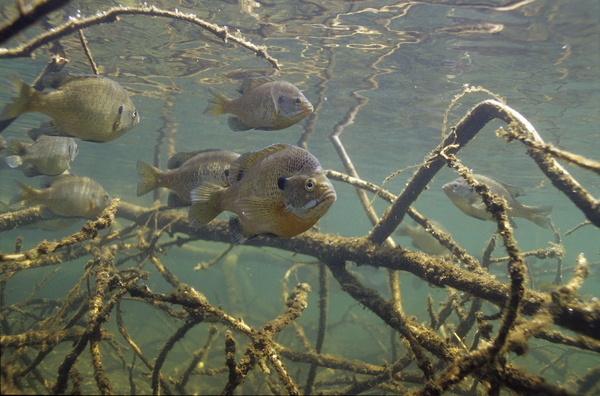
A fallen pine tree creates shelter for schools of small bluegill which attract
largemouth bass and other game fish.  (c) Eric Engbretson
When I speak to various organizations or lake associations, one of the questions most often asked is "How can we create good fish habitat?"  One way to do that is actually easier than you might imagine.  One of the best things we can do is... "nothing". 

Every time there's a storm and trees get blown down in our yards, we respond right away by picking up the brush and debris and quickly cutting up the fallen trees and branches with chainsaws to restore our yards to their pre-storm state.  This is fine to do in your yard, but if you have lakefront property, it's one of the worse things you can do near the water.  Trees, large and small that fall onto our beaches or into our lakes due to storms or natural decay are one of the most valuable habitat elements for fish, birds, reptiles and amphibians.  We're tempted to remove the trees to return our shorelines to a state that resembles Waikiki Beach, but when we do, we're robbing the lake and it's inhabitants are critical elements that enhance fish populations.    

Even small trees or branches in shallow water provide critical habitat elements
for a wide variety of fish. (c) Eric Engbretson
I visit many lakes that are ringed with homes and bordered by forest, but in a great many lakes, there’s scarcely any downed trees in the water. Since trees must go down from time to time in storms, falling into the water, I can only assume that lakefront property owners quickly remove them.  This should be avoided because wood and trees that have fallen in the water are a critical habitat element important to a variety of aquatic and terrestrial life. I strongly encourage all lakefront property owners to keep fallen trees in the lake instead of removing them. If they absolutely impede navigation, they should be moved, but not removed.

Trees that fall into lakes are magnets for crappie and
other panfish. (c) Eric Engbretson
I have thousands of underwater pictures that show what great habitat fallen trees provide and how fish utilize them.  Trees of all sizes provide important shade, cover for minnows and juvenile fish, ambush areas for game fish, and protection that's important for successful spawning.  They attract aquatic insects, crayfish and other food sources important to fish.  Studies done in northern Wisconsin show that lakes without coarse woody habitat show declines in fish growth rates and the amount of fish a lake can support. 

So, one of the best ways to actually create terrific fish habitat in our lakes is simply not to destroy or remove the habitat that is naturally made by nature when trees are blown down in storms.