Engbretson Underwater Photography

Search The Fish Photos


News From Behind the Scenes at Engbretson Underwater Photo and Stories about the Freshwater Environments We Visit.


Showing posts with label Fish. Show all posts

Sunday, August 23, 2020

Summer Largemouth Bass-Where to Find Them

Largemouth Bass in Milfoil

It's late summer and we're getting some really attractive Largemouth Bass images showing these fish using thick weed cover and a variety of other natural habitat elements.  

At this time of year, we face several obstacles when photographing bass. They tend to be harder to find because they're occupying all areas of the water column and tend to be widely dispersed. Water clarity diminishes this time of year as well, making normally suitable lakes too murky or "green" for good photography.  Finally, there's a seasonal shift in attitude of these fish by August.  Bass that were very approachable in the spring have become more wary and timid by late summer, so getting closeups of them becomes more difficult.  

Despite all those challenges, we're still able to get some fine images of them in their natural habitat.  Check out all our latest Largemouth Bass in our Largemouth Bass Gallery.

Tuesday, July 17, 2018

Can you Recommend a Good Underwater Camera?


Scott P. wrote to me recently asking about Spearfishing and Underwater Photography:

“Been spearfishing for a while. Wanting to get into underwater photography. Any tips on a decent, but simple to operate camera? – Scott P.”
As an underwater photographer, I can always tell when a lake or a river gets a certain amount of spearfishing pressure because the fish become very wary of divers. They learn to avoid us. In waters where spearfishing doesn't happen, the fish tend to be friendlier and you can approach them closely and quite easily.  I mention this to you because if you start doing any underwater photography, you will definitely want to avoid lakes you spearfish and vice versa.

Spearfishing is outlawed in most counties of the northern Wisconsin where I spend a lot of time so luckily I don't encounter fish that are inherently frightened of divers. When I go to southern Wisconsin, or even Lake Michigan, it's a different story. When photographing fish, ideally you want to be about 2 feet away from them. As you can imagine, on lakes where spearfishing occurs, the fish never let you approach that closely.
There's a lot of digital cameras on the market that work well underwater. As a rule, the more expensive they are, the better they perform. If I had to single out one to recommend to you, I'd say go with a GoPro Hero. The latest one is the Hero 6, but the Hero 5 and Hero 4 models are also excellent. You'll be able to get some nice photos with any of these models along with truly exceptional video. You won't be disappointed. Trust me. They're small, easy to use and the results are very impressive. Both the GoPro Hero 5 and Hero 6 are waterproof to 33 feet. The Hero 4 requires a waterproof housing.  All the GoPro models shoot exceptional videos. However, their still photo capabilities are limited to 12MP images, which is a little less than we like to use for professional purposes.  All that means is that unless you’re a professional photographer, the images from the GoPros will be more than satisfactory.

Thanks for your question Scott.  If you have a question about fish, underwater photography or any related subjects, feel free to email me here.

Thursday, March 22, 2018

Florida Springs

Our Isaac Szabo, has been busy this spring photographing a variety of fish that make their homes in the springs of Florida.  The clear water here helps to contribute to some truly stellar underwater images, like this spotted sunfish pictured below.  You can view all of Isaac's latest underwater work, including new images from Florida Springs in our Isaac Szabo gallery here.

Monday, February 5, 2018

How Do Spawning Benches Work?


Spawning Bench or half-log. (C) Eric Engbretson
In northern states, fish managers sometimes use spawning benches to promote the spawning of smallmouth bass.  While largemouth bass, rock bass, and sometimes bluegill also use spawning benches, it is the spawning of smallmouth bass that inspired the design. 
 
In a healthy lake, smallmouth bass build spawning nests against rocks, sunken trees, or large pieces of wood in about four to ten feet of water.  Next to these structures, the male excavates a shallow, circular crater in the lake bottom.  This system provides good natural protection to eggs and fry. 
 
But in lakes without coarse woody habitat, large rocks or similar objects, smallmouth bass may be forced to construct their nests out in the open.  When spawning and is over and the female has deposited her eggs in the nest, the male diligently guards the eggs and later the fry from predatory fish and crayfish.  When the nests are out in the open without natural protection, the male must guard up to 360 degrees of the crater he has dug.  This is exhausting and dangerous, since his back is always turned away from part of the nest.  Far fewer eggs incubate, and far fewer fry survive their first few weeks when fish have to use nests that lack the natural shield of a habitat's woody elements. 
 
Fish managers have studied the hard work put in by bass and have noted the decreased recruitment of young fish.  The managers came up with an idea for a simple structure they hoped would meet the needs of nesting fish and make it easier for eggs and fry to survive.  The idea for spawning benches was born. 
 
A spawning bench consists of a four to six foot piece of log sawed lengthwise in half and attached to concrete or cinder blocks on each end.  Spawning benches are therefore sometimes called half-logs.  Once placed on the suitable substrate, the spawning bench provides overhead cover from birds of prey.  The concrete blocks on each end protect the nest from raiders on two sides. 
Smallmouth bass guarding nest built adjacent to one of the concrete blocks of a spawning bench. (c) Eric Engbretson
It was a sound design and one that smallmouth bass readily used, but not exactly as intended.  It turned out that smallmouth bass weren't concerned about overhead cover. The benches usually sat in water deep enough to preclude threats from above by ospreys and other birds of prey.  While nests are occasionally built between the two concrete blocks as the designers intended, smallmouth bass usually construct nests next to one side or the other, thus allowing the male to guard the nest from only three sides.  The key element seems to be the concrete block itself and not so much the half log.  In fact, if the spawning bench falls on its side, it still provides excellent protection. 
 
Spawning benches are poor substitutes for the naturally occurring woody cover that fish prefer.  But in lakes devoid of suitable wood, rocks, or trees, spawning benches provide a superb means of helping smallmouth bass defend their nests and allowing more of their offspring to survive.

Thursday, December 7, 2017

How Important Are Cameras In Underwater Photography?

People interested in underwater photography often ask me what kind of camera equipment I use. 

I’ve always felt that underwater photographers put far too much    
 emphasis on their equipment and not enough on studying the behavior, habits and biology of their subjects.  The best equipment won’t help you if you don’t know where to go, what you’re looking at or whether you’re truly seeing something rare, unusual or out of the ordinary. 

How many photographers can tell the difference between a good looking clown fish and a bad looking one?  If they all look the same to you, you need to study clown fish better.  What I mean is this:  In every species, you’ve got your pretty Scarlet Johansson types and your skanky Courtney Love types.  It's easy to notice the distinction when we're looking at our own species, but not as easy when we're viewing other species, like fish for example.  If you don’t recognize the differences, you’re in trouble, because the people buying your pictures often times can.  And if you try to pass off a Courtney Love for a Scarlett Johansson, you’re going to be regarded as someone who doesn’t really know what you’re photographing, even if your pictures are technically perfect. 

Too much emphasis is put on the equipment we use.  But the "secret sauce" so to speak, is not the cameras and lenses, rather the familiarity with the subject matter.  That's what makes the difference between good photos and bad ones.  I’ve seen some amazing pictures taken with crappy point and shoots because the photographer understood the situation he was in and what he was shooting.  So the emphasis on the equipment you use is really overrated and of little importance.  Think of it this way: If your girlfriend told you she found a great dress on sale at the mall, would you ask her what kind of car she drove to get to the mall?

Monday, October 30, 2017

Prehistoric Paddlefish Underwater-New Images

Today we've added some very cool new Paddlefish pictures to our Stock Photo Collection.  They come to us from our Viktor Vrbovsky, who's brilliantly photographed these rare enigmatic fish in their natural habitat.  Like sturgeon and gar,  paddlefish have remained unchanged for eons.  Fossil records of  paddlefish date back over 300 million years, nearly 50 million years before dinosaurs first appeared.  You can view all of Viktor's exceptional underwater fish photography, including his excellent Paddlefish images on our website in our Viktor Vrbovsky Gallery.

Sunday, April 30, 2017

What Do Fish Think of Humans Who Scuba Dive Into Their Homes?

(c)Engbretson Underwater Photography

I've been photographing fish underwater for twenty five years and this is a question I've thought about a lot. I know what's it's like on the lake bottom taking pictures of fish, but what's it like from the fish's point of view?  How do they process the experience?  I can’t imagine what it’s like for them, but let's try to experience the encounter from their point of view.  Let's imagine for a moment that the roles are reversed.

So imagine you’re sitting in your living room one day and then, out of nowhere, an alien creature enters your home. It doesn’t resemble anything you’ve ever seen before. It has eyes like you do, but there’s very little about its body that you can comprehend. It doesn’t resemble anything you’ve ever seen. It’s enormous in size and you’re not sure where it came from or why it’s in your home. You’re terrified. But…. you might also be a little curious. You’re torn between running for your life, and trying to understand what you’re seeing. Let’s say you choose not to run. You keep your distance and start observing this alien life form. It’s immediately obvious that this creature has severe limitations. It seems to be clumsy and awkward. It doesn’t move with any grace or fluidity. In fact, it seems to have difficulty moving around at all. It’s also slow. This is reassuring to you because you’re certain you can outrun it easily if it approaches too closely.    Then suddenly it moves up to the ceiling of your living room and seemingly disappears. Where did it go? The entire encounter is incomprehensible to you. This is how I imagine the first time encounter would be like if the roles were reversed.

I can’t imagine what fish think of us.  But I’m always impressed with the fish that don’t immediately flee. I don’t know if I would have the nerve to hang around and observe this strange monster in the scenario I described. It’s extremely humbling to realize that these fish are braver and have more courage than I would in their situation.

I think after many repeated encounters, a certain level of comfort develops. While fish may never understand what we are, they know we’re not the otters they see who move with great speed and agility and should be feared. We’re probably regarded more like the way they view snapping turtles. Large, plodding creatures with no real underwater skills who aren’t a threat unless they get very close.

Over time, the fish begin to notice that as we clumsily move through the water, we create a disturbance. Unseen insects and other invertebrates that are hiding on plants or on the lake floor may be exposed or displaced and to the fish, they magically appear for them to eat. Maybe a crayfish is suddenly seen fleeing and again a food item is summoned out of nowhere. They may begin to view us as sorcerers who can conjure up food items by our mere presence. If they arrive at this conclusion, the entire dynamic between fish and us changes. We become viewed as a waiter or sorts. Instead of fearing us, we instead become something that should be paid attention to and even followed around so they’re able to snap up any treats that we may cause to appear.  For this reason, eventually, over time, I would say some of the fish are absolutely gleeful when they see us.

Saturday, September 13, 2014

Wild Ohio Magazine

From Chad Crouch, Photo Editor of Wild Ohio Magazine:
"I would like to give a long overdue "electronic high-five" to Eric Engbretson for his fantastic underwater photography of native freshwater fish. On the cover of Wild Ohio Magazine, we have had the opportunity to feature Eric's underwater "models" four times since 2009. Visit http://lnkd.in/dDTFyWm and check out Eric’s vast library of life under the water … you will not be disappointed!"
 
Thanks so much for the kind words and the wonderful endorsement Chad.  It's working with people like you over the years that's made it all possible and so much fun. 

Saturday, August 23, 2014

Amazing Underwater Trout Photos From Montana

Westslope Cutthroat Trout (c)Patrick Clayton/Engbretson Underwater Photography

Patrick Clayton, our top trout photographer here at Engbretson Underwater Photography, has just returned from the back country of the Montana wilderness with some sensational new trout pictures!  Patrick has trekked into remote areas at high elevations to find and photograph native Golden Trout and Cutthroat Trout.  His new images are astounding.  You can view all of Patrick's work in our on-line gallery here.  All of his images are available for editorial and commercial licensing through our agency.

Saturday, June 21, 2014

Fishiding Leads the Way in Artificial Fish Habitat-Designed By Fish, For Fish

Newly placed, this Fishiding High Rise model towers 12 feet off the lake floor and will soon become a haven for fish in lakes where natural cover is at a premium.  (C)Eric Engbretson Photo

Artificial fish habitat structures are becoming more popular today.  They're being used more and more, especially in large southern reservoirs devoid of important structure fish need.  Fish managers have traditionally placed bundles of Christmas trees or cedar trees on the lake bottom to try to provide cover for fish.  While effective, the lifespan of tree bundles or brush piles is limited, so replenishing them has always been an ongoing and expensive process.  Today, artificial habitat structures are gaining popularity because they don't decay or deteriorate. 

Of all the outfits manufacturing artificial habitat, David Ewald's Wonder Lake, IL company Fishiding, is ahead of all others, at least if you ask the fish, which is what David does.  Ewald has recently introduced his latest models:  The High Rise.  Ranging in height from 8 to 14 feet, these new designs are the only artificial fish habitat on the market today that incorporate the vertical element.  They tower off the lake floor and provide legitimate structure for fish, unlike his competitors who largely manufacture small and short structures that are inconspicuous to fish and do little to provide them with the kind of cover they're looking for.  The vertical dimension used in Ewald's High Rise models gives fish a range or depth at which to stage, and mimics the effectiveness of sunken vertical timber.      

Ewald's company, Fishiding sells a variety of different fish habitat structures that continue to evolve.  The reason for this is repeated testing.  Ewald monitors test structures over time and modifies them based on how fish respond to them.  The prototypes that don't attract as many fish are retooled and modified until they do or even scrapped altogether.  In effect, the fish vote, and new habitat is designed based on the observed preferences of fish.  No other artificial habitat structures are custom made for fish preferences the way Fishiding is.  When Ewald learned about the often overlooked but highly important vertical dimension, he got to work designing new models that would address this important fish preference and give fish what they want.  The result is his High Rise line of structures.  "Fishiding's artificial fish structures are designed not by what we think will be effective, but what they fish tell us they prefer", says Ewald.

For more information on Fishiding structures or the innovative High Rise models, click on this link, or go to http://www.fishiding.com/

Monday, May 5, 2014

Fish Sticks-The Habitat Management Tool That's Giving Wisconsin Lakes A Make-Over

 
Fish Sticks are assembled on lake ice over the winter. (DNR Photo)

In pre-settlement times, the near shore areas of all of Wisconsin’s lakes were filled with vast amounts of fallen trees.  Due to natural decay and storms that toppled large trees into lakes, our waters contained impressive amounts of timber that provided important habitat for fish and other species.  Today, those natural shorelines and their abundance of downed trees can only be found in a few places.  Lakes like those in Michigan’s undisturbed Sylvania Wilderness Area for example, give us a glimpse of the way all our lakes looked at one time.

As Wisconsin was settled and lakes were developed, shoreline trees were removed to make swimming beaches or to create an “uncluttered” look.  Large trees still growing along the shores were cut down to provide vistas of the lake for home owners to gaze at from their cottage windows.  In a short period of time, most of the wood on Wisconsin’s lakes was gone, eliminating a critical habitat element important to a wide variety of animals who made their homes in or near the lakes.
Today, we recognize the damage we’ve done by removing trees and interrupting the eons old process that replenished our lakes with a constant source of wood.  While it may take hundreds of years to restore our lakes to begin to resemble their original state, one innovative idea is jump-starting the process.  Referred to as “Fish Sticks”, it’s a way to move wood back to our lakes that’s been lost.  Fish sticks were made popular in Wisconsin by Bayfield County Fisheries Biologist Scott Toshner.  He’s worked on more than twenty fish sticks projects in the past four years.  "People tend to clean up their shorelines and remove fallen trees," said Toshner. "Sometimes the trees never get the chance to naturally fall into the water because lawns have taken over eliminating trees, shrubs, and ground cover. Fortunately, some northern Wisconsin communities are taking action to turn back the clock and restore the habitat on which fish, frogs, turtles, bugs, songbirds, ducks, and other critters thrive. Not only that, but they're good for water quality and shoreline protection, too."
Last year, a similar project, called “tree-drops” began on Florence County’s Lake Emily.  Tree drops are helpful but differ in that they usually involve single trees.  While their impact is important, a single tree can’t do the same job as multiple fish sticks.  Dr. Mike Bozek, formally of UW-Stevens Point, has studied this distinction.  “Submerged trees located closer to other submerged trees result in greater numbers and diversity of fish compared to individual trees. Larger numbers of submerged trees create a mosaic of habitats over greater shoreline areas than single trees do. This underscores the importance of riparian areas. We need to manage entire riparian areas and develop complex littoral zone habitats, not just individual trees.” 

As science has begun to better understand the importance of woody habitat in lakes, one type of habitat enhancement that’s been used on Wisconsin’s lakes for generations is on the way out.  In recent years, Fish cribs, have fallen out of favor with fish managers.  New studies show it’s a poor substitute for more natural and legitimate types of fish habitat like fish sticks.   "With the fish cribs, the one thing you kind of miss with them is the link between the near shore area where a lot of these fish spawn and spend their lives as juveniles ... [With fish sticks] the wood in this near shore area may be a missing link in terms of habitat in some of these lakes," Toshner said. 

To further illustrate the difference between single tree drops and fish sticks complexes, we can look to Bony Lake in Bayfield County.  This 191 acre lake was one of the first to employ fish sticks.  To date, more than 400 trees have been added to the lake, and they’re not done yet.  This may seem like a whole lot of wood, but in truth, it’s only a fraction of what the lake would have contained had shoreline property not been radically altered by development. Toshner hopes that as users of lakes, we’ll redefine our idea of what beauty is and discard our desire to create white sandy beaches and instead embrace the wild, unorganized, and natural look of shorelines comprised of fallen trees.  “Fish sticks projects are paying off in northern Wisconsin lakes by providing critical habitat for fish and insects, birds, turtles and frogs," says Toshner. “Beaches are really ecological deserts which don’t support any habitat or sustain any life”. 
A new streamlined permit available from the state and an easy step-by-step guide for fish sticks is now available from the Wisconsin Department of Natural Resources.  This will help lake associations or individuals get started with their own lake improvement projects that incorporate fish sticks.  Scott Toshner is excited about the changing landscapes of our lakes and is optimistic about how as stewards we’ll make better decisions in the future.  "If people can see that trees in the near shore area are a valuable resource, they're less likely to remove a tree that might fall in along their own shoreline."

Wednesday, March 12, 2014

Creating Great Fish Habitat

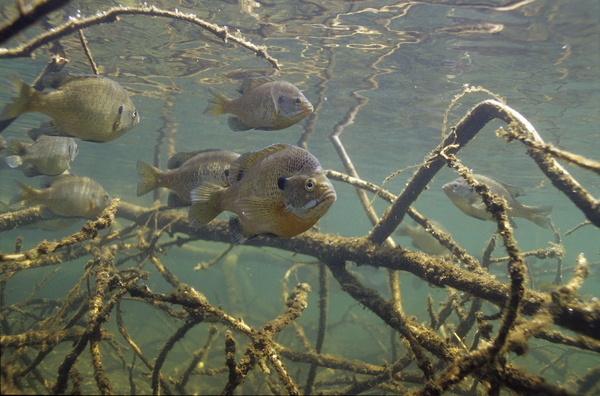
A fallen pine tree creates shelter for schools of small bluegill which attract
largemouth bass and other game fish.  (c) Eric Engbretson
When I speak to various organizations or lake associations, one of the questions most often asked is "How can we create good fish habitat?"  One way to do that is actually easier than you might imagine.  One of the best things we can do is... "nothing". 

Every time there's a storm and trees get blown down in our yards, we respond right away by picking up the brush and debris and quickly cutting up the fallen trees and branches with chainsaws to restore our yards to their pre-storm state.  This is fine to do in your yard, but if you have lakefront property, it's one of the worse things you can do near the water.  Trees, large and small that fall onto our beaches or into our lakes due to storms or natural decay are one of the most valuable habitat elements for fish, birds, reptiles and amphibians.  We're tempted to remove the trees to return our shorelines to a state that resembles Waikiki Beach, but when we do, we're robbing the lake and it's inhabitants are critical elements that enhance fish populations.    

Even small trees or branches in shallow water provide critical habitat elements
for a wide variety of fish. (c) Eric Engbretson
I visit many lakes that are ringed with homes and bordered by forest, but in a great many lakes, there’s scarcely any downed trees in the water. Since trees must go down from time to time in storms, falling into the water, I can only assume that lakefront property owners quickly remove them.  This should be avoided because wood and trees that have fallen in the water are a critical habitat element important to a variety of aquatic and terrestrial life. I strongly encourage all lakefront property owners to keep fallen trees in the lake instead of removing them. If they absolutely impede navigation, they should be moved, but not removed.

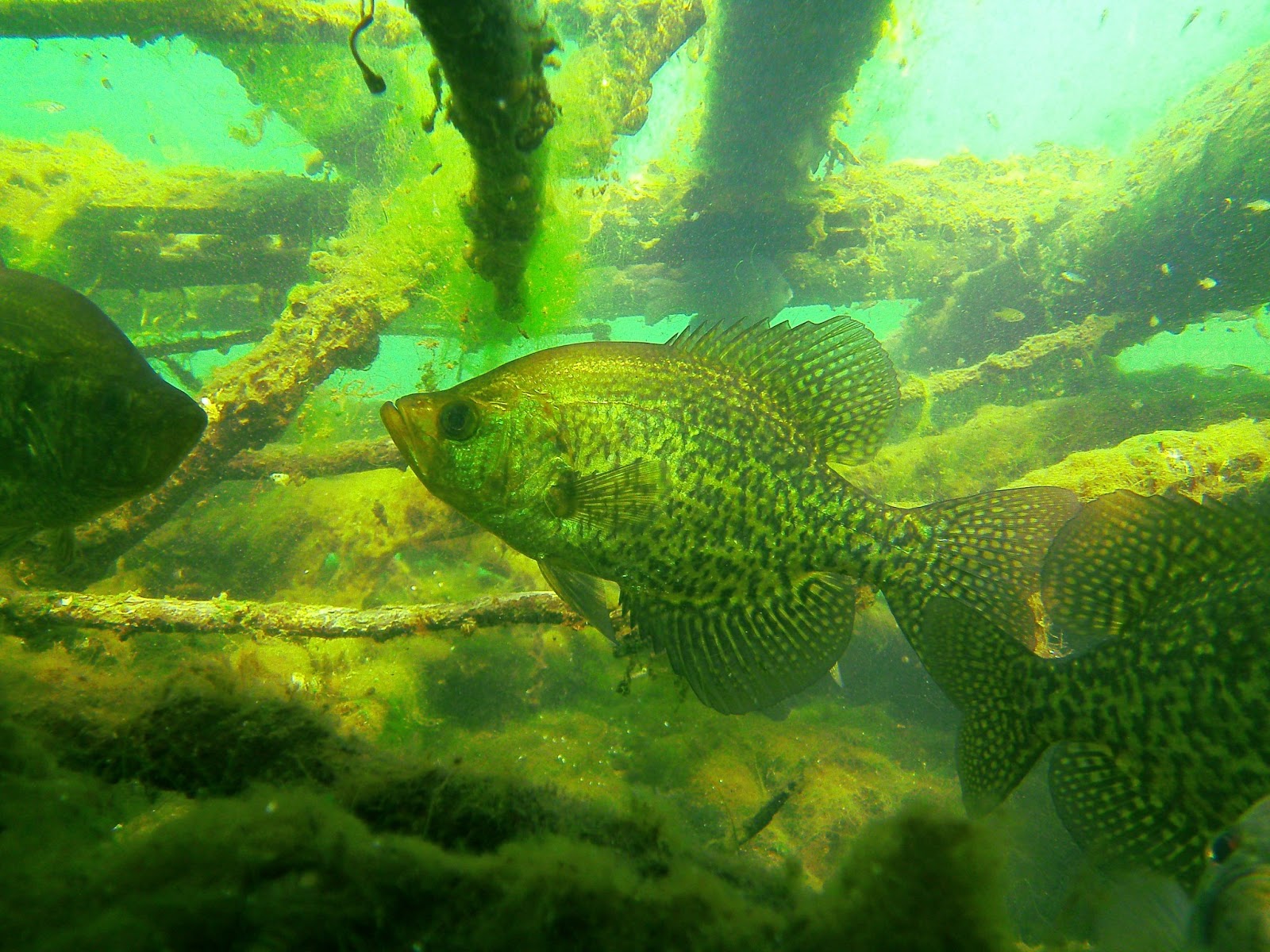
Trees that fall into lakes are magnets for crappie and
other panfish. (c) Eric Engbretson
I have thousands of underwater pictures that show what great habitat fallen trees provide and how fish utilize them.  Trees of all sizes provide important shade, cover for minnows and juvenile fish, ambush areas for game fish, and protection that's important for successful spawning.  They attract aquatic insects, crayfish and other food sources important to fish.  Studies done in northern Wisconsin show that lakes without coarse woody habitat show declines in fish growth rates and the amount of fish a lake can support. 

So, one of the best ways to actually create terrific fish habitat in our lakes is simply not to destroy or remove the habitat that is naturally made by nature when trees are blown down in storms. 

Wednesday, October 30, 2013

Best Pictures of Ciscoes Ever Taken

School of Ciscoes Underwater (c)Paul Vecsei/Engbretson Underwater Photography

Our top contributing photographer, Paul Vecsei, has done it again!  He's taken some truly remarkable photos of a rather elusive fish.  Paul has captured the best pictures of Cisco ever taken.  This is a species that has rarely been photographed in it's natural habitat.  Paul's images of these fish are breath-taking and are without questions the most exceptional images of this species ever made.  To view these stunning images of Ciscoes, click here.  To see all of Paul's remarkable fish photography, click here.  Paul's images can be licensed for commercial and editorial use by contacting Engbretson Underwater Photography.

Saturday, September 21, 2013

Photographing fish in their habitat - Hutchinson Leader: Outdoors & Recreation


Last August, freelance writer Scott Mackenthun interviewed me at the American Fisheries Society national convention in St. Paul, MN.  He asked how I got started in underwater photography and about some of the things I've seen over the years.  His interview with me was published in the Hutchinson Leader and can be read by clicking on this link:  Photographing fish in their habitat - Hutchinson Leader: Outdoors & Recreation

Sunday, July 7, 2013

Fisheries Scientist Now On Board

Sockeye Salmon (c)Todd Pearsons/Engbretson Underwater Photography

I'm genuinely thrilled to welcome the addition of Todd Pearsons to our team of superb underwater photographers here at Engbretson Underwater Photography!  Todd is a true expert in his field.  He has a Ph.D. in fisheries science.  (They don't give those things out to just anybody.)  Todd has studied and photographed fish for over 25 years and is a well known and respected figure in this field.  His list of published scientific credits is both lengthy and impressive.  In short-Todd knows fish!  

Todd is based in Ellensburg, Washington and regularly photographs many of the west coast trout and salmon  species that region is so famous for.  His underwater images of sockeye salmon are striking but he also photographs many other species of the Pacific Northwest that aren't quite as sexy.  His portfolio contains many non-game species including rare underwater images of Northern Pikeminnow for example.   

I'm excited to be representing the underwater photography of Todd Pearsons which can be licensed for editorial and commercial purposes on my website.  You can view more of Todd's work in the Todd Pearsons Gallery on my website.  Todd joins Christopher Morey, Paul Vecsei, Roger Peterson, Isaac Szabo and myself on the "dream team" here at Engbretson Underwater Photography.

Sunday, June 16, 2013

Why Fish Cribs Work and Why They Fail


When I encounter fish cribs in lakes where I scuba dive, I typically see one of two opposite things: cribs holding fish, and cribs attracting no fish at all. In years of first-hand underwater observation, I have noticed that the cribs with fish share certain characteristics. So do the cribs devoid of fish. I’ve concluded that there are two key aspects of cribs that succeed in drawing and holding impressive numbers of fish. Those two critical components are design and location. Let’s look at each one separately and see why some cribs succeed while other cribs fail.  

Design:

Years ago, fish cribs usually shared a single design. They consisted of big logs lashed together to make a cube like a miniature log cabin without a roof. The interior was stuffed with brush or tree branches and they were weighed down with concrete, cinder blocks, or heavy rocks. Since these structures can be very large, heavy, and almost impossible to move, they’re built in the wintertime in northern states and left on the ice, where they sink into place in the spring when the ice starts to melt. The cribs are usually square but sometimes rectangular. They are typically four or five feet high and four to eight feet long.

Since the classic wooden log-cabin style is the most popular kind of fish crib, my observations and comments focus on these specific types of cribs and in particular on the best ways to make them as effective as possible.

By their very nature, most fish cribs have a distinctly limited lifespan. When they’re fresh and their interiors are tightly packed with brush and tree limbs, minnows and juvenile fish will flock their way. The thick cover provides shelter and a place to hide from predators. The smaller fish penetrate deep into the cribs. Panfish will congregate outside or squeeze their way in where they can. Larger predator fish, such as bass and northern pike, will hang around the perimeter, attracted by the throngs of fish concentrated in this area.

The interior material of thick brush or tree branches gives rise to a problem that is endemic to fish cribs. The material provides dense cover that small fish need, but over time it disintegrates, leaving only the cribs’ outside skeleton intact. The center portion remains basically empty. Without brush and branches, the cribs can no longer protect small fish from larger fish. And once the small fish--a source of food--disappear, the crib also loses its appeal to the game fish, which no longer gather around the crib to enjoy the all-you-can-eat buffet it once was. While these cribs might occasionally still draw a few larger fish for shade or cover, they lose their major attraction as a feeding center. Most people don’t understand that the secret ingredient that makes a crib design successful is not the frame or the exoskeleton, but the thick interior brush. If that’s not a central component from the start, or if it’s lost, cribs will stop attracting fish. The frame may stay intact and last for decades, but the brush deteriorates much more quickly. If there were some way to re-stock these cribs with interior brush, we could vastly extend their viability and lifetime.

The Vertical Dimension

Height is infinitely more important than length. The higher the walls of the crib extend from the bottom, the more attractive the crib will prove to fish. You want a piece of genuine structure, not something that is just an inconspicuous component of the floor of the lake. In fact, cribs should measure no less than four feet high. Fish want something well above the lake floor, and they like to choose the depth they want to hold while remaining close to the structure.

One of the best fish cribs I’ve ever seen was created entirely by accident. It was rectangular and four feet high, four feet wide, and 12 feet long. It was placed on the ice in 17 feet of water. When the ice melted in the spring, the rocks weighing it down shifted position, and the crib plunged to the bottom on its side. As a result, the crib towered 12 feet from the bottom. Underwater it looked like a skyscraper. Fish flocked to the crib and occupied various stories from top to bottom. A long, dark shadow fell on one side and served as a magnet for fish. In short, the structure turned into an amazingly effective accidental home. Another crib of the same dimensions fell nearby as originally intended but, since it ranged only four feet from the bottom, it attracted only a fraction of the fish the skyscraper did.

Complexity of Design

Since this is not an article about building cribs, I won’t go into the blueprints on how to construct them. The key element in one word is complexity. This refers to the guts of the crib, not the frame. The interior brush should be packed tightly enough to block out most light. Don’t worry about making it so dense that fish won’t be able to get inside. Pockets will form here and there, and fish are astoundingly adept at squeezing into the tiniest spaces. Long branches should extend from the crib on all sides and through all the slats. If possible, include some long branches stuck into the top of the crib to give it some extra dimension. The idea is to create as thick and complex a jungle as possible. The final result will resemble a thick mass of long branches extending from the dense pack inside the crib. The branches should reach from every depth of the crib in every direction and at every possible angle. If your finished crib looks even vaguely tidy, it needs more work.
View from Inside a Fish Crib (c)Eric Engbretson

Designs that Don’t Work from Day One

Cribs that incorporate Christmas trees work adequately but for a very short time. Christmas trees deteriorate so quickly that in just a year or two, they no longer provide the complex cover that fish desire. In addition, fish will ignore cribs that are too small, too short, or too simple in design.

Examples of poor designs are cribs made of wooden pallets that rest only a couple of feet off the bottom, or cribs with huge spaces between pallets and no interior brush. Star-shaped cribs that resemble the obstacles used on the beaches of Normandy in World War II may look fascinating, but they lack the complexity, shade, and cover to attract fish well. This list is scarcely exhaustive: There are many other design flaws in cribs that don’t attract fish.

Location:

Depth

When it comes to location, success depends largely on depth. When cribs are placed shallow enough to let sunlight reach them, they grow algae and other organic material. This serves as a food source for juvenile fish and also makes the cribs fuller and denser. When cribs are placed closer to the littoral zone, they’re much more accessible to the newly hatched fry that will quickly colonize them and provide the food that attracts larger fish.
 
When I’m scuba diving, I see fish cribs in deep water go largely unused most of the year. The water is colder here and may lack adequate oxygen. In general, these cribs receive visits by fish in fall and winter. On the other hand, fish in shallower water will use a crib virtually year-round. Some of the best fish cribs I’ve seen were ones that weren’t properly weighted. When the ice melted, they floated toward shore and ran aground. When allowed to remain in place, these cribs were quickly covered by algae and were populated immediately by juvenile fish and newly hatched fry. Despite their extremely shallow location, they attracted game fish year after year and even served some fish as a structure for spawning.

The Substrate

Cribs should always be placed on a hard bottom or substrate. If placed on a lake bottom with 12 inches of muck, let’s say, the crib will sink into the muck and you’ll effectively lose a foot of height. Since height is vital to fish, you don’t want to lose it. A muck bottom also eliminates the basement floor.

The Basement Level

Another reason a hard bottom matters is that you want about a foot of clearance between the lake bottom and the base of the crib. If fish can swim underneath your crib in this basement level, you’ve really got something to brag about. Walleyes and bass, by the way, are two species especially drawn to cribs that let them swim underneath.

Plants

If the crib rests in shallow water where plants can grow, it’s often possible to extend the life of the crib almost indefinitely. As multitudes of fish congregate around the crib season after season, their feces can accelerate a lush growth of plants. This patch of vegetation is denser than the surrounding area and creates desirable habitat all by itself. In time, after the interior brush decomposes, it’s possible that tall aquatic plants will replace it, a process that prolongs the lifespan and effectiveness of the crib. If the crib sits in water that’s too deep for plants to grow, none of this growth will take place.

Multiple Cribs in One Location

Cribs located close to each other always outperform single units. Fish will often travel back and forth in a cluster of cribs. Even if they are built alike and placed at the very same depth, they form individual identities, and multiple cribs will be used by different species in various ways. For example, one crib may attract many more rock bass than another that is just a few feet away and populated mainly by sunfish. The differences in the cribs are largely indiscernible to our eyes, but the fish notice subtle distinctions that drive their preferences. The rule, then, is simple: Multiple cribs offer multiple choices and greater numbers of fish.

Regulations

The regulations on the placement of fish cribs are mandated by Natural Resources Departments in many states and other jurisdictions. In my state, Wisconsin, permits for fish crib construction and placement explicitly instruct builders to place them with at least five feet of water over the top of the structure. Since the cribs themselves are typically four or five feet high, the minimum depth for placement is nine or ten feet. The concern here is understandable. Cribs can create hazards for boaters, who may be unaware of their locations. However, if I were placing cribs on my own private lake, free from regulations, I would place them shallow enough so that only two or three feet of water covered the top. This way, I might be able to replenish them with new brush from time to time as the older material disintegrated. This would greatly extend their natural lifespan.

The Future of Artificial Fish Shelters

In recent years, fish-crib makers have gotten very creative and used a variety of materials. Most popular of the new wave of materials are things normally destined for the junk pile or landfill. Today it’s not unusual to see fish cribs made of stacked wooden pallets, plastic, or PVC. They feature clever designs, and I’ve seen some of them underwater in lakes that I frequent. But the truth is that they don’t seem to fare well. While they may be lighter, easier, and cheaper to make, their main drawback is that they lack the size and complexity to prove attractive to fish. The best ones take up the most space and most effectively mimic trees, sunken timber, and other natural elements.

When artificial cribs made of PVC pipe first appeared, it was widely believed that they would be less effective because fish would refuse to be silhouetted against a white background.  Although I also originally believed this, I've reversed my position.  What we've discovered in further studying this is that color doesn't seem to be the significant factor we once thought it was.  In fact, there's evidence that suggests that PVC pipe color plays no role in fish preference whatsoever.  Instead, the combination of vertical height and complexity determine whether any structure, natural or artificial, will be attractive to fish.
 

An example of a poorly constructed fish attractant.  Notice the lack of complexity and the large open spaces that provide shade, but nothing in the way of cover. @Eric Engbretson Photo


Fish Cribs as Fish Habitat

Let’s get one thing straight. Fish cribs are definitely not fish habitat. They’re artificial constructions designed to concentrate unusually large numbers of fish in a very small area so fishermen can catch them. Fish cribs do not normally provide the elements fish need for spawning or nesting. At their best, fish cribs merely impersonate fish habitat. In fact, in lakes with an abundance of excellent fish habitat, even the best- made and best-placed cribs will go ignored by fish in favor of superior natural structure. In sum, fish cribs work best in lakes where there is little or no natural structure for fish to use.

Traits of Effective Cribs

·They reside in relatively shallow water (10 to 15 feet)

·They receive ample sunlight and they support algae and other organic growth

·They are in water that is shallow enough to let submergent plants grow nearby

·They sit on a hard bottom

·They are at least four feet high

·They have a space at the base that lets fish swim under the crib

·They are thickly packed in the center with various sizes of brush and branches

·They have long and complex branches on all faces extending away from the crib

·They have a complex design

·They are placed together with other cribs

·They are in lakes that contain little or no natural structure

Traits of Ineffective Cribs

·They sit in water that’s too deep (or too shallow if the water’s too warm for fish)

·They sit too deep to receive ample sunlight and support organic growth

·They are in water too deep for plants to grow nearby

·They sit on a mucky bottom

·They are less than four feet high

·They have no space at the base where fish can swim under the crib

·They contain Christmas trees or have little or no brush packed into their center

·They have a design of limited complexity

·They are placed alone

·They are in lakes with abundant natural habitat and structure

Conclusion

As with any set of guidelines and suggestions, there are always exceptions. My observations and conclusions come from years of scuba diving in the northern lakes of the upper Midwest. While complexity of design is universally important, in other parts of the country, many of my suggestions on placement may ignore local conditions and require adaptation. For example, in large southern reservoirs, water temperatures can soar into the 80s and force fish to spawn and live in far deeper water, where lower and more comfortable temperatures prevail. In very clear lakes, sunlight may penetrate 30 feet or more, and plants can grow at greater depths than in other locales. In lakes like these, specific local conditions must be taken into account. Because of such variables, it’s important to have a good understanding of your lake’s ecology and other characteristics. Understanding the specific dynamics of any given lake will help immeasurably when you decide on the best locations for a crib.


Monday, March 4, 2013

My Best Advice For New Underwater Photographers

There’s always room for more good photographers, and I think interest in underwater subjects will continue. I encourage beginners to learn about their subjects. Become an expert on the life and behavior of your animal subjects. Become a steward of their habitat. Think of yourself as a PR person for that particular animal. If you do this, you’ll show them in the best light, you’ll be mindful of disturbing them, and your work will automatically show these creatures at their most magnificent. Don’t sell pictures. Instead, fall in love with your subjects and sell that love! And instead of exploiting them for personal profit, you’ll become partners with them in calling attention to their inherent beauty and value in the ecosystem, and the special problems each one of them face in an increasingly crowded world.

Engbretson Underwater Photography is always on the look-out for talented underwater shooters.  If you work in freshwater environments and you're interested in joining our team contact us today.

Wednesday, January 2, 2013

How Do Spawning Benches Work?


Spawning Bench or half-log. (C) Eric Engbretson


In northern states, fish managers sometimes use spawning benches to promote the spawning of smallmouth bass.  While largemouth bass, rock bass, and sometimes bluegill also use spawning benches, it is the spawning of smallmouth bass that inspired the design. 
 
In a healthy lake, smallmouth bass build spawning nests against rocks, sunken trees, or large pieces of wood in about four to ten feet of water.  Next to these structures, the male excavates a shallow, circular crater in the lake bottom.  This system provides good natural protection to eggs and fry. 
 
But in lakes without coarse woody habitat, large rocks or similar objects, smallmouth bass may be forced to construct their nests out in the open.  When spawning and is over and the female has deposited her eggs in the nest, the male diligently guards the eggs and later the fry from predatory fish and crayfish.  When the nests are out in the open without natural protection, the male must guard up to 360 degrees of the crater he has dug.  This is exhausting and dangerous, since his back is always turned away from part of the nest.  Far fewer eggs incubate, and far fewer fry survive their first few weeks when fish have to use nests that lack the natural shield of a habitat's woody elements. 
 
Fish managers have studied the hard work put in by bass and have noted the decreased recruitment of young fish.  The managers came up with an idea for a simple structure they hoped would meet the needs of nesting fish and make it easier for eggs and fry to survive.  The idea for spawning benches was born. 
 
A spawning bench consists of a four to six foot piece of log sawed lengthwise in half and attached to concrete or cinder blocks on each end.  Spawning benches are therefore sometimes called half-logs.  Once placed on the suitable substrate, the spawning bench provides overhead cover from birds of prey.  The concrete blocks on each end protect the nest from raiders on two sides.

 
Smallmouth bass guarding nest built adjacent to one of the concrete blocks of a spawning bench. (c) Eric Engbretson
 
It was a sound design and one that smallmouth bass readily used, but not exactly as intended.  It turned out that smallmouth bass weren't concerned about overhead cover. The benches usually sat in water deep enough to preclude threats from above by ospreys and other birds of prey.  While nests are occasionally built between the two concrete blocks as the designers intended, smallmouth bass usually construct nests next to one side or the other, thus allowing the male to guard the nest from only three sides.  The key element seems to be the concrete block itself and not so much the half log.  In fact, if the spawning bench falls on its side, it still provides excellent protection. 
 
Spawning benches are poor substitutes for the naturally occurring woody cover that fish prefer.  But in lakes devoid of suitable wood, rocks, or trees, spawning benches provide a superb means of helping smallmouth bass defend their nests and allowing more of their offspring to survive.