Engbretson Underwater Photography

Search The Fish Photos


News From Behind the Scenes at Engbretson Underwater Photo and Stories about the Freshwater Environments We Visit.


Showing posts with label Habitat. Show all posts

Thursday, February 10, 2022

Why Do-It-Yourself Artificial Fish Habitat Fails:

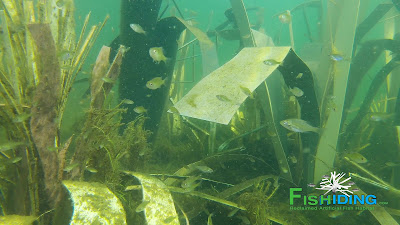
Fishiding Artificial Fish Habitat is unique because of its size, complexity, and the protection it provides juvenile fish.

Constructing a conglomeration of rubber tubing, plastic barrels, and old hose, throwing it into the lake and calling it fish habitat because we saw a bass next to it, is like putting a cardboard box on the street corner and calling it “housing” when a homeless person takes refuge in it. Most DIY fish habitat is as much fish habitat as a plastic tarp strung between two shopping carts is “a house” to a homeless person.

Look around at your own home. Why is it comfortable? Why do you like it? Look past the man cave you’ve built in the basement, the expensive wall-to-wall carpeting, and the refrigerator with the built-in ice-cube dispenser. What makes your house useful and practical is its utilitarian functionality.

The insulation keeps you warm in the winter. The roof keeps the rain out. There’s a dark bedroom to sleep in at night. The doors and windows all have locks that provide you with safety and security. Your pantry is stocked with food and you have a kitchen to prepare it. Your home functions in a way that addresses all your family’s needs in a utilitarian way.

By and large, DIY artificial fish habitat doesn’t do anything close to that. To be comparable, artificial fish habitat needs to be large to accommodate many fish. (You wouldn’t want to live in a one-bedroom bungalow with a family of six would you?) It needs to provide a refuge for young fish the same way your children have their bedrooms where they can be away from grown-ups while hanging out with their friends. There needs to be on-site food so you’re not driving to McDonald’s every single time you want a snack. Size, security, protection, privacy, and food are just some of the important aspects of any home that we would never compromise on in our dwellings yet seemingly never consider when constructing habitat for fish. Instead, we create the equivalent of tent cities in the most impoverished part of town and congratulate ourselves when homeless people congregate there to get out of the rain. That’s not a solution to the homeless problem any more than lashing rubber hoses to cinder blocks is to solving the lack of fish habitat.

What’s needed in both scenarios is genuine housing/habitat for both impoverished people and fish.

When looking at the wide variety of homemade so-called fish habitat, one thing seems to be evident. Most well-intentioned builders don’t seem to know exactly what fish need and the poverty of their designs betray this fact. Bad designs continue to be copied, while far superior ones are ignored. This is because so few of us can tell the difference between good designs and poor ones. This failure is epidemic but also understandable. Fish live in a separate world largely invisible to us. We rarely glimpse them in their natural habitat and have little idea of how they live or how they spend their time. Our only interaction is when we hoist them into the boat on the end of our fishing lines. Occasionally we notice that fishing under the neighbor’s dock or next to that old Cyprus tree stump seem to be good spots, but we’re completely in the dark about why. We often leap to the false conclusion that any structure in the water is a fish’s home and any solid piece of material we find in the back of our garage could work just as well. Do it yourselfers are thwarted not only by their lack of understanding of fish but also by what materials might currently be available in their sheds and garages. I think this explains why we see so many awful constructions.

To design and construct authentic fish habitats and not merely dilapidated, makeshift shelters of the kind we might see on urban streets, we need to think backward. We need to think first about function over form. Utility over availability. We need our designs to meet the specific needs of fish. We can look to natural habitats for guidance. Natural habitat has a myriad of desirable characteristics but for this discussion, we can single out the three most often violated elements that any proposed artificially constructed fish habitat must have. The first is size. Is our construction large enough to accommodate a community of fishes? The second is protection. Are there tight spaces, crevices, alleys, pockets, holes, depressions, and retreats that smaller fish can occupy that larger fish absolutely cannot access? The third is complexity. Is the structure large and complex enough to offer shade, to block sight-lines, and to hide or conceal what’s in and around it? If it were in your backyard, could your kids use it when they play hide and seek?  Keeping in mind this trio of primary functions will help you begin to understand what fish need and enable you to reject bad design ideas and eliminate potential construction materials that don’t amplify these important characteristics.

Across our country, there are many bodies of water from large sprawling reservoirs to small backyard ponds. Many of them are lacking fish habitat for a variety of reasons. In many cases, artificial habitat can be a surrogate but only if it addresses in utilitarian ways the features of genuine habitat. 

If you work in the fish management sector, you and your colleagues have an obligation to be very critical of the designs being paraded in front of you. If we’re not more careful about scrutinizing and properly evaluating artificial fish habitats, we run the risk of unknowingly filling our waterways with useless materials instead of creating legitimate habitat. 

Certainly, there’s much to discuss about creating artificial fish habitat, and because true innovation has slowed to a trickle, we find ourselves mired in a kind of estuary between realizing we have a habitat deficiency and creating the kinds of authentic habitat that will make any difference. Artificial fish habitat needs to provide functional value to our fish. The scale of the problem is enormous in many locations, and won’t be solved by adding more sub-standard and inadequate structures any more than human homelessness can be solved by putting out more cardboard boxes and tents. 

Monday, May 27, 2019

How Does Artificial Fish Habitat Work?

The Science Behind Fishiding Artificial Fish Habitat


I recently collaborated with David Ewald from Fishiding.com on a ten-part video series that explains how artificial fish habitat works. In the videos, which you can watch on myYouTube channel, we examine many of the characteristics that are necessary to design the kinds of structures that serve fish most effectively.

While natural elements like trees, stumps, rocks and plants provide the best habitat, artificial surrogates have a place in this conversation. The bottom of many southern reservoirs resemble moonscapes and there is little if any existing natural habitat. In many of these man-made lakes, man-made habitat is often the only viable option to provide young fish with the kind of sanctuaries they require to survive the challenges of early life.

In our video series “The Science behind Fishiding Artificial Fish Habitat”, we show you never-before-seen underwater footage of how fish utilize this habitat and why it should be considered a legitimate tool for fisheries professionals faced with managing waters where habitat is marginal.

If you’re interested in watching the videos, make sure you also read the 800 word narratives that accompany each video. Each narrative provides a complete description of the footage you see and points out key aspects of design, function, installation, testing, configuration, size and complexity. There really is a lot to know, but we’ve worked to distill everything we’ve learned into an easy to understand presentation that we hope you’ll find both interesting and useful.

You can view the entire video series on YouTube here and on the Fishiding page here.

Wednesday, December 16, 2015

Watch Bass Swim Where They Live | Bassmaster


Sunday, July 26, 2015

Amazing Underwater Pictures of Invasive Carp!

Bighead Carp (c)Viktor Vrbovsky/Engbretson Underwater Photography
I'd like to welcome the newest talent to our "Dream Team" of the world's best freshwater fish photographers!  Viktor Vrbovsky is an award-winning underwater photographer who travels the world shooting the most amazing fish in both freshwater and marine environments.  His collection of Bighead Carp images are likely the best ever taken of this species in the wild. There's been enormous interest in invasive Asian Carp species in recent years and now we're pleased to have some incredible underwater images of this enigmatic fish.  Viktor's images are now available for commercial, editorial and educational licensing from Engbretson Underwater Photography

Friday, December 12, 2014

Where Have All the Perch Gone?

There's an interesting new story that just appeared in Minnesota Outdoor News.  Researchers with the Minnesota Department of Natural Resources say that in 900 lakes they've surveyed in that state, numbers of yellow perch are down significantly.

Over the years, I've noticed the same thing while diving and photographing fish in Wisconsin lakes... there just aren't as many perch as there used to be.  The news report says in part that DNR researchers are looking at not only what might be holding back yellow perch, but also potentially dragging them down. 

"A new study looking at yellow perch is being led by DNR research biologists  Jeff Reed, of Glenwood, and Bethany Bethke, of Duluth. Related research conducted by Bethke during the past couple of years pointed to a likely decline in perch numbers; in more than 900 lakes studied, perch numbers had dropped on average, from about 10 fish per gill net to around five fish per gill net during DNR surveys.
“When you see something going in half over a 25-year period, it’s something you want to look at,” Reed said.

Examination of netting data yields some clues regarding why perch might be declining in some places. High water levels have created fertile breeding grounds for northern pike, and a corresponding increase in the pike population could be putting a bigger dent in the perch population, Reed said. Also, invasives – such as zebra and quagga mussels, and spiny water fleas, where they exist – could be reducing the foods available – like zooplankton – for very small perch.

One other factor could be in play, too. Longer growing seasons in lakes are helping species like bluegills, which compete with yellow perch.
  
Bethke adds yet another item to the list of possible culprits for perch decline: the loss of near-shore habitat, which could be lakeshore property owners removing woody debris or bulrush."

To read the entire article, go to this link.

Monday, May 5, 2014

Fish Sticks-The Habitat Management Tool That's Giving Wisconsin Lakes A Make-Over

 
Fish Sticks are assembled on lake ice over the winter. (DNR Photo)

In pre-settlement times, the near shore areas of all of Wisconsin’s lakes were filled with vast amounts of fallen trees.  Due to natural decay and storms that toppled large trees into lakes, our waters contained impressive amounts of timber that provided important habitat for fish and other species.  Today, those natural shorelines and their abundance of downed trees can only be found in a few places.  Lakes like those in Michigan’s undisturbed Sylvania Wilderness Area for example, give us a glimpse of the way all our lakes looked at one time.

As Wisconsin was settled and lakes were developed, shoreline trees were removed to make swimming beaches or to create an “uncluttered” look.  Large trees still growing along the shores were cut down to provide vistas of the lake for home owners to gaze at from their cottage windows.  In a short period of time, most of the wood on Wisconsin’s lakes was gone, eliminating a critical habitat element important to a wide variety of animals who made their homes in or near the lakes.
Today, we recognize the damage we’ve done by removing trees and interrupting the eons old process that replenished our lakes with a constant source of wood.  While it may take hundreds of years to restore our lakes to begin to resemble their original state, one innovative idea is jump-starting the process.  Referred to as “Fish Sticks”, it’s a way to move wood back to our lakes that’s been lost.  Fish sticks were made popular in Wisconsin by Bayfield County Fisheries Biologist Scott Toshner.  He’s worked on more than twenty fish sticks projects in the past four years.  "People tend to clean up their shorelines and remove fallen trees," said Toshner. "Sometimes the trees never get the chance to naturally fall into the water because lawns have taken over eliminating trees, shrubs, and ground cover. Fortunately, some northern Wisconsin communities are taking action to turn back the clock and restore the habitat on which fish, frogs, turtles, bugs, songbirds, ducks, and other critters thrive. Not only that, but they're good for water quality and shoreline protection, too."
Last year, a similar project, called “tree-drops” began on Florence County’s Lake Emily.  Tree drops are helpful but differ in that they usually involve single trees.  While their impact is important, a single tree can’t do the same job as multiple fish sticks.  Dr. Mike Bozek, formally of UW-Stevens Point, has studied this distinction.  “Submerged trees located closer to other submerged trees result in greater numbers and diversity of fish compared to individual trees. Larger numbers of submerged trees create a mosaic of habitats over greater shoreline areas than single trees do. This underscores the importance of riparian areas. We need to manage entire riparian areas and develop complex littoral zone habitats, not just individual trees.” 

As science has begun to better understand the importance of woody habitat in lakes, one type of habitat enhancement that’s been used on Wisconsin’s lakes for generations is on the way out.  In recent years, Fish cribs, have fallen out of favor with fish managers.  New studies show it’s a poor substitute for more natural and legitimate types of fish habitat like fish sticks.   "With the fish cribs, the one thing you kind of miss with them is the link between the near shore area where a lot of these fish spawn and spend their lives as juveniles ... [With fish sticks] the wood in this near shore area may be a missing link in terms of habitat in some of these lakes," Toshner said. 

To further illustrate the difference between single tree drops and fish sticks complexes, we can look to Bony Lake in Bayfield County.  This 191 acre lake was one of the first to employ fish sticks.  To date, more than 400 trees have been added to the lake, and they’re not done yet.  This may seem like a whole lot of wood, but in truth, it’s only a fraction of what the lake would have contained had shoreline property not been radically altered by development. Toshner hopes that as users of lakes, we’ll redefine our idea of what beauty is and discard our desire to create white sandy beaches and instead embrace the wild, unorganized, and natural look of shorelines comprised of fallen trees.  “Fish sticks projects are paying off in northern Wisconsin lakes by providing critical habitat for fish and insects, birds, turtles and frogs," says Toshner. “Beaches are really ecological deserts which don’t support any habitat or sustain any life”. 
A new streamlined permit available from the state and an easy step-by-step guide for fish sticks is now available from the Wisconsin Department of Natural Resources.  This will help lake associations or individuals get started with their own lake improvement projects that incorporate fish sticks.  Scott Toshner is excited about the changing landscapes of our lakes and is optimistic about how as stewards we’ll make better decisions in the future.  "If people can see that trees in the near shore area are a valuable resource, they're less likely to remove a tree that might fall in along their own shoreline."

Monday, March 4, 2013

My Best Advice For New Underwater Photographers

There’s always room for more good photographers, and I think interest in underwater subjects will continue. I encourage beginners to learn about their subjects. Become an expert on the life and behavior of your animal subjects. Become a steward of their habitat. Think of yourself as a PR person for that particular animal. If you do this, you’ll show them in the best light, you’ll be mindful of disturbing them, and your work will automatically show these creatures at their most magnificent. Don’t sell pictures. Instead, fall in love with your subjects and sell that love! And instead of exploiting them for personal profit, you’ll become partners with them in calling attention to their inherent beauty and value in the ecosystem, and the special problems each one of them face in an increasingly crowded world.

Engbretson Underwater Photography is always on the look-out for talented underwater shooters.  If you work in freshwater environments and you're interested in joining our team contact us today.

Wednesday, January 2, 2013

How Do Spawning Benches Work?


Spawning Bench or half-log. (C) Eric Engbretson


In northern states, fish managers sometimes use spawning benches to promote the spawning of smallmouth bass.  While largemouth bass, rock bass, and sometimes bluegill also use spawning benches, it is the spawning of smallmouth bass that inspired the design. 
 
In a healthy lake, smallmouth bass build spawning nests against rocks, sunken trees, or large pieces of wood in about four to ten feet of water.  Next to these structures, the male excavates a shallow, circular crater in the lake bottom.  This system provides good natural protection to eggs and fry. 
 
But in lakes without coarse woody habitat, large rocks or similar objects, smallmouth bass may be forced to construct their nests out in the open.  When spawning and is over and the female has deposited her eggs in the nest, the male diligently guards the eggs and later the fry from predatory fish and crayfish.  When the nests are out in the open without natural protection, the male must guard up to 360 degrees of the crater he has dug.  This is exhausting and dangerous, since his back is always turned away from part of the nest.  Far fewer eggs incubate, and far fewer fry survive their first few weeks when fish have to use nests that lack the natural shield of a habitat's woody elements. 
 
Fish managers have studied the hard work put in by bass and have noted the decreased recruitment of young fish.  The managers came up with an idea for a simple structure they hoped would meet the needs of nesting fish and make it easier for eggs and fry to survive.  The idea for spawning benches was born. 
 
A spawning bench consists of a four to six foot piece of log sawed lengthwise in half and attached to concrete or cinder blocks on each end.  Spawning benches are therefore sometimes called half-logs.  Once placed on the suitable substrate, the spawning bench provides overhead cover from birds of prey.  The concrete blocks on each end protect the nest from raiders on two sides.

 
Smallmouth bass guarding nest built adjacent to one of the concrete blocks of a spawning bench. (c) Eric Engbretson
 
It was a sound design and one that smallmouth bass readily used, but not exactly as intended.  It turned out that smallmouth bass weren't concerned about overhead cover. The benches usually sat in water deep enough to preclude threats from above by ospreys and other birds of prey.  While nests are occasionally built between the two concrete blocks as the designers intended, smallmouth bass usually construct nests next to one side or the other, thus allowing the male to guard the nest from only three sides.  The key element seems to be the concrete block itself and not so much the half log.  In fact, if the spawning bench falls on its side, it still provides excellent protection. 
 
Spawning benches are poor substitutes for the naturally occurring woody cover that fish prefer.  But in lakes devoid of suitable wood, rocks, or trees, spawning benches provide a superb means of helping smallmouth bass defend their nests and allowing more of their offspring to survive.