 |
| Fish Sticks are assembled on lake ice over the winter. (DNR Photo) |
In pre-settlement times, the near shore
areas of all of Wisconsin’s lakes were filled with vast amounts of fallen
trees. Due to natural decay and storms
that toppled large trees into lakes, our waters contained impressive amounts of
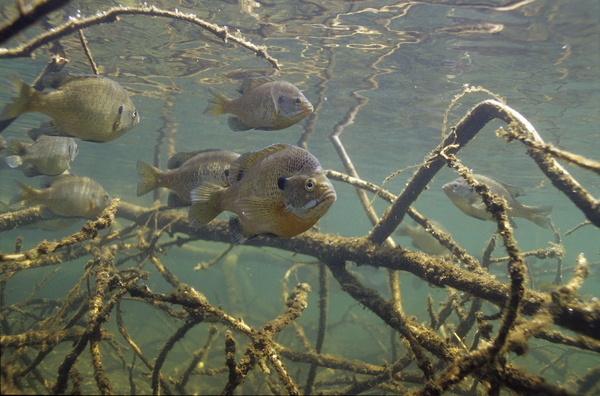
timber that provided important habitat for fish and other species. Today, those natural shorelines and their
abundance of downed trees can only be found in a few places. Lakes like those in Michigan’s undisturbed Sylvania
Wilderness Area for example, give us a glimpse of the way all our lakes looked
at one time.
As Wisconsin was settled and lakes were
developed, shoreline trees were removed to make swimming beaches or to create
an “uncluttered” look. Large trees still
growing along the shores were cut down to provide vistas of the lake for home
owners to gaze at from their cottage windows.
In a short period of time, most of the wood on Wisconsin’s lakes was
gone, eliminating a critical habitat element important to a wide variety of
animals who made their homes in or near the lakes.
Today, we recognize the damage we’ve
done by removing trees and interrupting the eons old process that replenished
our lakes with a constant source of wood.
While it may take hundreds of years to restore our lakes to begin to
resemble their original state, one innovative idea is jump-starting the
process. Referred to as “Fish Sticks”,
it’s a way to move wood back to our lakes that’s been lost. Fish sticks were made popular in Wisconsin by
Bayfield County Fisheries Biologist Scott Toshner. He’s worked on more than twenty fish sticks
projects in the past four years. "People
tend to clean up their shorelines and remove fallen trees," said Toshner.
"Sometimes the trees never get the chance to naturally fall into the water
because lawns have taken over eliminating trees, shrubs, and ground cover.
Fortunately, some northern Wisconsin communities are taking action to turn back
the clock and restore the habitat on which fish, frogs, turtles, bugs,
songbirds, ducks, and other critters thrive. Not only that, but they're good
for water quality and shoreline protection, too."
Last year,
a similar project, called “tree-drops” began on Florence County’s Lake
Emily. Tree drops are helpful but differ
in that they usually involve single trees.
While their impact is important, a single tree can’t do the same job as
multiple fish sticks. Dr. Mike Bozek,
formally of UW-Stevens Point, has studied this distinction. “Submerged trees located closer to other submerged trees
result in greater numbers and diversity of fish compared to individual trees.
Larger numbers of submerged trees create a mosaic
of habitats over greater shoreline areas than single trees do. This underscores
the importance of riparian areas. We need to manage entire riparian areas and
develop complex littoral zone habitats, not just individual trees.”
As science has begun to better understand the importance of
woody habitat in lakes, one type of habitat enhancement that’s been used on Wisconsin’s
lakes for generations is on the way out.
In recent years, Fish cribs, have fallen out of favor with fish
managers. New studies show it’s a poor
substitute for more natural and legitimate types of fish habitat like fish
sticks. "With the fish cribs, the one thing you kind of miss with them is
the link between the near shore area where a lot of these fish spawn and spend
their lives as juveniles ... [With fish sticks] the wood in this near shore
area may be a missing link in terms of habitat in some of these lakes,"
Toshner said.
To further
illustrate the difference between single tree drops and fish sticks complexes,
we can look to Bony Lake in Bayfield County.
This 191 acre lake was one of the first to employ fish sticks. To date, more than 400 trees have been added to the lake, and they’re not done
yet. This may seem like a whole lot of
wood, but in truth, it’s only a fraction of what the lake would have contained
had shoreline property not been radically altered by development. Toshner hopes
that as users of lakes, we’ll redefine our idea of what beauty is and discard our
desire to create white sandy beaches and instead embrace the wild, unorganized,
and natural look of shorelines comprised of fallen trees. “Fish sticks projects are paying off in
northern Wisconsin lakes by providing critical habitat for fish and insects,
birds, turtles and frogs," says Toshner. “Beaches are really ecological
deserts which don’t support any habitat or sustain any life”.
A
new streamlined permit available from the state and an easy step-by-step guide
for fish sticks is now available from the Wisconsin Department of Natural
Resources. This will help lake
associations or individuals get started with their own lake improvement
projects that incorporate fish sticks.
Scott Toshner is excited about the changing landscapes of our lakes and
is optimistic about how as stewards we’ll make better decisions in the
future. "If people can see that trees in the
near shore area are a valuable resource, they're less likely to remove a tree
that might fall in along their own shoreline."




 Posts
Posts


