Engbretson Underwater Photography

Search The Fish Photos


News From Behind the Scenes at Engbretson Underwater Photo and Stories about the Freshwater Environments We Visit.


Saturday, August 24, 2019

Where to Find Walleyes-Secret Locations That Are Often Overlooked

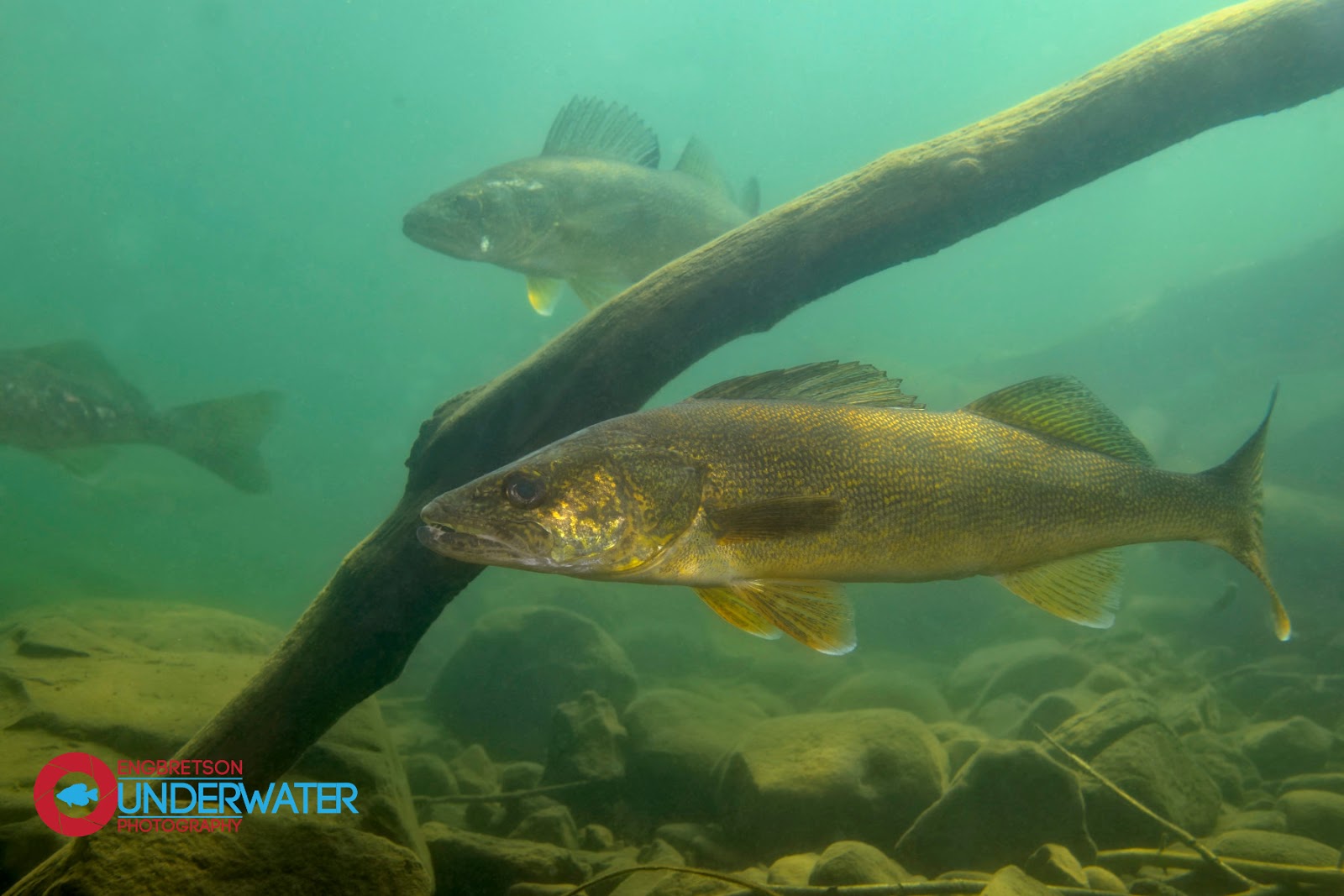
Often times when I'm coming off the lake and loading my scuba diving equipment and cameras into the car, fisherman will approach me at the boat landings to ask "Did you see any fish?"  Or, "Where are all the big ones?"  Since I'm actually under the water swimming with the fish, I do notice some things that escape most fisherman.  So in answer to the question, "Where are the fish?" I've compiled a list of the five most surprising areas where I regularly encounter walleyes that few fisherman pay any attention to. How many of these locations do you completely ignore when targeting walleyes?

1) Shallow Water. Since I'm trying to photograph fish, I tend to concentrate on areas where the light is the best.  This often means depths of 12 feet or less.  This shallow water is where I take 90% of my walleye pictures.  It's surprising how many fish can be found close to shore in water that's barely over your head.  If there are large submerged trees close to shore, I almost always find walleyes there.  Most walleye fisherman ignore shallow water, but I can tell you that the fish are there.

2) Under boat docks.  Not all boat docks have walleyes under them, but the ones that share certain characteristics will hold walleyes most of the year.  Nobody seems to fish for walleyes around shallow boat docks, but if you can find ones that have a hard or gravel substrate, extensive areas of shade, and deep water nearby, you'll find walleyes there.

3) Eurasian Watermilfoil.  This invasive plant is almost universally regarded as bad, but fish love milfoil.  If I'm on a lake where EWM is present, I head right for it. It's a fish magnet for all species including walleye.  Sometimes I'll find walleye cruising along the deep edge of milfoil colonies, but usually they're buried inside the thickest and most dense parts of milfoil beds.  It's hard to photograph walleyes in cover this thick and just as difficult to fish for them in these areas, but they're always there.

4) Fish Cribs.  Everyone knows that there are fish around fish cribs, but they aren't as famously known to be places to find walleyes.  The walleyes I see around cribs fall into two categories. Inactive fish are typically underneath the cribs, or buried deep inside them in thick brush.  Active fish cruise cribs in a radius that can extend up to 20 feet.  While it's easy for me to photograph them here, catching them here is harder because there's often an abundance of bass or panfish around that are higher in the water column that will strike the baits or lures before the walleyes get a chance to.  In the presence of other fish, walleyes are timid and won't fight a rock bass or smallmouth to get to a bait first.

5) Sunny days.  The last location where I always find walleyes isn't a location at all, but a condition.  Walleyes have a reputation for avoiding bright sunshine, or going deep on sunny days.  When I'm photographing fish, I relish bright sunny days with calm surface conditions and I'm usually in the water around high noon when the light penetration into the water is the best.  You might think these would be terrible conditions for walleye fishing, but I can tell you I encounter plenty of large walleyes actively feeding during these times... often in shallower water.  If you're a walleye fisherman and as a rule, avoid fishing during the midday hours or on bright sunny days, you're missing out on good opportunities to encounter fish.

For over twenty years I've been photographing walleyes underwater and those are some of my go-to places.  They're certainly overlooked locations and might even seem counter intuitive to most walleye fisherman, but I wouldn't be wasting my own time with them if they weren't highly productive.

(To view our walleye image gallery, click here.)
(For more on walleye behavior click here.)

Friday, July 26, 2019

Largemouth Bass Underwater in HD

We're getting some really nice Largemouth Bass images this summer showing these fish using thick weed cover, sunken timber and other natural habitat elements.  Check out all our latest Largemouth Bass in our Largemouth Bass Gallery. We're also getting some very nice HD video of these fish and we have some superb b-roll footage available.  As always we're interested in partnering with producers of outdoors related content who are looking for excellent high-quality underwater footage of freshwater game fish to include in their programs and films. For more information on licensing our video clips for your project contact us.  

Friday, June 28, 2019

The Best Thing About Being An Underwater Photographer


What's it like to be a professional underwater photographer? It’s like every day is Saturday!  

Sometimes in the mornings when I’m driving to a lake I plan to shoot in, I’ll see people on their way to work.  Inside the other cars are guys wearing suits and ties holding cellphones in one hand and spilling coffee from the other.  Often they have scowls on their faces.  The stress and despair is evident in their zombie-like gazes and they haven’t even arrived at the office yet.  Meanwhile, I’m in shorts and sandals and heading to my office: the lake bottom.  I never forget that I was just like them not too long ago, and I feel so grateful and appreciative of the life I have now. I’m really lucky to love what I do, and do what I love.  I wouldn’t trade places with anybody.  

The early days were tough. I began taking pictures professionally in 1993.  I was disillusioned with my previous occupation (radio broadcasting) and was looking for some kind of business where I could set my own hours and be my own boss.  I had no training or education in photography whatsoever and knew nothing about the business aspects of shooting, selling and marketing stock images.  But I had a passion for my subject matter that made up for my lack of experience and knowledge. I loved fish, and I just wanted to show people images of common freshwater fish that perhaps they’d never seen before.  Seeing underwater Images of freshwater fish in their natural habitat were almost as rare then as they continue to be today.  I was motivated by three things:  1) I wanted to create a self-sustaining income that would replace my regular 9-5 hamster wheel job, 2) I knew it had to something that I enjoyed, had fun with, and would never regard as work, and 3) I wanted to generate in others the same kind of awe and appreciation I had for fish, and I thought that through photos I might be able to do that.     
During those humble early years, it was difficult to even find a mentor. There were many underwater photographers, but none who worked in freshwater with the subjects I was interested in.  One guy who did a little of the kind of photography I wanted to do was Doug Stamm.  He became a role model to me because of the way he was able to sell and market so many of his images to the same venues that I would later work for.  I remember going to the magazine stand and counting the number of covers and inside pictures he was selling in any given month and being astounded.  One of my goals then was to generate an income I could live from, so seeing what Doug was doing gave me hope that it was indeed possible. 

I’ve gotten so much help over the years.  I can’t begin to tell you about all the different individuals who have made it all possible.  From fisheries biologists who share information with me about lakes and fish behavior to lake-front property owners who grant me access to their lakes and suggest specific places to check out. There’s been family members who gave me financial support in the early years that made it possible for me to spend time shooting instead of “working”.  There’s literally been hundreds of people who certainly share a part in my success.  

But not every association was useful. Because of the uniqueness of what I was doing, it was difficult to find a group of people to relate to.  I dive underwater to photograph fish, but I’ve found I have little in common with either photographers or divers.  The photography people just wanted to talk about cameras.  The scuba diving people just wanted to talk about dive computers or dive vacations.  Nobody wanted to talk about fish.  I felt very alone until I began meeting professional fisheries biologists. Those were the friendships that were naturally harmonious. I'd finally found a group of people, who like me, could talk about fish all day long.

I'm often asked what advice I have for aspiring underwater photographers. I think today it's very difficult to make a living in this field. The saltwater environments are really saturated with photographers, many of whom have the world’s best locations in their back yards.  It would be extremely difficult to compete with them.  They actually live in the same places that others spend thousands of dollars and travel thousands of miles to get to.  How can you possibly compete with someone who has access to places like that 51 weeks of the year more than you do?  Freshwater however, is a different situation altogether.  Freshwater material is an area nobody is covering, so there is no competition.  On the down side, the demand for freshwater images isn’t as great either.  I’m hoping to draw more awareness to freshwater environments so that more people will become aware of the importance of these ecosystems.
I think there’s always room for more good photographers, and I think interest in underwater subjects will continue.  I encourage beginners to learn about their subjects.  Become an expert on the life and behavior of your animal subjects.  Become a steward of their habitat.  Think of yourself as a PR person for that particular animal.  If you do this, you’ll show them in the best light, you’ll be mindful of disturbing them, and your work will automatically show these creatures at their most magnificent.  Don’t sell pictures.  Instead, fall in love with your subjects and sell that love!  And instead of exploiting them for personal profit, you’ll become partners with them in calling attention to their inherent beauty and value in the ecosystem, and the special problems each one of them face in an increasingly crowded world.   You know, the freshwater world has never had an ambassador in the same way the oceans had Jacques Cousteau.  Perhaps, all of us who spend time in lakes can collectively be some sort of equivalent to that.  At least that's my dream.
Speaking of dreams-  I often refer to the small group of freshwater photographers that my stock photo agency represents as the “dream team”. I look for people who have a genuine interest in freshwater subjects.  They’re not as glamorous and sexy as whales, dolphins and sharks, so very few people are attracted to them.  I look for people who can competently take a picture and get it technically right.  And I look for people who are going to be shooting freshwater with some regularity and frequency.  Anybody can get a picture here or there, but I want someone who’s going to be generating new material often.  That essentially means someone who's spending a whole lot of time in freshwater.  
I see how miserable many people are at their daily jobs, and I still remember what it was like to live that way.  I’m thankful and appreciative for what I have and the niche I’ve carved out.  I guess my only goals are to be able to get up tomorrow morning and do the same thing all over again.  For people lucky enough to have a career that brings them genuine joy, it’s indescribable.  You’d do it for free because you’re so passionate about it.  It’s like being on vacation every day.  When there’s no distinction between work and play, you know you’re there.  What more could anyone want?

Monday, May 27, 2019

How Does Artificial Fish Habitat Work?

The Science Behind Fishiding Artificial Fish Habitat


I recently collaborated with David Ewald from Fishiding.com on a ten-part video series that explains how artificial fish habitat works. In the videos, which you can watch on myYouTube channel, we examine many of the characteristics that are necessary to design the kinds of structures that serve fish most effectively.

While natural elements like trees, stumps, rocks and plants provide the best habitat, artificial surrogates have a place in this conversation. The bottom of many southern reservoirs resemble moonscapes and there is little if any existing natural habitat. In many of these man-made lakes, man-made habitat is often the only viable option to provide young fish with the kind of sanctuaries they require to survive the challenges of early life.

In our video series “The Science behind Fishiding Artificial Fish Habitat”, we show you never-before-seen underwater footage of how fish utilize this habitat and why it should be considered a legitimate tool for fisheries professionals faced with managing waters where habitat is marginal.

If you’re interested in watching the videos, make sure you also read the 800 word narratives that accompany each video. Each narrative provides a complete description of the footage you see and points out key aspects of design, function, installation, testing, configuration, size and complexity. There really is a lot to know, but we’ve worked to distill everything we’ve learned into an easy to understand presentation that we hope you’ll find both interesting and useful.

You can view the entire video series on YouTube here and on the Fishiding page here.

Wednesday, April 17, 2019

What are Wisconsin's Clearest Lakes?


What are the clearest lakes in Wisconsin?  Every year, I consult with Wisconsin's state-wide citizen's lake monitoring group. They're a network of individuals, usually lake-front property owners who monitor and regularly take a variety of water samples from lakes all across Wisconsin.  The data they compile helps to give us a look at how our lakes are doing. One of the many tasks lake monitors perform is to take regular sechi disc readings. This is a universal way of assessing and comparing water clarity.  I'm always interested in knowing which Wisconsin inland lakes are the clearest.  Here are the lakes that recorded the highest average water clarity in 2018. In short-here are Wisconsin's clearest inland lakes and their average water clarity in 2018:

1)   Lake Wazee, Jackson Co. 30.3 feet
2)   Whitefish Lake, Douglas Co.  27 feet
3)   Smoky Lake, Vilas Co. 26.7 feet
4)   Paya Lake, Oconto Co. 26.6 feet
5)   Black Oak Lake, Vilas Co. 26.5 feet
6)   Pine Lake, Waukesha Co. 25.5 feet
7)   Lake Metonga, Forest Co. 25.5 feet
8)   Presque Isle Lake, Vilas Co. 25 feet
9)   Mildred Lake, Oneida Co. 24.3 feet
10) Blue Lake, Oneida Co. 23.25 feet

To See the lake list from 2017, click here. To see the lake list from 2016, click here.To see the lake list from 2015, click here.  To see the lake list from 2014, click here.  For the lake list from 2013, click here.  And for the 2012 list of clear lakes, click here.

Tuesday, March 26, 2019

How To Photograph Timid Fish Underwater


In freshwater environments, photographing timid fish can be an exercise in frustration. After nearly 30 years of working with subjects underwater, I’ve learned a couple of things that might help you get closer to fish and get better images.
Since freshwater fish are relatively small, you have to get extremely close to them for striking, frame-filling pictures. On the other hand, this isn’t as difficult as it may seem. Once you see a fish, you need to make a quick assessment of its potential for your photographs. If it’s swimming away, let it go. Swimming after a fish is futile and results only in pictures of tails, not the stunning full-body portraits that you’re really trying to make. You’ll want instead to concentrate on fish that are not in motion. These are the easiest fish to photograph. Once you see a fish nearby, the first thing to do is to freeze and let the fish come to you. If you remain motionless and quiet, many fish are curious enough to swim right up to you for further investigation. Any sudden movements will cause them to swim away quickly.
Remain still and allow the fish to become accustomed to your presence. After a few minutes, if the fish doesn’t approach you, and it doesn’t swim off, move in closer. Do this slowly and only a few inches at a time, pausing with each new advance. Always try to approach fish mainly from the front. Let the fish see you. Because this approach is an unnatural tactic for a predator, the fish will more likely regard you as non-threatening if you behave like this in a slow and deliberate manner. As you move in closer and closer, stop to take a few pictures. Continue to move closer while carefully watching the fish. At some point, you will go beyond the fish’s zone of acceptable comfort. This is when the fish will retreat because you’ve gotten too close. But if you move slowly, studying the fish as you approach, you’ll see the early signs from the fish that you’re getting too near. It may begin to get nervous, to turn, or move slowly away. This is where you stop. This is as close as you’re going to get to this particular fish at this time. This is where you take your close-up pictures. If you’re doing it right, you should be only one to three feet away. Your pictures at this distance will be amazing, especially in very clear water on a bright sunny day!
It’s important to keep in mind that fish vary from lake to lake and species to species. If fish in a particular lake refuse to let you approach closely, go to another lake. There are just some places where fish don’t see many divers, snorkelers or swimmers.  In waters like these, they tend to be more apprehensive. On other lakes, where fish see people with more regularity, they’re less frightened by our presence.
 One technique I often employ is called the “swim by”. That’s where you make one pass near a group of fish at a distance. Your objective here is simply to be seen. You swim by not approaching them or barely even paying them any attention. This gives them an opportunity to see and evaluate you.  Later you can return to this group. They’ll be less alarmed because they’ve seen you before and their prior experience with you wasn’t regarded as hostile.  The “swim by” helps to build some confidence in timid fish.
Don’t be disappointed if you don’t get near enough for that breath- taking close-up every time you shoot. There will be other opportunities. With time and patience, you’ll enhance your skills at this method. With experience, you’ll get within arm’s length of most fish most of the time.