Engbretson Underwater Photography

Search The Fish Photos


News From Behind the Scenes at Engbretson Underwater Photo and Stories about the Freshwater Environments We Visit.


Showing posts with label photography techniques. Show all posts

Thursday, October 29, 2020

Photographing Native Fish in Freshwater Lakes: Overcoming the Obstacles

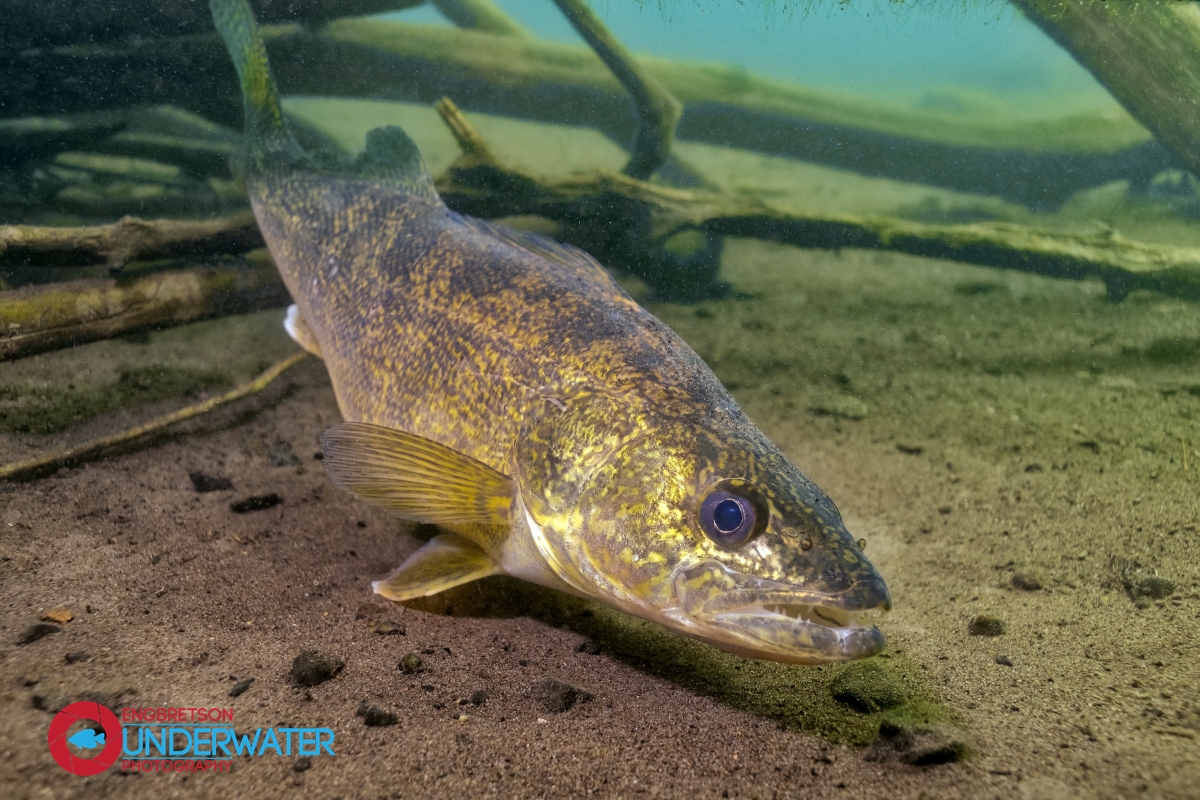
Walleye Underwater

I'm often asked what the biggest challenge is to taking underwater fish pictures.  Well, there are quite a few obstacles and many things that have to be right to be able to get a good picture.  First, the water has to be clear, which is actually a greater challenge than you might think.  Freshwater lakes are typically pretty crummy so finding lakes that have the necessary clarity is an ongoing process.  I usually won't even look at a lake if the clarity isn't at least 18 feet.  Water clarity can change from week to week and season to season too, so even though I have my favorite lakes, they’re not always clear enough to work in.  Everything starts with water clarity and if you don’t have that, nothing else matters.  It’s always a challenge to find clear water.

Once I find a clear lake, I have to find fish.  Next I have to find fish of desirable size.  This is easier said than done too.  It's always a problem especially these days when it seems like there’s fewer and fewer really nice fish available.  If I do find a lake that’s clear and it does have a few good fish, another challenge is getting close enough to photograph them.  I like to be 2 or 3 feet away.  Any further and I won’t take a picture at all.  Fish often times have a problem with a diver being that close, so it takes a lot of patience to even get close enough to think about composing a picture.  But once I have clear water, good fish, and get close enough to shoot them, I still have to make the shot.  So even if everything else is right, sometimes I blow it all on the final step because I was moving, or the composition is bad or I forgot to turn on the strobe, etc.….

A lot goes wrong.  Sometimes I feel like it’s truly a miracle to get any good pictures at all because so many things that I can’t control have to be right all at the same time.

Conditions underwater are typically very hostile to a photographer.  The lakes and rivers where I shoot can be very cold.  In rivers, currents can be strong, and visibility is always an issue.  Underwater photography is inherently tricky.  Water is 800 times thicker than air, and there's always particles floating around or algae and things like that, so you've never going to get the really "clean" look you can get shooting through air. The water is often cold, the fish can be elusive, and you've got to always be concerned about your air supply, so there's a lot to think about. The light underwater is very poor too, so often I have to carry underwater strobes to illuminate subjects in deeper water. If you can imagine taking photos on a dark, cold, foggy, windy day… that sort of comes close to the everyday conditions of the environment I work in.  Saltwater environments are infinitely easier.  The water’s 100 times clearer, there’s 100 times more light, and ocean fish are used to seeing very large things swimming around them.  In freshwater, you look like Godzilla to those poor fish.

So, yes-the challenges are many, but as I always say, "If it was easy, everyone would be doing this".

Monday, October 21, 2019

Mastering the Close-Up Fish Portrait: How It's Done


The number one mistake novice underwater photographers make is failing to get close enough to their subjects. Since freshwater fish are relatively small, you have to get extremely close to them for striking, frame-filling pictures. On the other hand, this isn’t as difficult as it may seem. 

Once you see a fish, you need to make a quick assessment of its potential for your photographs. If it’s swimming away, let it go. Swimming after a fish is futile and results only in pictures of tails, not the stunning full-body portraits that you’re really trying to make. You’ll want instead to concentrate on fish that are not in motion. These are the easiest fish to photograph. 

Once you see a fish nearby, the first thing to do is to freeze and let the fish come to you. If you remain motionless and quiet, many fish are curious enough to swim right up to you for further investigation. Any sudden movements will cause them to swim away quickly. Remain still and allow the fish to become accustomed to your presence. After a few minutes, if the fish doesn’t approach you further, and it doesn’t swim off, move in closer. Do this slowly and only a few inches at a time, pausing with each new advance. 

Always try to approach fish mainly from the front. Let the fish see you. Because this approach is an unnatural tactic for a predator, the fish will more likely regard you as non-threatening if you behave like this in a slow and deliberate manner. As you move in closer and closer, stop to take a few pictures. Continue to move closer while carefully watching the fish. At some point, you will go beyond the fish’s zone of acceptable comfort. This is when the fish will retreat because you’ve gotten too close. But if you move slowly, studying the fish as you approach, you’ll see early signals from the fish that you’re getting too near. It may begin to get nervous, to turn, or move slowly away. This is where you stop. This is as close as you’re going to get to this particular fish at this time. This is where you take your close-up pictures. 

If you’re doing it right, you should be only one to three feet away. Your pictures at this distance will be amazing, especially in very clear water on a bright sunny day! It’s important to keep in mind that fish vary from lake to lake and species to species. Don’t be disappointed if you don’t get near enough for that breath- taking close-up every time you shoot. There will be other opportunities. With time and patience, you’ll enhance your skills at this method. With experience, you’ll get within arm’s length of most fish most of the time. 

If you have a question or comment about photographing fish in freshwater environments, you can contact me at eric@underwaterfishphotos.com

Saturday, September 28, 2019

Working with Fish Models: The Best Angle To Photograph Fish


Recently, a friend of mine commented on my photography: "I can always spot your fish images when I see them in magazines...", he said. "It's because you always show the fish from below".  I haven't thought about that for a long time, but he's right.  

When I first began taking portraits of fish underwater, I was almost always hovering above the fish looking down on them.  It was just more convenient for me to shoot pictures that way.  The images were Ok, but this angle tended to give them a flat and uninteresting look. It also made them somehow insignificant or easily dismissible. Every beginners book on photography points out that pets and children will always look awful when photographed from above and that you should try to shoot them at eye-level.  I began trying this underwater with fish and noticed the immediate improvement in my images.  

Later, I was reading about Vogue and Cosmo photographers and how the pros never shoot a super-model from below unless she has a terrific jaw-line.  It occurred to me that fish, with their gills, all had great jaw-lines, so I began getting below eye-level and photographing them from below.  The results were so breathtakingly stunning that I began to try to compose every fish picture this way.  Over time, it's become a distinct hallmark of my work.  I'm convinced that it's the best angle to photograph fish underwater.

I think it's incumbent on all wildlife photographers to portray their subjects with as much style and beauty as possible.  This is easy to do with cuddly puppies and furry baby seals, but with reptiles, amphibians and even fish, we often have to work hard to convey their inherent beauty to our audience. People will always care more about pretty things than ugly ones. That's just human nature. 

As a fish photographer, I feel a responsibility to my subjects to try to portray their magnificence in every picture I make. Because of this, I usually won't shoot fish with split fins, scars, injuries or other physical deficiencies. Instead I look for fish that are healthy and vibrant. I want the best ambassadors of each species to represent the entire population. If I want viewers to care about fish the way I do, I have to make it as easy as possible for them to appreciate and embrace these finned marvels.