 |
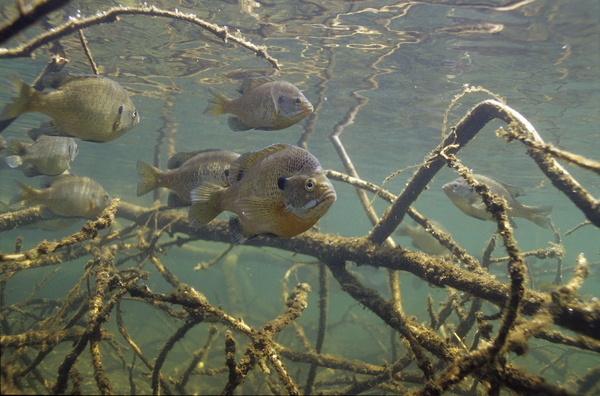
| Large Bluegill |
Often,
when I’m coming out of lakes in my scuba gear with cameras, I’m approached by
fisherman who ask me “if I saw any big ones?”
The answer is usually yes and
no. As you might expect, the large fish
I tend to see are species where catch and release fishing is the norm. It’s common to see giant smallmouth bass and
large muskies, because while fishing pressure is often heavy on these species,
they’re almost always released to
grow bigger. Conversely, species that
don’t enjoy high levels of catch and release and are kept for the dinner table
like walleyes, bluegills, crappie, and yellow perch have a harder time reaching
their full potential. So I don’t often
see large panfish with regularity. I still encounter some very large walleyes because regulations like slot limits
that are in place in many waters help to keep fish in the system longer which
means they have an improved chance to reach larger sizes.
So
how much does harvest affect fish sizes?
I think it’s pretty significant.
Liberal
bag limits on panfish for example will likely not lead to decreased abundance,
but they do cause poor size structure.
When bluegills get around 7 inches, and are at a size worth cleaning and
eating, very few of them are released.
So the population gets further compressed into mainly fish that are 6
inches or less. It tends to be the same
way with yellow perch and crappie. The
problem is not the total amount of the harvest, but the selective harvest of what fish managers call “quality fish”.
Since
larger panfish are less common than smaller, younger fish, they often can’t
sustain this extra selective targeting.
While many fisherman have long encouraged letting the big ones go and keeping a few smaller ones for the
frying pan, it doesn’t seem like this is happening on a scale that could make any
real difference. Quality panfish are
being targeted and harvested and the numbers of larger, older fish have plummeted.
I
spend 70-90 days a year in lakes taking fish pictures. That’s a lot of time underwater where I observe many fish. In an average year, in
dozens of different lakes, I might see only one or two 10 inch bluegills a year. That’s how rare they are. Perch of the same size are also rare as are
large crappie. I think it’s important
for fisherman to realize that when they catch an 10 inch bluegill and put
it on the stringer, they are very likely removing the largest bluegill from that
lake. On smaller sized bodies of water,
this is most certainly true. You might
erroneously think there must be many others of that size, so taking that single
large fish wouldn’t be reason to pause.
But if you could be with me in these lakes and see what I see, you would
realize how truly rare and special these large panfish are. If you knew
you were removing the largest fish of that species from the lake, would it make
any difference to you?
Fish managers are aware of the declining numbers of larger panfish
available in Wisconsin Lakes, and have been working on new panfish regulations
that would address overharvesting of quality fish. When I asked Andrew Rypel, the top panfish expert with Wisconsin’s DNR about the problem, here’s what he told me:
“There is no doubt that anglers probably affect
bluegill size structure more than any other factor in
Wisconsin. However in our statewide surveys of angler attitudes and
public hearings, we were unable to find public support at this point in
time for changing the statewide panfish
regulation, but we did find support for doing
something about problem lakes where we thought angling was the
problem. The adaptive panfish management plan is definitely not
a permanent solution to broad-scale overfishing of panfish,
but it does allow us to conduct a large-scale science-based
study that will allow us to learn more about conservation management
of all three of our big panfish species. It's unique among approaches
taken in other states (almost all of which still have only high bag limits) and
allows for the potential to manage lakes in the future on more
of a lake-specific basis. So in a sense, Wisconsin is becoming a
leader on this topic, albeit on a limited basis. However, I believe the results
of this work will be helpful to our managers in the near future. For example,
some lakes can probably take more harvest sustainably, however others can tolerate only very
little harvest. I'll bet you could take a pretty good
guess at which lakes might fall into these categories based on your
knowledge of underwater habitats, lake fertility and fish abundances. It
is indeed amazing to see unfished bluegill populations -
to see the full complement of ages in their population. It would be nice to have some populations like
this in Wisconsin that weren't in the middle of nowhere, and only have
size-structures like this because people cannot access the lakes. However, we
are taking a step in the right direction, and my sense is that most anglers
want to do the right thing for future generations.”




 Posts
Posts


