Engbretson Underwater Photography

Search The Fish Photos


News From Behind the Scenes at Engbretson Underwater Photo and Stories about the Freshwater Environments We Visit.


Thursday, October 29, 2020

Photographing Native Fish in Freshwater Lakes: Overcoming the Obstacles

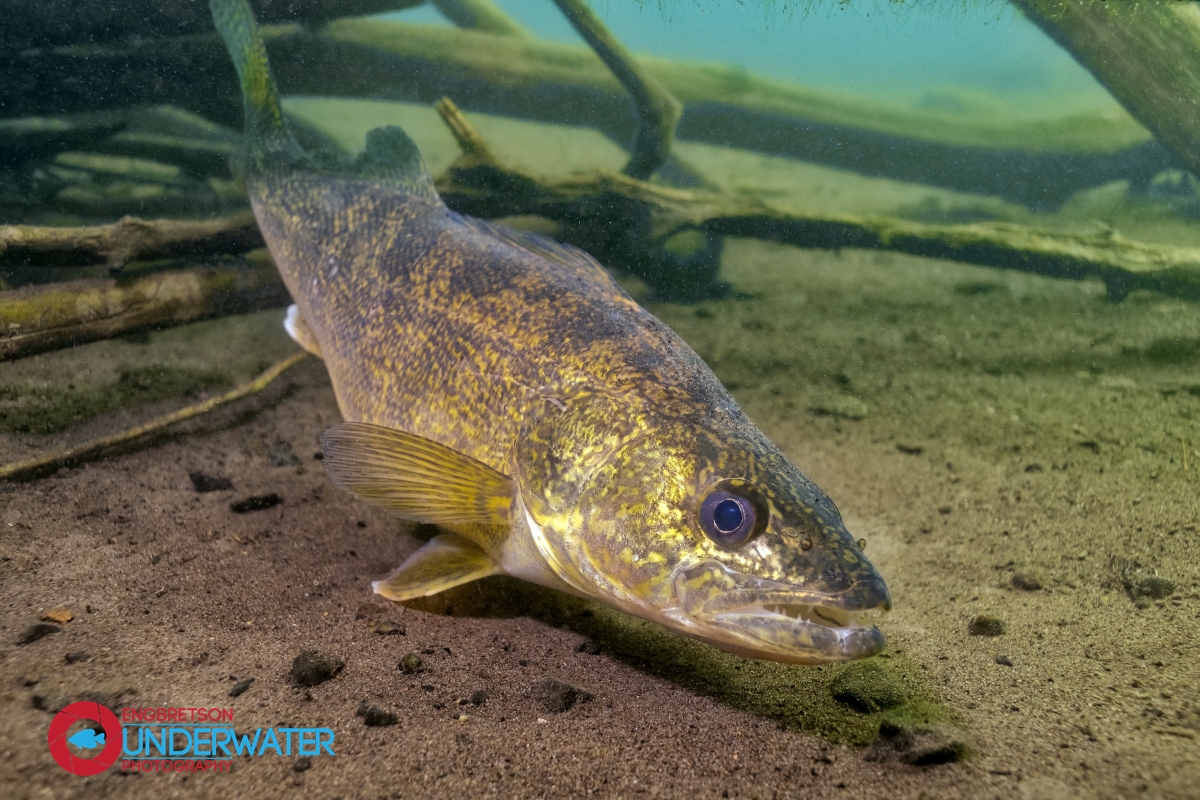
Walleye Underwater

I'm often asked what the biggest challenge is to taking underwater fish pictures.  Well, there are quite a few obstacles and many things that have to be right to be able to get a good picture.  First, the water has to be clear, which is actually a greater challenge than you might think.  Freshwater lakes are typically pretty crummy so finding lakes that have the necessary clarity is an ongoing process.  I usually won't even look at a lake if the clarity isn't at least 18 feet.  Water clarity can change from week to week and season to season too, so even though I have my favorite lakes, they’re not always clear enough to work in.  Everything starts with water clarity and if you don’t have that, nothing else matters.  It’s always a challenge to find clear water.

Once I find a clear lake, I have to find fish.  Next I have to find fish of desirable size.  This is easier said than done too.  It's always a problem especially these days when it seems like there’s fewer and fewer really nice fish available.  If I do find a lake that’s clear and it does have a few good fish, another challenge is getting close enough to photograph them.  I like to be 2 or 3 feet away.  Any further and I won’t take a picture at all.  Fish often times have a problem with a diver being that close, so it takes a lot of patience to even get close enough to think about composing a picture.  But once I have clear water, good fish, and get close enough to shoot them, I still have to make the shot.  So even if everything else is right, sometimes I blow it all on the final step because I was moving, or the composition is bad or I forgot to turn on the strobe, etc.….

A lot goes wrong.  Sometimes I feel like it’s truly a miracle to get any good pictures at all because so many things that I can’t control have to be right all at the same time.

Conditions underwater are typically very hostile to a photographer.  The lakes and rivers where I shoot can be very cold.  In rivers, currents can be strong, and visibility is always an issue.  Underwater photography is inherently tricky.  Water is 800 times thicker than air, and there's always particles floating around or algae and things like that, so you've never going to get the really "clean" look you can get shooting through air. The water is often cold, the fish can be elusive, and you've got to always be concerned about your air supply, so there's a lot to think about. The light underwater is very poor too, so often I have to carry underwater strobes to illuminate subjects in deeper water. If you can imagine taking photos on a dark, cold, foggy, windy day… that sort of comes close to the everyday conditions of the environment I work in.  Saltwater environments are infinitely easier.  The water’s 100 times clearer, there’s 100 times more light, and ocean fish are used to seeing very large things swimming around them.  In freshwater, you look like Godzilla to those poor fish.

So, yes-the challenges are many, but as I always say, "If it was easy, everyone would be doing this".

Saturday, September 26, 2020

The Prettiest Freshwater Fish

Pumpkinseed Sunfish by Engbretson Underwater

"A very beautiful and compact little fish, perfect in all its parts, looking like a brilliant coin fresh from the mint." - David Jordan and Barton Evermann-American Food and Game Fishes, 1905.

One of the most colorful of our common freshwater fish is the​ Pumpkinseed Sunfish. Like other sunfish, I think the most striking photographs of pumpkinseed are images of male fish photographed in the spring when they display their vibrant spawning coloration.  They look like jeweled treasures. However, pumpkinseeds retain much of their brilliant hues all year as evidenced by this photo I took in mid September. 

One of the most interesting things about Pumpkinseeds is the strong instinct they have for a home range. Pumpkinseeds have a remarkable ability to find their way back to a familiar location. In fisheries studies, pumpkinseeds that have been captured, marked, and then released in another part of the same lake, are often recaptured near the location where they were first caught.

As fall began I was able to take pictures of several gorgeous Pumpkinseeds staging in deep water along well defined weed-lines in a northern Michigan lake. Aren't they magnificent little fish?  You can view all of my newest underwater pumpkinseed images in our ​Pumpkinseed Sunfish Gallery here.

Sunday, August 23, 2020

Summer Largemouth Bass-Where to Find Them

Largemouth Bass in Milfoil

It's late summer and we're getting some really attractive Largemouth Bass images showing these fish using thick weed cover and a variety of other natural habitat elements.  

At this time of year, we face several obstacles when photographing bass. They tend to be harder to find because they're occupying all areas of the water column and tend to be widely dispersed. Water clarity diminishes this time of year as well, making normally suitable lakes too murky or "green" for good photography.  Finally, there's a seasonal shift in attitude of these fish by August.  Bass that were very approachable in the spring have become more wary and timid by late summer, so getting closeups of them becomes more difficult.  

Despite all those challenges, we're still able to get some fine images of them in their natural habitat.  Check out all our latest Largemouth Bass in our Largemouth Bass Gallery.

Thursday, July 30, 2020

There's a Poisonous Spider in Your Wetsuit!

It was a normal day much like any other. I drove from my home in northern Wisconsin to a nearby lake in Michigan’s Upper Peninsula to take underwater pictures of largemouth bass.  The water was clear, the fish eagerly posed for my cameras and another successful dive trip was in the books. While changing out of my wetsuit I noticed what I thought at the time was a mosquito bite on the calf of my leg. I work in lakes and rivers every day, so dealing with insect bites are routine. I didn’t think anything of it. The next morning, the bite seemed to look a little odd and I took this picture of it.


By the end of the day, it was clear that the bite was infected and looking worse. The doctor I saw that evening told me it was likely a non-venomous spider bite. She prescribed a dose of antibiotics, bandaged it and sent me on my way. Three days later, I was in the emergency room. My entire leg was severely swollen and had turned bright red. The area around the bite was badly infected and turning black. ER doctors peppered me with questions and determined that the bite had come from a Brown Recluse Spider, one of three venomous spiders we have in the USA.

The bite of brown recluse spiders contain a potentially deadly hemotoxic venom.  These toxins destroy red blood cells, disrupt blood clotting and cause tissue damage.  We’ve all heard terrifying stories of what can happen to people who are bitten by brown recluse spiders. The worst cases, the ones that get all the press, are indeed horrifying.
 

In the ER, I was immediately placed on a powerful antibiotic IV drip. The prescription antibiotics I had been taking are ineffective against venomous spider bites. They were replaced by a much stronger type. I was also prescribed another drug that is typically used to treat leprosy, to help prevent possible tissue loss.  

The doctor who examined me speculated that my wetsuit had caused compression on my leg that may have exasperated the effects of the bite and the amount of venom the spider had injected.  Did the spider somehow get into my wetsuit while I was at the lake, or did it crawl inside the suit while it hung in its regular place in my basement laundry room?  Who knows? 

It’s been four weeks and my wound is barely noticeable now. I consider myself lucky that I won’t have a permanent scoop mark or divot in my leg. Scuba diving has inherent risks and dangers, but until now, I never thought those risks also included poisonous spider bites. 

From now on, I’ll be diligent where I store my wetsuit between dives. More importantly, I think it’s critical to carefully check your wetsuit, dive boots, gloves, and all your dive equipment before every use. They all provide the kind of dark and secluded hiding places spiders like to inhabit, especially if they’re routinely stored in your basement or garage.        

Saturday, June 20, 2020

What's the Easiest Fish to Photograph Underwater?

Smallmouth Bass Underwater (c)Eric Engbretson

I received an email the other day from someone who asked me what I thought was the easiest fish to photograph. Well, none of them are that easy to photograph well, but if I had to pick one that gave me the least trouble, it would be smallmouth bass. The reason for that is they have a unique inherent curiosity and sociable nature. They’re not by nature a timid fish so they'll eagerly come around you. I think they've learned that divers stir up food items. They’ve kind of put that together. So when you get in the water, you’ll get them following you around after a while. It’s not unusual at the end of a dive to have 15 or 20 smallmouth bass in a parade, following you. 

If a smaller one comes too close to you the larger ones will chase them away so they can have exclusive access. Because they are so friendly and easy to approach, you can blow all the bubbles you want to or spend crazy amounts of time fooling around with different camera adjustments or lighting angles without worrying about them being scared off.  

They're an excellent fish to spend time with if you're a novice photographer, because they have loads of patience. But after decades of underwater photography, I wouldn't say photographing them is especially challenging. At the end of a dive, if I can’t find anything else, that’s when I do the smallmouth pictures.

So, what's the most difficult fish to photograph? I think it's the carp. They are so aware. They have excellent vision and hearing. They can see you so far away in clear water and if you make any slight noise, they're gone. Even if you don’t blow a bubble but you take a breath, it makes a tiny whooshing noise. It’s such a tiny sound, but they hear that and they react. You have to be so still and so quiet. 

What I do with carp is I pick a spot where I know they’re milling about and I get behind a rock and hide and hopefully one will cruise by. If they see you it’s over. They’re really smart and are really sensitive to the bubbles of divers. That's why they give me so much trouble. But they're not the only species that are bothered by bubbles. Crappie, yellow perch, trout, catfish, sturgeon are some others. They’re all hard to get close enough to to get great pictures. To be successful, you need patience, and frankly a lot of times luck.


Tuesday, May 26, 2020

What are the Clearest Lakes in Wisconsin? 2019 Report


What are the clearest lakes in Wisconsin?  Every year, I consult with Wisconsin's state-wide citizen's lake monitoring group. They're a network of individuals, usually lake-front property owners who monitor and regularly take a variety of water samples from lakes all across Wisconsin.  The data they compile helps to give us a look at how our lakes are doing. 

One of the many tasks lake monitors perform is to take regular secchi disc readings. This is a universal way of assessing and comparing water clarity.  I'm always interested in knowing which Wisconsin inland lakes are the clearest.  Ordinarily, I rank the lakes that recorded the highest average water clarity for the previous year. This year, I'm looking at lakes that recorded the single highest secchi disc reading in 2019. Here are Wisconsin's clearest inland lakes and their highest single day water clarity readings taken in 2019:

1)   Pine Lake, Waukesha Co. 52 feet
2)   Lake Metonga, Forest Co. 37 feet
3)   Maiden Lake, Oconto Co. 35 feet
4)   Wazee Lake, Jackson Co. 34 feet
5)   Sugar Camp Lake, Oneida Co. 33 feet
6)   Whitefish Lake, Douglas Co. 31 feet
7)   Lake Lucerne, Forest Co. 31 feet
8)   Deer Lake, Polk Co. 30 feet
9)   Crystal Lake, Marquette Co. 29 feet
10) Stone Lake, Washburn Co. 29 feet
11) Lake Owen, Bayfield Co. 29 feet
12) Blue Lake, Oneida Co. 28 feet
13) Smoky Lake, Vilas Co. 28 feet
14) Millicent Lake, Bayfield Co. 28 feet
15) Big Portage Lake, Vilas Co. 28 feet

To see the lake list from 2018, click here. To see the lake list from 2017, click here. To see the lake list from 2016, click here.To see the lake list from 2015, click here.  To see the lake list from 2014, click here.  For the lake list from 2013, click here.  And for the 2012 list of clear lakes, click here.