Engbretson Underwater Photography

Search The Fish Photos


News From Behind the Scenes at Engbretson Underwater Photo and Stories about the Freshwater Environments We Visit.


Wednesday, March 17, 2021

What we Can Learn From Fish When We Spend Time With Them:

Do fish have individual personalities? I'm often asked this question and I have some definite thoughts about it. For me, the answer is unequivocally yes. I’ve been photographing fish underwater in their natural habitat for over 25 years. In that time, there are long stretches when I’ve worked with the same individual fish for years at a time. I think most would agree that just like the personality distinctions one could make between say poodles and collies, distinctions between different types of fish certainly exist. Northern pike have different personality traits than largemouth bass and bluegills. Each species possess their own “group personality identity”.  But I would also suggest that it goes further than that. Individual fish behave differently from their cohorts and exhibit what can only be regarded as unique personalities with as much depth and richness as those of our own pets. 

Epiphanies about fish like this one can easily escape the casual observer and are only possible when one spends an extended amount of time observing and interacting with them. But because fish live in a world separate from ours, it’s difficult to do this in the same way birdwatchers can for example.  To observe fish in their natural habitat, we have to go under the surface with masks & snorkels or diving equipment. 

On warm summer days, our lakes are filled with swimmers and boaters, but they’re largely unaware of the diversity of life that swims just below them. We’re deaf to a grand symphony in concert under the surface. In recent years kayaking has become a very popular way to enjoy our waters. I’d love to see snorkeling gain that same kind of popularity in our inland lakes and become something you do every weekend, and not just when you’re in Hawaii on vacation. 

I’d encourage anyone interested in animals, and especially those interested in fish specifically to explore snorkeling as a way to observe and enjoy fish. They’re so fascinating to watch and there’s much we can learn about them.

Saturday, February 20, 2021

What are the Clearest Inland Lakes in Wisconsin? The 2020 Report:

For the best underwater photography, finding clear water with high transparency is essential. So what are the clearest lakes in Wisconsin?  Every year, I consult with Wisconsin's state-wide citizen's lake monitoring group. They're a network of individuals, usually lake-front property owners who monitor and regularly take a variety of water samples from lakes all across Wisconsin.  The data they compile helps to give us a look at how our lakes are doing. 

One of the many tasks lake monitors perform is to take regular Secchi disc readings. This is a universal way of assessing and comparing water clarity.  I'm always interested in knowing which Wisconsin inland lakes are the clearest.  Ordinarily, I rank the lakes that recorded the highest average water clarity for the previous year. This year, I'm looking at lakes that recorded the single highest Secchi disc reading in 2020. Because of Covid-19, not all the usual lakes were sampled at their usual intervals, so we have only the data that was collected. With that in mind, here are Wisconsin's clearest inland lakes and their highest single-day water clarity readings taken in 2020:

1)   Upper Eau Claire Lake, Bayfield Co. 39.5 feet

2)   White Lake, Marquette Co. 36 feet

3)   Middle Eau Claire Lake, Bayfield Co. 35.75 feet

4)   Whitefish Lake, Douglas Co. 35 feet

5)   Blue Lake, Oneida Co. 32 feet

6)   Lee Lake, Oneida Co. 31.5 feet

7)   Black Oak Lake, Vilas Co. 30.5 feet

8)   Forest Lake, Vilas Co. 30.5 feet

9)   Stone Lake, Washburn Co. 30 feet

10) Pearl Lake, Waushara Co. 30 feet

11) Lower Eau Claire Lake, Bayfield Co. 29.75 feet

12) Bass Lake, Oconto Co. 29 feet

13) Smoky Lake, Vilas Co. 29 feet

14) Sugar Camp Lake, Oneida Co. 28.5 feet

15) Upper Nemahbin Lake, Waukesha Co. 28 feet


To see the lake list from 2019, click here

Monday, January 25, 2021

Why Underwater Photography in Freshwater?


I'm often asked why I'm interested in freshwater fish like bass and walleye.  Well, the freshwater world has never had an ambassador in the same way the oceans had Jacques Cousteau.  Perhaps, all of us who spend time in lakes can collectively be some sort of equivalent to that.

I think there’s always room for more good photographers, and I think interest in freshwater fish will continue.  I’d encourage beginners to learn about their subjects.  Become an expert on the life and behavior of these fish.  Become a steward of their habitat.  Whether it's a musky, a largemouth bass or a bluegill, think of yourself as a PR person for that particular fish.  If you do this, you’ll show them in the best light, you’ll be mindful of disturbing them, and your work will automatically show these creatures at their most magnificent.  Don’t sell pictures or videos.  Instead, fall in love with your subjects and sell that love!  And instead of exploiting them for personal profit, you’ll become partners with them in calling attention to their inherent beauty and value in the ecosystem, and the special problems each one of them face in an increasingly crowded world.

Sunday, December 27, 2020

2021 Fishing Calendar

Looking for a cool wall calendar for 2021?  Check out the 2021 Fishing Calendar from Bic Graphics featuring 13 images all from the Engbretson Underwater Photography team. Bass, salmon, musky, trout, and panfish are all represented in vibrant color expertly photographed underwater in their natural habitats. Click here to order from Amazon.com


Monday, November 30, 2020

How to Use GoPros to get Great Underwater Fish Videos

Whether you're scuba diving or just snorkeling, shooting nice underwater footage of fish from a nearby lake has never been easier. Here's a few answers to questions I'm often asked by beginners:

Where can I go?
No matter where you live, there's probably a pond, lake or river nearby teeming with fish and other interesting underwater subjects. It's important to find the clearest body of water you can, since clarity is critical to underwater videography. Contact your state's fish and wildlife office. They're very familiar with the characteristics of local lakes and can point you in the right direction.

Which GoPro should I use?
Gopro seems to come out with a new camera every year.  Their latest, the Hero 9 is their best by far. Waterproof to 33 feet without a supplemental housing, it's video and stabilization capabilities are superb. If you can't afford the newest GoPro, the Hero 8 and Hero 7 are also good choices. I wouldn't suggest using anything older than the Hero 6. The earlier models (1 thru 5) just don't work as well.

Do I need to use a filter?
If you use strobes as I do, you won't need filters to correct for losses in the light spectrum which filters are designed to compensate for. The term "strobe" is a bit of a misnomer. Basically any powerful waterproof flashlight will work as well. If you use strobe lights, you'll also need a handle and tray that you can attach your camera and lights to. This keeps everything together and is easy to hold and swim with.  Strobe lighting is wonderful because it brings out colors and fills in dark shadows. 

How do I get close to the fish?
The best way is to let them come to you. If you remain relatively still and non threatening, fish will usually come right to you which makes your video of them much more interesting that than the "tail shots" you'll always get if you chase them.  Fish are naturally curious and if you're patient, you'll find that they'll swim directly into your lens on their own.

I don't want to get wet. Can't I just mount my GoPro on a pole and shoot video that way?
You can try, but you'll be frustrated. Using a pole cam seems like a good idea, because you won't have to get your head underwater. But because you're not able to see through the viewfinder, you'll never be sure your videos are being framed correctly. I've shot many videos using pole cams trying carefully to aim the camera at the fish. Many times I've been disappointed because I've guessed wrong and the fish was barely in frame. When you're underwater, the aiming is precise every time. Also, being underwater with the fish is half the fun!  

If you have any questions about using GoPros to film fish, please let me know. I'm happy to share what I've learned over the years. Filming fish underwater has never been easier, and most anyone can get great underwater video with a little patience. If you try it, let me know how it goes for you.
 
To see more of my underwater fish videos, visit my YouTube Channel.

Thursday, October 29, 2020

Photographing Native Fish in Freshwater Lakes: Overcoming the Obstacles

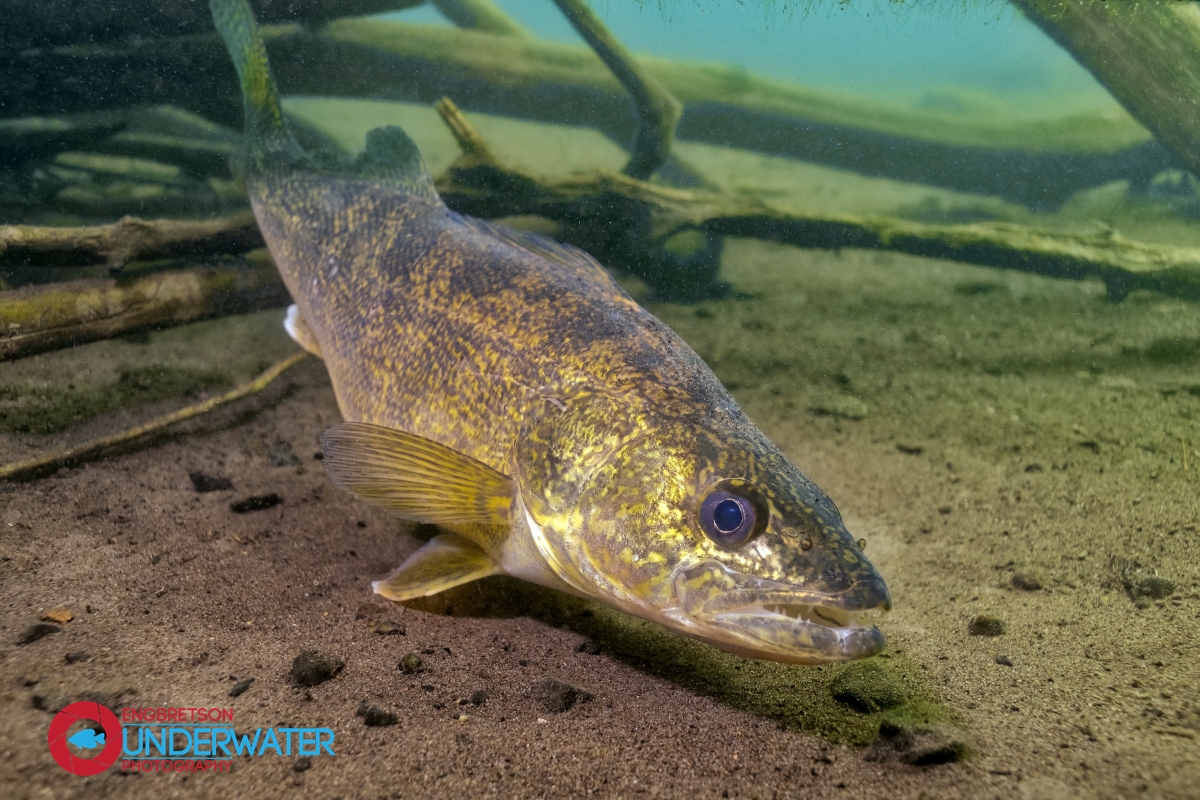
Walleye Underwater

I'm often asked what the biggest challenge is to taking underwater fish pictures.  Well, there are quite a few obstacles and many things that have to be right to be able to get a good picture.  First, the water has to be clear, which is actually a greater challenge than you might think.  Freshwater lakes are typically pretty crummy so finding lakes that have the necessary clarity is an ongoing process.  I usually won't even look at a lake if the clarity isn't at least 18 feet.  Water clarity can change from week to week and season to season too, so even though I have my favorite lakes, they’re not always clear enough to work in.  Everything starts with water clarity and if you don’t have that, nothing else matters.  It’s always a challenge to find clear water.

Once I find a clear lake, I have to find fish.  Next I have to find fish of desirable size.  This is easier said than done too.  It's always a problem especially these days when it seems like there’s fewer and fewer really nice fish available.  If I do find a lake that’s clear and it does have a few good fish, another challenge is getting close enough to photograph them.  I like to be 2 or 3 feet away.  Any further and I won’t take a picture at all.  Fish often times have a problem with a diver being that close, so it takes a lot of patience to even get close enough to think about composing a picture.  But once I have clear water, good fish, and get close enough to shoot them, I still have to make the shot.  So even if everything else is right, sometimes I blow it all on the final step because I was moving, or the composition is bad or I forgot to turn on the strobe, etc.….

A lot goes wrong.  Sometimes I feel like it’s truly a miracle to get any good pictures at all because so many things that I can’t control have to be right all at the same time.

Conditions underwater are typically very hostile to a photographer.  The lakes and rivers where I shoot can be very cold.  In rivers, currents can be strong, and visibility is always an issue.  Underwater photography is inherently tricky.  Water is 800 times thicker than air, and there's always particles floating around or algae and things like that, so you've never going to get the really "clean" look you can get shooting through air. The water is often cold, the fish can be elusive, and you've got to always be concerned about your air supply, so there's a lot to think about. The light underwater is very poor too, so often I have to carry underwater strobes to illuminate subjects in deeper water. If you can imagine taking photos on a dark, cold, foggy, windy day… that sort of comes close to the everyday conditions of the environment I work in.  Saltwater environments are infinitely easier.  The water’s 100 times clearer, there’s 100 times more light, and ocean fish are used to seeing very large things swimming around them.  In freshwater, you look like Godzilla to those poor fish.

So, yes-the challenges are many, but as I always say, "If it was easy, everyone would be doing this".