When I
encounter fish cribs in lakes where I scuba dive, I typically see one of two
opposite things: cribs holding fish, and cribs attracting no fish at all. In
years of first-hand underwater observation, I have noticed that the cribs with
fish share certain characteristics. So do the cribs devoid of fish. I’ve
concluded that there are two key aspects of cribs that succeed in drawing and
holding impressive numbers of fish. Those two critical components are design and location. Let’s look at each one separately and see why some cribs
succeed while other cribs fail.
Design:
Years ago,
fish cribs usually shared a single design. They consisted of big logs lashed
together to make a cube like a miniature log cabin without a roof. The interior
was stuffed with brush or tree branches and they were weighed down with
concrete, cinder blocks, or heavy rocks. Since these structures can be very
large, heavy, and almost impossible to move, they’re built in the wintertime in
northern states and left on the ice, where they sink into place in the spring
when the ice starts to melt. The cribs are usually square but sometimes
rectangular. They are typically four or five feet high and four to eight feet
long.
Since the
classic wooden log-cabin style is the most popular kind of fish crib, my
observations and comments focus on these specific types of cribs and in
particular on the best ways to make them as effective as possible.
By their
very nature, most fish cribs have a distinctly limited lifespan. When they’re
fresh and their interiors are tightly packed with brush and tree limbs, minnows
and juvenile fish will flock their way. The thick cover provides shelter and a
place to hide from predators. The smaller fish penetrate deep into the cribs. Panfish
will congregate outside or squeeze their way in where they can. Larger predator
fish, such as bass and northern pike, will hang around the perimeter, attracted
by the throngs of fish concentrated in this area.
The
interior material of thick brush or tree branches gives rise to a problem that
is endemic to fish cribs. The material provides dense cover that small fish
need, but over time it disintegrates, leaving only the cribs’ outside skeleton
intact. The center portion remains basically empty. Without brush and branches,
the cribs can no longer protect small fish from larger fish. And once the small
fish--a source of food--disappear, the crib also loses its appeal to the game
fish, which no longer gather around the crib to enjoy the all-you-can-eat buffet
it once was. While these cribs might occasionally still draw a few larger fish
for shade or cover, they lose their major attraction as a feeding center. Most
people don’t understand that the secret
ingredient that makes a crib design successful is not the frame or the
exoskeleton, but the thick interior brush. If that’s not a central component
from the start, or if it’s lost, cribs will stop attracting fish. The frame may
stay intact and last for decades, but the brush deteriorates much more quickly.
If there were some way to re-stock these cribs with interior brush, we could
vastly extend their viability and lifetime.
The
Vertical Dimension
Height is
infinitely more important than length. The higher the walls of the crib extend
from the bottom, the more attractive the crib will prove to fish. You want a
piece of genuine structure, not something that is just an inconspicuous
component of the floor of the lake. In fact, cribs should measure no less than
four feet high. Fish want something well above the lake floor, and they like to
choose the depth they want to hold while remaining close to the structure.
One of the
best fish cribs I’ve ever seen was created entirely by accident. It was
rectangular and four feet high, four feet wide, and 12 feet long. It was placed
on the ice in 17 feet of water. When the ice melted in the spring, the rocks
weighing it down shifted position, and the crib plunged to the bottom on its side. As a result, the crib
towered 12 feet from the bottom. Underwater it looked like a skyscraper. Fish
flocked to the crib and occupied various stories from top to bottom. A long,
dark shadow fell on one side and served as a magnet for fish. In short, the
structure turned into an amazingly effective accidental home. Another crib of
the same dimensions fell nearby as originally intended but, since it ranged
only four feet from the bottom, it attracted only a fraction of the fish the
skyscraper did.
Complexity
of Design
Since this
is not an article about building cribs, I won’t go into the blueprints on how
to construct them. The key element in one word is complexity. This refers to the guts of the crib, not the frame. The
interior brush should be packed tightly enough to block out most light. Don’t
worry about making it so dense that fish won’t be able to get inside. Pockets
will form here and there, and fish are astoundingly adept at squeezing into the
tiniest spaces. Long branches should extend from the crib on all sides and
through all the slats. If possible, include some long branches stuck into the
top of the crib to give it some extra dimension. The idea is to create as thick
and complex a jungle as possible. The final result will resemble a thick mass
of long branches extending from the dense pack inside the crib. The branches
should reach from every depth of the crib in every direction and at every
possible angle. If your finished crib looks even vaguely tidy, it needs more
work.
 |
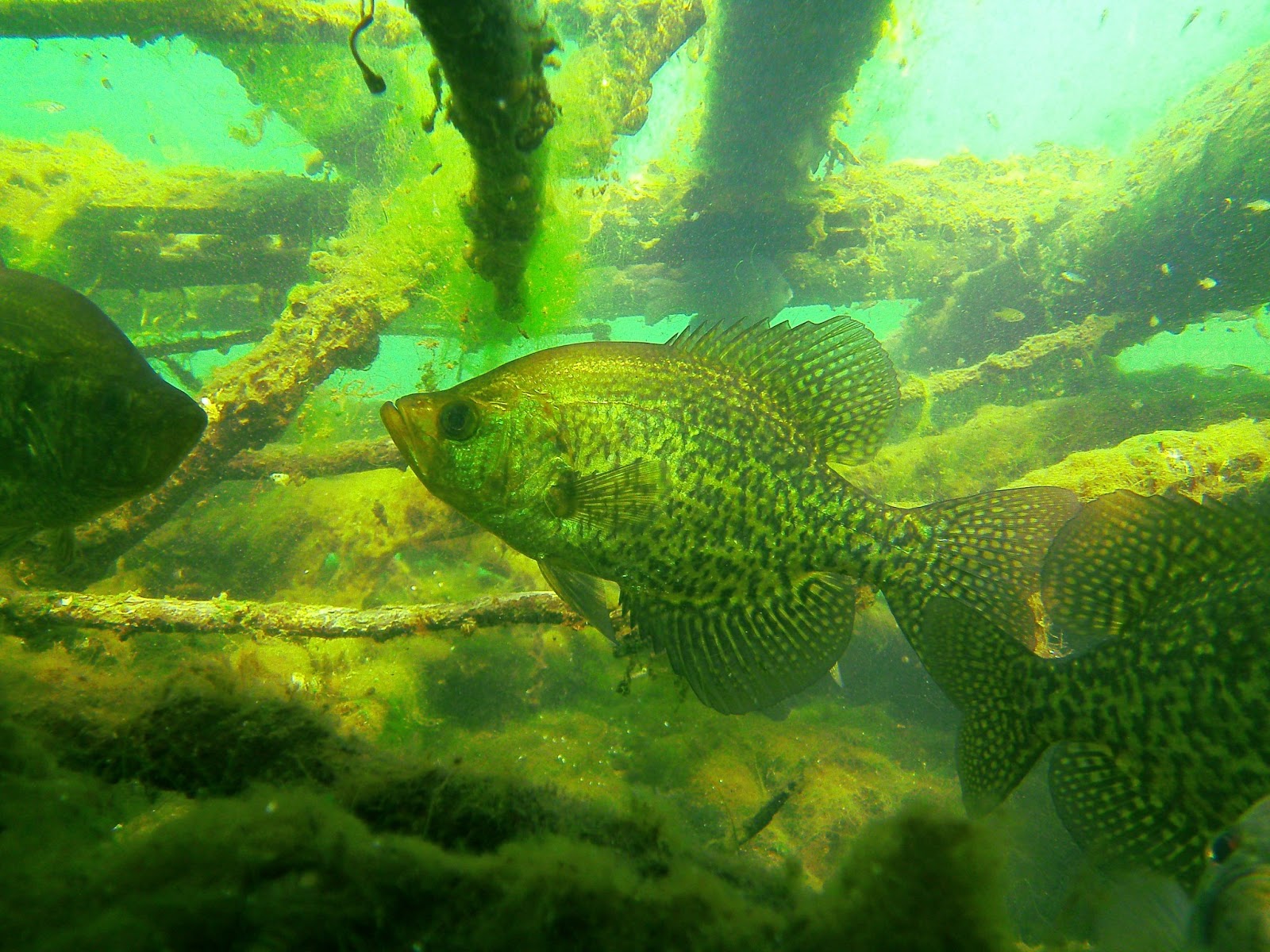
| View from Inside a Fish Crib (c)Eric Engbretson |
Designs
that Don’t Work from Day One
Cribs that
incorporate Christmas trees work adequately but for a very short time.
Christmas trees deteriorate so quickly that in just a year or two, they no
longer provide the complex cover that fish desire. In addition, fish will
ignore cribs that are too small, too short, or too simple in design.
Examples of
poor designs are cribs made of wooden pallets that rest only a couple of feet
off the bottom, or cribs with huge spaces between pallets and no interior
brush. Star-shaped cribs that resemble the obstacles used on the beaches of
Normandy in World War II may look fascinating, but they lack the complexity,
shade, and cover to attract fish well. This list is scarcely
exhaustive: There are many other design flaws in cribs that don’t attract fish.
Location:
Depth
When it
comes to location, success depends largely on depth. When cribs are placed
shallow enough to let sunlight reach them, they grow algae and other organic
material. This serves as a food source for juvenile fish and also makes the
cribs fuller and denser. When cribs are placed closer to the littoral zone,
they’re much more accessible to the newly hatched fry that will quickly
colonize them and provide the food that attracts larger fish.
When I’m
scuba diving, I see fish cribs in deep water go largely unused most of the
year. The water is colder here and may lack adequate oxygen. In general, these
cribs receive visits by fish in fall and winter. On the other hand, fish in
shallower water will use a crib virtually year-round. Some of the best fish cribs
I’ve seen were ones that weren’t properly weighted. When the ice melted, they
floated toward shore and ran aground. When allowed to remain in place, these
cribs were quickly covered by algae and were populated immediately by juvenile
fish and newly hatched fry. Despite their extremely shallow location, they
attracted game fish year after year and even served some fish as a structure
for spawning.
The
Substrate
Cribs
should always be placed on a hard bottom or substrate. If placed on a lake
bottom with 12 inches of muck, let’s say, the crib will sink into the muck and
you’ll effectively lose a foot of height. Since height is vital to fish, you
don’t want to lose it. A muck bottom also eliminates the basement floor.
The
Basement Level
Another
reason a hard bottom matters is that you want about a foot of clearance between
the lake bottom and the base of the crib. If fish can swim underneath your crib in this basement level, you’ve really got
something to brag about. Walleyes and bass, by the way, are two species
especially drawn to cribs that let them swim underneath.
Plants
If the crib
rests in shallow water where plants can grow, it’s often possible to extend the
life of the crib almost indefinitely. As multitudes of fish congregate around
the crib season after season, their feces can accelerate a lush growth of
plants. This patch of vegetation is denser than the surrounding area and
creates desirable habitat all by itself. In time, after the interior brush
decomposes, it’s possible that tall aquatic plants will replace it, a process
that prolongs the lifespan and effectiveness of the crib. If the crib sits in
water that’s too deep for plants to grow, none of this growth will take place.
Multiple
Cribs in One Location
Cribs
located close to each other always outperform single units. Fish will often
travel back and forth in a cluster of cribs. Even if they are built alike and
placed at the very same depth, they form individual identities, and multiple
cribs will be used by different species in various ways. For example, one crib
may attract many more rock bass than another that is just a few feet away and
populated mainly by sunfish. The differences in the cribs are largely
indiscernible to our eyes, but the fish notice subtle distinctions that drive
their preferences. The rule, then, is simple: Multiple cribs offer multiple
choices and greater numbers of fish.
Regulations
The
regulations on the placement of fish cribs are mandated by Natural Resources
Departments in many states and other jurisdictions. In my state, Wisconsin,
permits for fish crib construction and placement explicitly instruct builders
to place them with at least five feet of water over the top of the structure.
Since the cribs themselves are typically four or five feet high, the minimum
depth for placement is nine or ten feet. The concern here is understandable.
Cribs can create hazards for boaters, who may be unaware of their locations.
However, if I were placing cribs on my own private lake, free from regulations,
I would place them shallow enough so that only two or three feet of water
covered the top. This way, I might be
able to replenish them with new brush from time to time as the older material
disintegrated. This would greatly extend their natural lifespan.
The Future
of Artificial Fish Shelters
In recent
years, fish-crib makers have gotten very creative and used a variety of
materials. Most popular of the new wave of materials are things normally
destined for the junk pile or landfill. Today it’s not unusual to see fish
cribs made of stacked wooden pallets, plastic, or PVC. They feature clever
designs, and I’ve seen some of them underwater in lakes that I frequent. But
the truth is that they don’t seem to fare well. While they may be lighter,
easier, and cheaper to make, their main drawback is that they lack the size and
complexity to prove attractive to fish. The best ones take up the most space
and most effectively mimic trees, sunken timber, and other natural elements.
When artificial cribs made of PVC pipe first appeared, it was widely believed that they would be less effective because fish would refuse to be silhouetted against a white background. Although I also originally believed this, I've reversed my position. What we've discovered in further studying this is that color doesn't seem to be the significant factor we once thought it was. In fact, there's evidence that suggests that PVC pipe color plays no role in fish preference whatsoever. Instead, the combination of vertical height and complexity determine whether any structure, natural or artificial, will be attractive to fish.
 |
| An example of a poorly constructed fish attractant. Notice the lack of complexity and the large open spaces that provide shade, but nothing in the way of cover. @Eric Engbretson Photo |
Fish Cribs
as Fish Habitat
Let’s get
one thing straight. Fish cribs are
definitely not fish habitat. They’re artificial constructions designed to
concentrate unusually large numbers of fish in a very small area so fishermen
can catch them. Fish cribs do not normally provide the elements fish need for
spawning or nesting. At their best, fish cribs merely impersonate fish habitat.
In fact, in lakes with an abundance
of excellent fish habitat, even the best- made and best-placed cribs will go
ignored by fish in favor of superior natural structure. In sum, fish cribs work
best in lakes where there is little or no natural structure for fish to use.
Traits of
Effective Cribs
·They
reside in relatively shallow water (10 to 15 feet)
·They
receive ample sunlight and they support algae and other organic growth
·They
are in water that is shallow enough to let submergent plants grow nearby
·They
sit on a hard bottom
·They
are at least four feet high
·They
have a space at the base that lets fish swim under the crib
·They
are thickly packed in the center with various sizes of brush and branches
·They
have long and complex branches on all faces extending away from the crib
·They
have a complex design
·They
are placed together with other cribs
·They
are in lakes that contain little or no natural structure
Traits of
Ineffective Cribs
·They
sit in water that’s too deep (or too shallow if the water’s too warm for fish)
·They
sit too deep to receive ample sunlight and support organic growth
·They
are in water too deep for plants to grow nearby
·They
sit on a mucky bottom
·They
are less than four feet high
·They
have no space at the base where fish can swim under the crib
·They
contain Christmas trees or have little or no brush packed into their center
·They
have a design of limited complexity
·They
are placed alone
·They
are in lakes with abundant natural habitat and structure
Conclusion
As with any
set of guidelines and suggestions, there are always exceptions. My observations
and conclusions come from years of scuba diving in the northern lakes of the
upper Midwest. While complexity of design is universally important, in other
parts of the country, many of my suggestions on placement may ignore local
conditions and require adaptation. For example, in large southern reservoirs,
water temperatures can soar into the 80s and force fish to spawn and live in
far deeper water, where lower and more comfortable temperatures prevail. In
very clear lakes, sunlight may penetrate 30 feet or more, and plants can grow
at greater depths than in other locales. In lakes like these, specific local
conditions must be taken into account. Because of such variables, it’s
important to have a good understanding of your lake’s ecology and other
characteristics. Understanding the specific dynamics of any given lake will
help immeasurably when you decide on the best locations for a crib.




 Posts
Posts


