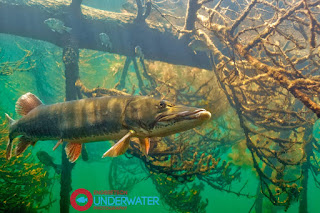
I’m very lucky that I just happen to live in an area that’s home to some of the most legendary muskie lakes in the country. Over the years, I’ve had a chance to swim in some of these famed waters and encounter muskies up close in their own environment. There’s nothing quite like seeing a large muskie underwater. They glide effortlessly through the water with the supreme confidence reserved for members at the top of their food chain. Because of this, they’re not afraid of divers and I’m able to approach them usually fairly easily. They are surely aware of all the other fish and animals that populate their world and because divers are an anomaly, they will routinely approach me with what I can only characterize as curiosity. They often make a complete circle around me as if to inspect this ‘strange creature” from every angle. They also display keen awareness. When I enter a lake, I don’t have to search for the muskies. I’ve discovered that if I’m patient, they will find me. Drawn, I’m sure by acute imperceptible sensory abilities and also probably just by the noise of my air bubbles too.
Thursday, January 27, 2022
Tuesday, December 28, 2021
What Makes A Captivating Image?
Imagine you’ve invited some friends over for dinner. You spend all afternoon preparing and cooking a well-planned meal. After your guests finish eating, they enthusiastically proclaim it be one of the best meals they’ve ever eaten. Then they ask “What kind of stove did you use?” In this context, it would be a nonsensical question that no one would ever ask. But as a photographer, I’m very frequently asked what kind of camera I use when well-meaning admirers view my underwater images.
The implication is that all the magic happens inside the
camera, and the photographer is merely the lever puller who simply manipulates
the marvelous technology that’s really responsible for creating the magical
images. To ask photographers what kind
of camera equipment they use is as meaningless as asking a chef what kind of
stove he uses. The question usually
comes from novice photographers who are looking for a shortcut to propel their
own photography to a higher level. It may seem like an innocent and not
irrelevant question, but it fails to identify the secret that’s the real
foundation of stunning images.
Thirty years ago when I first began taking underwater
pictures, I was consumed by the same quest. If I could just find a great
underwater camera, I’d be able to take pictures for National Geographic just
like the pros did. Every few years I would buy a better camera, a faster lens
or a more durable housing. While that
did make a difference in the quality of the pictures I took, something was
missing that took me years to detect. In my case, with underwater photography,
I had some of the best equipment I could afford, but what was lacking was
sufficient knowledge of my subjects.
This wasn’t something I was aware of decades ago. Instead, it
was a shortcoming that has only revealed itself in retrospect. Over time, as I
learned more about the lives of the fish I was photographing, my images of them
became more appealing and more penetrating. I began to study their behavior and
their body language and I began to notice how my own body language, movements, and
behavior affected them. In time, a kind of communication developed. I became
able to recognize subtle cues from timid fish and learned how to approach them
in non-threatening ways. I also learned how to send out my own signals which
fish could decipher that would put them at ease.
My office bookshelves that were once filled with
photography books began to be populated with books about fish and fish biology.
As I learned more and more about my subjects, not only did my appreciation and
knowledge for them grow, but my photography of them improved dramatically.
Reading about fish was invaluable, but my real education
came from the fish themselves. As I spent more and more time underwater
observing and interacting with them, they divulged more and more about
themselves. Over time and one by one, all their habits, routines, and
individualities that weren’t discussed in fish books were revealed like a
cascade of unmasked secrets. I make no apologies for anthropomorphizing fish
when I talk about their personalities. When you’ve spent as much time with them
in their underwater habitats as I have, these conclusions feel not only
justified but undeniable.
Today, when young photographers ask me what kind of camera I
use, I ignore the question entirely and instead encourage them to learn all
they can about their subjects. In all
areas of wildlife photography, if you fall in love with your subjects and let
them teach you, it will be impossible for your images to not mirror that love and
appreciation. And I think that single element, one that admittedly can’t be
quantified precisely, is what makes a captivating image.
Tuesday, November 23, 2021
2022 Underwater Fish Calendar from Engbretson Underwater Photography
Looking for a cool wall calendar for 2022? Check out the 2022 Fishing Calendar from the Koozie Group featuring 13 underwater images from the Engbretson Underwater Photography team. Bass, salmon, walleye, trout, panfish, and others are all represented in vibrant color expertly photographed underwater in their natural habitats.
Click here to order from Amazon.com Only $7.98!
Saturday, November 20, 2021
Underwater Photography of Reptiles and Amphibians
At Engbretson Underwater Photography we're best known for our exceptional underwater images of freshwater fishes of North America. But because our photographers spend so much time under the surface of lakes and rivers, they also often observe and photograph a variety of aquatic non-fish species. Over the years, we've accumulated many underwater images of turtles, snakes, and salamanders. We've added them to our online galleries because they represent a segment of the underwater ecosystem that helps make these freshwater environments both interesting and diverse.
Today we've added some new Eastern Hellbender Salamander images from our ace photographer Isaac Szabo. Because Eastern Hellbenders are largely reclusive creatures whose range is shrinking, they're not easy to locate and photograph. Isaac's done a great job of traveling to remote areas in North Carolina and other places where they can still be found in significant numbers. His hellbender images are striking.
To view all of Isaac's underwater material, see our Isaac Szabo Gallery here, or visit our gallery solely devoted to underwater images of reptiles and amphibians.
Thursday, September 30, 2021
Noted Conservation Photographer Joins Our Team
One of the best parts of operating a stock photo agency is acquiring exciting, new photographers to represent. Our newest contributor is Fernando Lessa, one of the country's most talented Salmon photographers. Fernando's amazing images of salmon, taken underwater in the iconic streams of the American Pacific Northwest and Canada are among the most stunning ever made.
Based in Vancouver, British Columbia, Lessa has both a biology degree and a master’s degree in photography and specializes in documenting the relationship between humans and mother nature. He's spent a great deal of time in the field, having worked on projects in a wide variety of areas, including the untouched Amazon Rainforest of Brazil, the unique Brazilian Savannah, and the Pacific Northwest. He's a book author, filmmaker, and superb underwater photographer.
Fernando joins Patrick Clayton, Jennifer Idol, Sean Landsman, Victor Vrbovsky, Garold Sneegas, Bryce Gibson, Todd Pearsons, Christopher Morey, Isaac Szabo, Paul Vecsei, and Roger Peterson on our "dream team" of the USA's best freshwater fish photographers. His work can be licensed for commercial and editorial purposes by contacting us here at Engbretson Underwater Photography. To view more of Fernando's work, check out our Fernando Lessa Gallery here.
Saturday, August 21, 2021
Ambassadors from an Underwater Realm
I’m often asked what my favorite fish is. That’s an impossible question because I love them all. While they’re all so wonderful in their own special ways, I do enjoy spending time with my Smallmouth Bass friends. They’re always friendly and curious and will eagerly pose for my cameras. They wait patiently while I fumble with the camera and strobe settings all while demonstrating my lack of swimming skills. To the fish, I’m a tourist visiting their world-largely ignorant and out of place despite my best efforts to fit in. Smallmouth Bass always make me feel welcome. Because they’re tirelessly cordial, friendly, and uncritical they are one of the best ambassadors of the piscine world. It’s a privilege to spend time with them and photograph them in their watery homes.