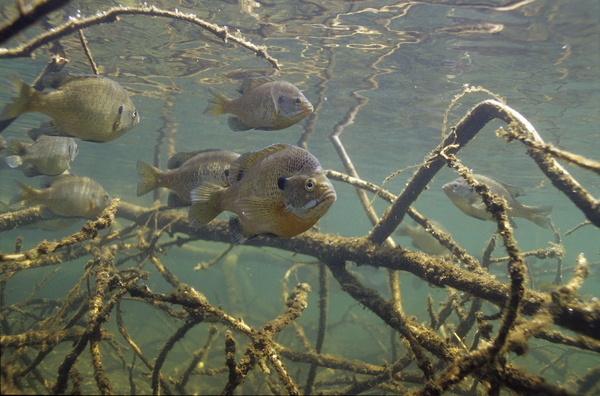
Sunday, April 6, 2014
How Important are Cameras to Underwater Photography?
People interested in underwater photography often ask me what kind of camera equipment I use.
I’ve always felt that underwater photographers put far too much
emphasis on their equipment and not enough on studying the behavior, habits and biology of their subjects. The best equipment won’t help you if you don’t know where to go, what you’re looking at or whether you’re truly seeing something rare, unusual or out of the ordinary.
How many photographers can tell the difference between a good looking clown fish and a bad looking one? If they all look the same to you, you need to study clown fish better. What I mean is this: In every species, you’ve got your pretty Scarlet Johansson types and your skanky Courtney Love types. It's easy to notice the distinction when we're looking at our own species, but not as easy when we're viewing other species, like fish for example. If you don’t recognize the differences, you’re in trouble, because the people buying your pictures often times can. And if you try to pass off a Courtney Love for a Scarlett Johansson, you’re going to be regarded as someone who doesn’t really know what you’re photographing, even if your pictures are technically perfect.
Too much emphasis is put on the equipment we use. But the "secret sauce" so to speak, is not the cameras and lenses, rather the familiarity with the subject matter. That's what makes the difference between good photos and bad ones. I’ve seen some amazing pictures taken with crappy point and shoots because the photographer understood the situation he was in and what he was shooting. So the emphasis on the equipment you use is really overrated and of little importance. Think of it this way: If your girlfriend told you she found a great dress on sale at the mall, would you ask her what kind of car she drove to get to the mall?
Wednesday, March 12, 2014
Creating Great Fish Habitat
![]() |
| A fallen pine tree creates shelter for schools of small bluegill which attract largemouth bass and other game fish. (c) Eric Engbretson |
Every time there's a storm and trees get blown down in our yards, we respond right away by picking up the brush and debris and quickly cutting up the fallen trees and branches with chainsaws to restore our yards to their pre-storm state. This is fine to do in your yard, but if you have lakefront property, it's one of the worse things you can do near the water. Trees, large and small that fall onto our beaches or into our lakes due to storms or natural decay are one of the most valuable habitat elements for fish, birds, reptiles and amphibians. We're tempted to remove the trees to return our shorelines to a state that resembles Waikiki Beach, but when we do, we're robbing the lake and it's inhabitants are critical elements that enhance fish populations.
![]() |
| Even small trees or branches in shallow water provide critical habitat elements for a wide variety of fish. (c) Eric Engbretson |
![]() |
| Trees that fall into lakes are magnets for crappie and other panfish. (c) Eric Engbretson |
So, one of the best ways to actually create terrific fish habitat in our lakes is simply not to destroy or remove the habitat that is naturally made by nature when trees are blown down in storms.
Wednesday, February 12, 2014
Lake Ellwood Update: Without Chemicals, Fish Return
![]() |
| Eurasian Watermilfoil (c)Eric Engbretson |
Last year on this blog, I wrote a piece about Lake Ellwood, the Florence County lake where reproduction by bass and bluegills had come to a halt due to lack of aquatic plants in the lake. (You can read my original posting here.) In the meantime, there's been some interesting new developments that I'd like to share with you in the following Lake Ellwood Update:
In the spring of 2013, an application from the Lake Ellwood Association to further chemically treat about three acres of Eurasian Watermilfoil was denied by the Wisconsin DNR. Instead, a 5 year whole-lake study began on the lake in the summer of 2013 headed by Dr. Greg Sass of the WDNR's Fisheries and Aquatic Sciences Research Section. The goal of the study is to better understand why a drastic change in the fish community occurred between 2002-2012 and to test for effects of chemical treatments/reduction in aquatic plants on the Lake Ellwood fishery.
In the early stages of the study, noticeable changes have already been observed. Since chemical treatments have ceased, the fish and aquatic plant community has responded. The most recent fish surveys conducted during September and October of 2013 revealed robust year classes of bluegills and largemouth bass. Native aquatic plants have also rebounded. Littoral areas that were barren just one year ago now have lush colonies of native plants. "I couldn't believe how fast the native plants returned", remarked an amazed Greg Matzke, Florence County Fisheries Biologist.
Matzke is optimistic about the five year study (which doesn't include any further chemical treatments for Eurasian Watermilfoil.) "It's my hope that after taking a very thorough look at the fish community, we can better understand what drives natural reproduction of fish in Lake Ellwood, and provide a plausible explanation of why the fish community crashed and how the fight to control Eurasian Watermilfoil has contributed to it."
Lake Ellwood still has a few acres of invasive milfoil and likely always will. What's returned are the native plants and young largemouth bass and bluegills. It's a trade off that feels like an immediate victory for fisheries managers at this point.
Tuesday, February 11, 2014
What are the Clearest Lakes in Wisconsin? 2013
I was talking to Jennifer Filbert at the Wisconsin DNR the other day. Jennifer manages the data for the state-wide citizen's lake monitoring group. They're a network of individuals, usually lake-front property owners who monitor and regularly take a variety of water samples from lakes all across Wisconsin. The data they compile helps to give us a look at how our lakes are doing. One of the many tasks lake monitors perform is to take regular sechi disc readings. This is a universal way of assessing and comparing water clarity. I was interested to know which Wisconsin inland lakes were the clearest. Jennifer sent me a spreadsheet of some really comprehensive data and I thought it would be interesting to pass this along. Here are the lakes that recorded the highest average water clarity in 2013. In short-here are Wisconsin's clearest inland lakes and their average water clarity in 2013:
1) Black Oak Lake-Vilas Co.-37 feet
2) Pine Lake-Waukesha Co.-27 feet
3) Maiden Lake-Oconto Co.-26 feet
4) Keyes Lake-Florence Co.-25 feet
5) Whitefish Lake-Douglas Co.-25 feet
6) Eagle Lake-Bayfield Co.-24 feet
7) Lake Metonga-Forest Co.-23 feet
8) Lake Lucerne-Forest Co.-23 feet
9) Stormy Lake-Vilas Co.-23 feet
10) Blue Lake-Oneida Co.-23 feet
11) Bolger Lake-Oneida Co.-23 feet
12) Lac Courte Oreilles-Sawyer Co.-22 feet
13) Lake Owen-Bayfield Co.-22 feet
14) Millicent Lake-Bayfield Co.-22 feet
15) Deer Lake-Polk Co.-22 feet
For the 2014 lake list, click here. For the 2012 list, click here.
Saturday, January 25, 2014
Subscribe to:
Posts (Atom)