Engbretson Underwater Photography

Search The Fish Photos


News From Behind the Scenes at Engbretson Underwater Photo and Stories about the Freshwater Environments We Visit.


Sunday, April 1, 2012

Creating Great Fish Habitat

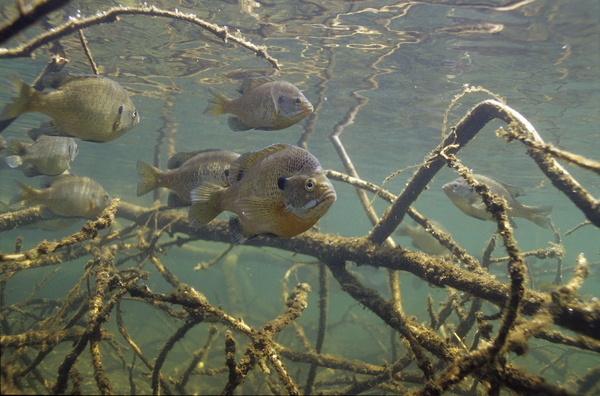
A fallen pine tree creates shelter for schools of small bluegill which attract
largemouth bass and other game fish.  (c) Eric Engbretson
When I speak to various organizations or lake associations, one of the questions most often asked is "How can we create good fish habitat?"  One way to do that is actually easier than you might imagine.  One of the best things we can do is... "nothing". 

Every time there's a storm and trees get blown down in our yards, we respond right away by picking up the brush and debris and quickly cutting up the fallen trees and branches with chainsaws to restore our yards to their pre-storm state.  This is fine to do in your yard, but if you have lakefront property, it's one of the worse things you can do near the water.  Trees, large and small that fall onto our beaches or into our lakes due to storms or natural decay are one of the most valuable habitat elements for fish, birds, reptiles and amphibians.  We're tempted to remove the trees to return our shorelines to a state that resembles Waikiki Beach, but when we do, we're robbing the lake and it's inhabitants are critical elements that enhance fish populations.    

Even small trees or branches in shallow water provide critical habitat elements
for a wide variety of fish. (c) Eric Engbretson
I visit many lakes that are ringed with homes and bordered by forest, but in a great many lakes, there’s scarcely any downed trees in the water. Since trees must go down from time to time in storms, falling into the water, I can only assume that lakefront property owners quickly remove them.  This should be avoided because wood and trees that have fallen in the water are a critical habitat element important to a variety of aquatic and terrestrial life. I strongly encourage all lakefront property owners to keep fallen trees in the lake instead of removing them. If they absolutely impede navigation, they should be moved, but not removed.

Trees that fall into lakes are magnets for crappie and
other panfish. (c) Eric Engbretson
I have thousands of underwater pictures that show what great habitat fallen trees provide and how fish utilize them.  Trees of all sizes provide important shade, cover for minnows and juvenile fish, ambush areas for game fish, and protection that's important for successful spawning.  They attract aquatic insects, crayfish and other food sources important to fish.  Studies done in northern Wisconsin show that lakes without coarse woody habitat show declines in fish growth rates and the amount of fish a lake can support. 

So, one of the best ways to actually create terrific fish habitat in our lakes is simply not to destroy or remove the habitat that is naturally made by nature when trees are blown down in storms. 


Saturday, March 3, 2012

Are The Muskies You See Really That Big?

Muskies underwater are only 3/4 of the size they appear.  (c)Eric Engbretson

One of my favorite websites for fishing information is Lake Link. The fishing reports posted on this site by the thousands of fisherman who fish the many lakes in the Midwest region can be useful, informative and entertaining. While some of the most experienced and knowledgeable fisherman post fishing reports and their observations while on the water, I am constantly amazed at one glaring mistake so many fisherman make. That error is not understanding the magnifying effects of water. Simply put-fish look bigger under water than they really are. The message boards on Lake Link are filled with hundreds of eye-witness accounts of fisherman reporting large muskies that "swam right next to the boat that were 50 inches!" Could there really be that many 50 inch muskies swimming around? The answer is a disappointing "No".  What these fisherman all fail to realize is that fish in water, viewed through air are only 3/4 of the size they appear to be. So, all those mammoth 50 inch fish are really just ordinary 37.5 inch long muskies.

Scuba divers all understand that one attribute of water is that when viewed through a prism of air, also known as a diver's mask, objects appear much larger than they really are. Underwater, a 45 inch musky will look a 60 inch whopper! Fisherman often ask me how large the fish are that I see underwater. Honestly, most fish look big underwater, and big fish look like Godzilla. In my early days of diving I was convinced that each musky I encountered was a world record.  Many scuba dives later, I've come to better understand the illusion, and realize that reports of monster muskie that "got off just as they were about to be netted" were likely ordinary sized fish.

Some may argue that the fish lined up exactly with something on the boat that's of known size and reference, but the viewer doesn't understand the illusion facing scuba divers all the time. Boats and the objects on them are poor comparison tools as they're in the atmosphere, visually accurate in size, while the musky is underwater, distorted in size. To test this concept yourself, measure your hand. Then lean over the side of a fishing boat or dock and stick it about a foot underwater. Hold the ruler above the surface while viewing your submersed hand, and measure it best you can. How'd the numbers come out? If you did this correctly, your dry hand will be roughly ¾ the underwater hand size.

While the fishing reports on websites like Lake Link can be valuable research tools, don't be fooled by eye-witness accounts of large fish that were seen underwater. They just weren't that big. 

Wednesday, February 8, 2012

3D Fish Pictures Return to Sport Shows

Award Winning 3D Picture "Exploring Smallmouth"

Our Award-winning 3D Fish Pictures return to the Midwest sport show circuit starting this weekend.  If you visit the Milwaukee Musky Expo this weekend, be sure to look for the 3D Picture Store booth.  Jay Garstecki (pictured above) will be on site and happy to show you our current line-up of amazing 3D fish prints.  The 3D effect is truly astounding.  It's "like holding an aquarium in your hands".   Prints for sale at this show include muskie, walleye, largemouth bass, smallmouth bass, and panfish in sizes small and large.  Prints can be purchased singly or beautifully matted and framed in barn wood. 

These prints won the best of show award at the 2011 ICAST in the giftware category!

Look for the 3D Picture Store and our amazing underwater fish images this weekend at the Milwaukee Musky Expo and February 24-26, 2012 at the Madison Fishing Expo.  

Thursday, January 26, 2012

Rare Lake Whitefish Underwater Images!


Engbretson Underwater Photography now represents the work of Paul Vecsei:

I'm proud to announce that Engbretson Underwater Photography is now representing selected images of photographer Paul Vecsei.  Paul's underwater images of Lake Whitefish and Cisco are without a doubt the finest images of these species ever taken in their natural habitat.  Paul has a fisheries science background which makes him uniquely able to understand the behaviors and habitat requirements of these fish and beautifully capture their magnificence in his stunning photos.  Whitefish and Cisco are two of the most difficult species of freshwater fish to photograph in their natural environment but Paul has done a masterful job.  His images of Arctic Grayling, Lake Trout, Chum Salmon, Cisco, Lake Whitefish and many others are now available for licensing at www.underwaterfishphotos.com
Welcome aboard Paul!

Friday, November 18, 2011

Lake Sturgeon Survey

David Sweet holds a Lake Sturgeon during the annual sturgeon survey conducted on Legend Lake, Menominee County, Wisconsin.

I recently spent a couple of days on Legend Lake with folks from the US Fish and Wildlife Service, and Menominee Tribal fish biologists.  They were conducting their annual survey of Lake Sturgeon.  Using gill nets, they captured many Lake Sturgeon which were subsequently measured, weighed and tagged with electronic IDs before they were released.   

Lake Sturgeon are regularly stocked in Legend Lake and data collected from recaptured and captured fish provides information on growth, movement patterns and health of the fish.  Continued success of population assessment data allows the tribe to make accurate management decisions in lake sturgeon management.  Currently, there is an abundance of Lake Sturgeon roaming the waters of the Legend Lake Chain.  For more information, contact Menominee Tribal Conservation Department fisheries biologist Don Reiter at djreiter@mitw.org

To see more pictures of this work, click here to view images in my Fisheries Management Gallery.

Sunday, October 30, 2011

Lake Michigan Salmon Getting Bigger

Chinook Salmon swimming up a Lake Michigan tributary stream during the fall spawning run.

Returning Salmon in Lake Michigan appear to be in great shape in 2011 according to the Wisconsin Department of Natural Resources.   Fisheries manager Scott Hansen reports that the Chinook return at Door County's Strawberry Creek took a very positive turn after generally declining trends in recent years of numbers and size of fish returning to the weir.  "We handled approximately 5,400 Chinooks over 6 harvest days this season. Our hatchery system collected about 2.3 million eggs for next year's Chinook stocking efforts. The improved physical condition of the fish has yet to be quantified but was quite evident while handling fish throughout the run. The average size of eggs increased considerably this year from last year, another encouraging sign. Although some increased numbers of fish stocked at Strawberry Creek the last couple years can account for some of the increase in returns, the remainder is simply a higher proportion of fish returning."

I was able to photograph many of the returning fish and the images can be viewed in my salmon gallery.