

Monday, June 16, 2025
Introducing Our Curated Collection of High-Quality, Royalty-Free Images


Sunday, March 19, 2023
Clearest Lakes in Wisconsin: The 2022 Report

One of the many tasks lake monitors perform is to take regular secchi disc readings. This is a universal way of assessing and comparing water clarity. I'm always interested in knowing which Wisconsin inland lakes are the clearest so here are Wisconsin's clearest inland lakes and their highest single-day water clarity readings taken in 2022:
1) Lake Metonga, Forest Co.42 feet
2) Sand Lake, Burnett Co. 40 feet
3) Pine Lake, Waukesha Co. 39 feet
4) Maiden Lake, Oconto Co. 37 feet
5) Lower Eau Claire Lake, Bayfield Co. 37 feet
6) Delavan Lake, Walworth Co. 34 feet
7) Thunder Lake, Marinette Co. 31 feet
8) Wazee Lake, Jackson Co. 30 feet
9) Whitefish Lake, Douglas Co. 30 feet
10) Blue Lake, Oneida Co. 30 feet
11) Black Oak Lake, Vilas Co. 29 feet
12) White Lake, Marquette Co. 29 feet
13) Archibald Lake, Oconto Co. 28 feet
14) Crystal Lake, Marquette Co. 28 feet
15) Stone Lake, Washburn Co. 26 feet
To see the list from 2021, click here
Friday, September 30, 2022
How Do Gamefish React to Fishing Lures
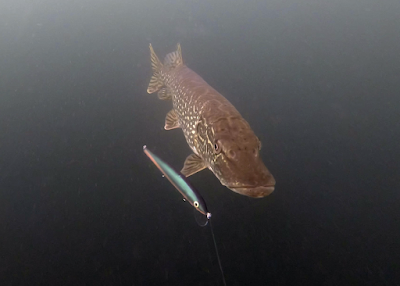
His website, The Fish Watcher, is a collection of fascinating underwater videos showing how fish relate to a variety of presentations. Peter's website also includes his own one-of-a-kind research findings in which he tries to quantify which species are the most curious, which ones eagerly follow and strike lures, and what depths and angles seem to be the most productive.
I found his research and videos to be fascinating because they give us a glimpse into the underwater world of fishes and keenly identify many interesting observations. I'd also add that his work demonstrates how little we really understand about what motivates fish. After watching the videos, you'll undoubtedly find you have many questions about how to catch fish that you've never thought of.
Peter's continued research into this area will only become clearer as he collects more data. There's so much we're still learning about the behavior of our native freshwater fish, but Peter's investigation into how fish relate to lures is both interesting and informative.
Tuesday, August 2, 2022
Michigan's Underwater Paradise
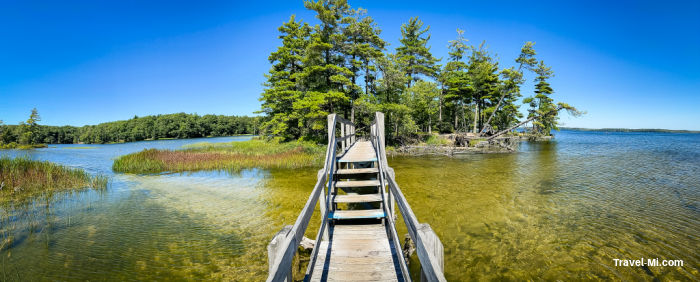
The following article appeared in the Ludington Daily News on 7/19/2022.
Ludington a snorkeling hotspot? Someday, group hopes
• By JUSTIN COOPER Daily News Staff Writer
Could these waters one day be dotted with snorkelers? A small but international group aims to bring freshwater snorkeling into the mainstream, with a particular focus on the Ludington area. One member, Martin Ruiz, described snorkeling the Big Sable River, as "the most wonderful experience that you can have."
The Ludington area has no shortage of outdoor activities to engage in. But someday, snorkeling could make its way onto that list.
A small but global group is imagining the city as an international destination for freshwater snorkeling, which they see as an untapped opportunity in outdoor recreation.
It’s all in the very early stages, and some of those involved aren’t even sure if it will involve a formal organization, a physical location or simply a website.
But at the heart of it is a belief that peeking under the fresh waters of the world is an overlooked but rich way of connecting with nature.
“Anyone who’s ever been on vacation to Florida or Hawaii … they all (snorkel) on vacation, and they all have a good time,” said freshwater photographer Eric Engbretson.
“I think people just don’t realize that we have these opportunities right here in our local lakes. … We’d just like to see it become more mainstream.”
Engbretson is part of the snorkeling enthusiast group trying to push its hobby — and Ludington’s opportunities for it — into the public eye.
Their plan could tack one more outdoor sport to the long list of them the Ludington area is known for.
But for them, it’s also a way of honoring a fellow freshwater explorer, whose favorite spot was right here in Ludington State Park.
‘The best place in the entire world’
The glue binding the group together is their admiration for Nancy Washburne, a Michigan woman whose underwater films attracted an online community of like-minded snorkelers before her death in January this year.
“She was so involved” in showing people “the incredible treasure that they have just below the surface of all these lakes and rivers all over the world,” said her husband, Martin Ruiz.
In her 60s, Washburne spent three years snorkeling nearly 500 of Michigan’s inland lakes, traveling solo in what Ruiz called “a clunker.”
Along the way, the former travel agent discovered Ludington was “the No. 1 location for snorkeling in Michigan, without any doubts — and No. 1 by far,” according to Ruiz.
“When she found the (Big) Sable River for the first time … she called me that night, and she said, you are not going to believe this. I just found the best place in the entire world,” Ruiz said.
He said the two of them returned to snorkel the river, which drains Hamlin Lake into Lake Michigan, for 15 consecutive summers.
With shallow water, no boat traffic and “hundreds” of colorful fish schooling by the riverbanks, he said it’s “the most wonderful experience that you can have.”
“It is nature at its best, and it’s always full of surprises,” he said, adding that “it’s very easy” and “free, basically.”
It’s in honor of Washburne and her favorite snorkeling spot that her husband and followers have zeroed in on Ludington as the focal point of their efforts to promote the sport.
Once the group has its ideas firmed up, Ruiz hopes to get state agencies involved in advancing Michigan, and Ludington in particular, as the “headquarters for the global alliance of freshwater discovery.”
The whole point is “to create an ecotourism industry,” he said, adding that just as Michigan draws snowmobilers in the wintertime, the Great Lakes could be a regional magnet for summertime snorkeling.
“That represents millions of dollars when you start getting this at the level it should be,” he said.
‘Oh, it’s so cool’
Mary Larson, a “big” Washburne fan from Indiana, said she started out as a hiker who “didn’t even think to look underwater.”
But she found inspiration in Washburne’s videos, and today, she is driven into freshwater by “a curiousness. I want to see what I can find, and once you actually do see the fish — oh, it’s so cool.”
For her, snorkeling has “taken over” hiking, and she regularly shares on Facebook what she sees under the waves.
She thinks it could do the same for anyone who “has that love for nature.”
“If you love hiking and seeing what kind of birds you can see — what kind of deer, animals, turkeys, bugs — if you like that, then you’re probably going to love the fish, too,” Larson said.
As for why freshwater snorkeling isn’t already big, “people don’t really understand what freshwater is all about,” said Mark Barrow, a Washburne fan in the United Kingdom who has been filming underwater for more than 30 years.
“They’re unsure of the species that live in (freshwater), and they tend to look at it as unimportant, even though they do rely on it,” he said.
It’s also partially because “the oceans always had Jacques Cousteau as an ambassador, and freshwater just doesn’t seem to have anyone,” he said — except, for some, Washburne.
Engbretson, who lives in Wisconsin, said freshwater bodies might fly under the radar because they’re “so close, and we drive by them everyday, (so) we just don’t think of them as being a destination” for snorkeling.
“And, to be fair, a lot of them are Coca Cola-colored, or chocolate milk,” he said.
But he noted Michigan is “a special place for clear lakes." And those who look into their depths may find more than just fish and seaweed.
In her “Snorkeling Guide to Michigan Inland Lakes,” Washburne described snorkeling as “a great spiritual experience.”
“Within seconds of parking the car and entering the lake, I can literally feel the tension oozing out through my fingertips,” she wrote.
“One can come out of the water in a state of spiritual and mental healing.”
Monday, June 27, 2022
Overcoming Obstacles: Why Photographing Fish in Their Natural Habitat Isn't as Easy as it Looks
 |
| Largemouth Bass (c)Engbretson Underwater Photography |
I'm often asked what
the biggest challenge is in taking underwater fish
pictures. There are quite a few obstacles and many things
that have to be right to be able to get a good picture.
First, the water has to be clear, which is actually a
greater challenge than you might think. Freshwater lakes
are typically pretty crummy so finding lakes that have the
necessary clarity is an ongoing process. I usually won't
even look at a lake if the clarity isn't at least 18
feet. Water clarity can change from week to week and
season to season too, so even though I have my favorite
lakes, they’re not always clear enough to work in.
Everything starts with water clarity and if you don’t have
that, nothing else matters. It’s always a challenge to
find clear water.
Once I find a clear lake, I have to find fish. Next, I
have to find fish of desirable size. This is easier said
than done too. It's always a problem especially these
days when it seems like there’s fewer and fewer really
nice fish available. If I do find a lake that’s clear and
it does have a few good fish, another challenge is getting
close enough to photograph them. I like to be 2 or 3 feet
away. Any further and I won’t take a picture at all.
Fish often times have a problem with a diver being that
close, so it requires patience to even get close enough to
think about composing a picture. But once I have clear
water, good fish, and get close enough to photograph them,
I still have to make the shot. So even if everything else
is right, sometimes I blow it all on the final step
because I was moving, or the composition is bad or I
forgot to turn on the strobe, etc.….
A lot goes wrong. Sometimes I feel like it’s truly a miracle to get any good pictures at all because so many things that I can’t control have to be right all at the same time. But as I always say, "If it were easy, everyone would be doing this".
Saturday, April 30, 2022
Photographing Walleyes in Their Natural Habitat

It's been my experience that photographing walleyes underwater in their natural habitat can be either ridiculously easy or extremely difficult. I'm convinced that there's a lot of luck involved. As most fishermen can attest to, even finding walleyes in a lake can be a tough assignment. Some fish are especially sensitive to air bubbles from divers, and walleyes are one of these species that seem troubled by the unusual sound. They will usually move away quickly when they hear the sounds of a diver's air bubbles streaming to the surface. Other times, I've found walleye to be completely at ease with my approach, my bubbles, and my general presence. At these times I'm able to easily take close-up pictures with my cameras just inches from the fish. I've spent a great deal of time analyzing the various factors and conditions that sometimes make photographing walleye easy and sometimes make it impossible.
After 27 years of encountering walleye underwater, I still don't have a definitive answer. One theory I have is that if the fish feels secure, a close approach is possible. If there are predators nearby, a lot of recreational watercraft traffic, or any other kind of perceived threat or disturbance, they will be anxious, nervous, and "edgy". When the lake is quiet and they feel secure near a piece of cover, they seem to be more relaxed and at ease. I think it all has to do with a sense of safety. Fishermen believe walleyes always prefer deep water and avoid light because of their sensitive eyes. I don't think that's necessarily true, or the real reason why walleye seem to seek out deeper, darker water. On some of the quieter lakes I visit, they can be found in very shallow, brightly sunlit water close to shore. On busier lakes, they almost always seem to be in the deeper stretches. It could be that the perceived threat to their safety has more to do with locations walleyes are found than depth or brightness of the sun.
I work with many fishing magazines and exceptional walleye images are seemingly always in demand. Consequently, I've spent a great deal of time learning about walleyes and their behavior to gain a better understanding of how to best find and approach them to take their pictures. Certainly, being in the water with the fish gives you a glimpse of their "real" behavior-a snapshot few people ever see. Correctly interpreting what you observe is another matter and is the beginning of understanding and wisdom.
Like all animals, walleyes have many secrets and as we begin to learn more about their endlessly fascinating lives, we'll be able to appreciate them more and more for their inherent beauty and magnificence. I know I do.
Subscribe to:
Posts (Atom)

 Posts
Posts


